14 Aug 2025 - {{hitsCtrl.values.hits}}
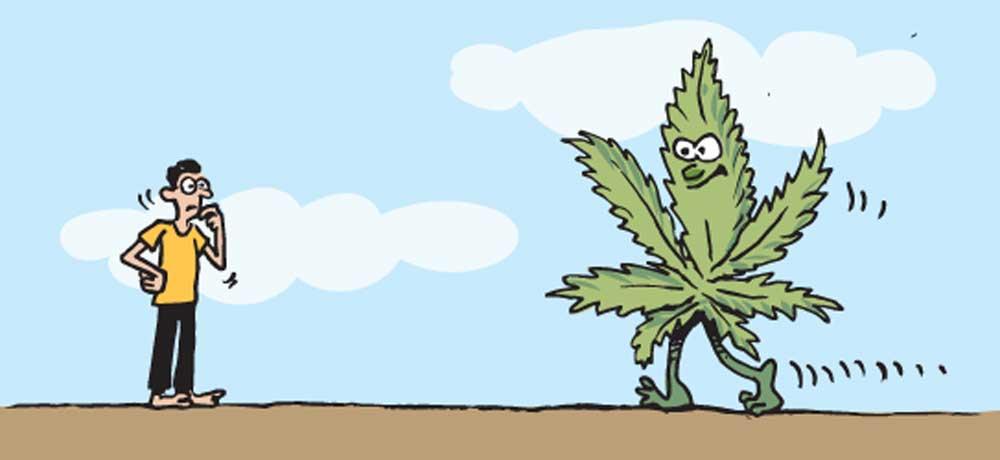
In 1935 under the Poisons, Opium and Dangerous Drugs Ordinance, the cultivation and use of cannabis was criminalised by the British, the colonial rulers of our country. However, cannabis has been used in Sri Lanka for traditional medicine and culinary purposes long before the British invaders entered our shores. There are no known specific or documented historical records of widespread cannabis addiction in ancient Sri Lanka.
Even today, particular groups continue to use the substance for culinary purposes. Ayurveda physicians use it for medicinal purposes and farmers often use it as a relaxant after a hard day’s work in the field. However, the use of cannabis remains a criminal offence in our law books even today.
Three days ago, media reported that the government has given the approval to seven foreign investors to cultivate cannabis in Lanka, with an addendum -- cultivation was for export purposes only.
A number of questions arise. Does our government recognise cannabis as a dangerous drug posing a danger to human life? If this is true, how come it decides it is OK for foreign companies to cultivate the weed in our country and export it to other lands? Don’t the lives of people in other lands too matter? Are they lesser beings?
Isn’t this somewhat similar to how the Europeans and Americans look on non white-skinned people? The slave trade boomed in colonial times under these racist beliefs. Israel continues its genocidal policies in Palestine based on a belief the Jewish race is superior to other ethnicities, creeds and religions.
Does our government really believe that using cannabis is such a dangerous drug? Or is it the social pressures from men of the cloth, and a plethora of Non-Government Organisations (NGOs) which are instrumental to keeping these old colonial laws in our law books?
Let’s face it -- the British banned the cultivation and use of cannabis in then Ceylon NOT to protect Lanka’s population from any ill-effects of the herb. The British were here to extract the wealth of the lands they had colonised.
In fact Britain went to war with China in the mid-19th century (1839-1842 and 1856-1860), over China’s attempts to suppress the opium trade.
In those days, the British had no scientific knowledge as to whether cannabis had dangerous side effects or not. They simply viewed cannabis as a competitor to tobacco --a product Britain was keen to export to its colonies -- which brought them large profits. For this reason, they demonised cannabis and banned its use.
Both cannabis and tobacco have harmful effects. But cannabis when smoked does not result in cancer according to the ‘Harm Reduction Journal’ -Cannabis and Tobacco smoke are not equally carcinogenic. The truth is, Britain was promoting the use of tobacco (cigarettes) in its colonies including then Ceylon. Tobacco was a huge industry in Britain and its sales worldwide brought huge profits. Cannabis on the other hand was a common local weed which brought no income to the colonial power.British American Tobacco (BAT) set up its local subsidiary the Ceylon Tobacco Company (CTC) in 1932. Three years later the cultivation and use of cannabis was criminalised in then Ceylon.
Figures show that in Sri Lanka today, there are an estimated 1.4 million adult daily tobacco smokers in the country (according to the ‘Tobacco Atlas’). It translates to 20.50% of the population and includes young people as well. Additionally, smoking causes cancer, heart disease, stroke, lung diseases, diabetes, and chronic obstructive pulmonary disease.
Again, the cultivation of tobacco needs specific weedicides and fertilizer, all imported products each costing foreign exchange. It’s estimated that the economic cost of smoking in the country is Rs. 90,474,350,714 /-.There is a belief that cannabis/marijuana is as safe as alcohol and cigarettes –or even safer– and that it should be legal for use in a similar manner to those substances. Cannabis is also considered to be useful medicinally for pain relief, as well as for the treatment of illnesses.
This column does not, however, promote the use of cannabis –- it merely focuses attention on why the British banned the use of cannabis. It questions whether it is ethically correct to export the product to third countries while it remains a banned product in our own land for reasons of safeguarding the local population.
‘Your Thought’ is a space, a right of the readers to support or contradict and discuss the issues highlighted in the editorial and other articles in the editorial and op-ed pages. Designed as the reader’s editorial; our readers can send in their writings, with a word count not exceeding 200, to ‘Your Thought’, Daily Mirror Political Features Desk, No 8, Hunupitiya Cross Road, Colombo 2 or email to [email protected]
10 Jun 2026 2 hours ago
10 Jun 2026 2 hours ago
10 Jun 2026 3 hours ago
10 Jun 2026 4 hours ago
10 Jun 2026 5 hours ago