20 Jul 2026 - {{hitsCtrl.values.hits}}
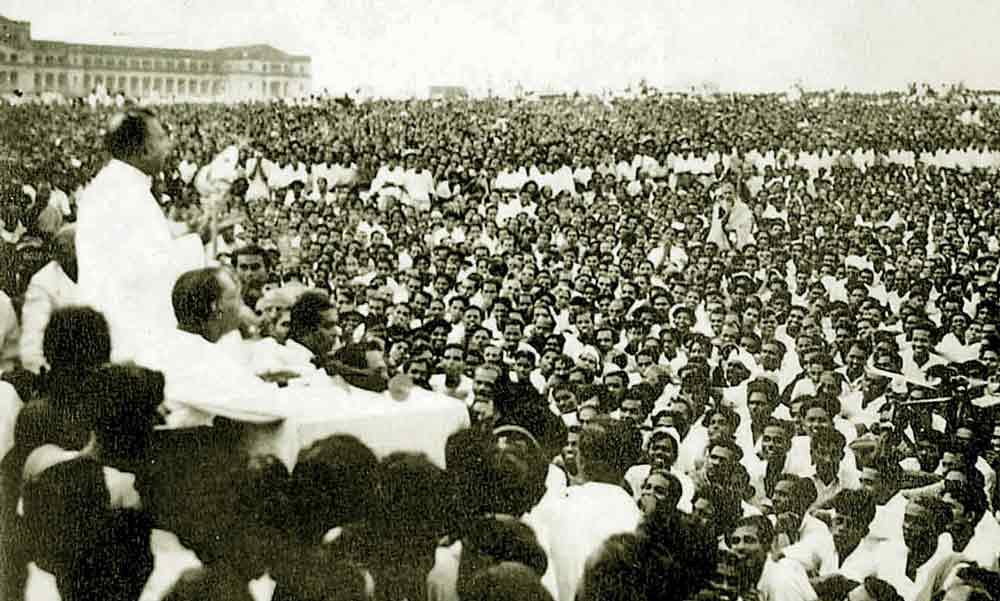
At a time when the impact of left wing parties was strong, politicians like Merill Fernando of Moratuwa and Henry Peiris of Panadura stood out for their integrity
 George Orwell once wrote that in our age, there is no such thing as keeping out of politics, that politics itself is “a mass of lies, evasions, folly, hatred and schizophrenia.”
Looking at Sri Lanka’s present crop of leaders, it is hard to argue with him. None of today’s politicians comes close to the stature of a Senanayake, a Bandaranaike, or an N.M. Perera, a Kadirgamar or a T.B. Jayah. That such quality should have all but vanished from our political top tier seems almost to defy natural law.
It is against this backdrop that I find myself looking back at three Rathu Sahodarayas I knew between the late 1940s and early 1970s. All three came from modest, middle-class or lower-middle-class backgrounds. All three were men of principle who never once betrayed the people who trusted them. In defiance of Orwell, they practised a politics free of lies, evasions, folly, hatred and schizophrenia. They won their seats without spending a single rupee, built no personal wealth in office, and went home in the end with empty pockets and no pensions.
Merrill Fernando of Moratuwa
In the early 1960s, travelling by CTB double-decker bus from Panadura to an A-Level class in Dehiwala, I watched a lean, fair-skinned gentleman, neatly dressed in a white shirt, red tie, and a white drill coat draped over one arm boarding the bus. A fellow passenger recognised him at once and offered his seat: “Wadivenna, Merrile Sahodaraya, ada parlimenthu wageyi.”
Merrill Fernando, from the fishing village of Koralawella, had been among the leading agitators of the 1953 Hartal, the general strike that shook the government of the day. Contesting under the LSSP banner, he defeated the Moratuwa business magnate Ruskin Fernando of Velona fame in both the March and July elections of 1960. Years later, in 1967, I met him again by chance on a homeward train, though I failed to place him until he stepped off at Koralawella Station to be greeted by two fisherwomen chanting, “Merrill apita, api Merrilta” ,[we are for Merrill, and Merrill is for us]. Slogans were never in short supply for him, and nor, it seemed, was the affection of the people who called him comrade.
An ideologue to the end, Fernando broke away with fellow revolutionaries when the LSSP leadership entered into coalition with “capitalist” Sirimavo Bandaranaike in 1964, and duly lost the Moratuwa seat to his former party colleague Wimalasiri de Mel in 1965.
Henry Peiris of Panadura
Henry Peiris, MP for Panadura from 1947 to 1952, campaigned across his electorate on the only vehicle he owned, a push bicycle. As a sitting MP, he travelled to Parliament by public bus, since the CTB did not yet exist. He was the father of the veteran journalist, the late Janadasa Peiris, and in the 1947 election he defeated the Deputy Speaker of the State Council, Sir Susantha de Fonseka, who stood for the UNP and came from one of Panadura’s wealthiest landowning families.
Sir Susantha toured his constituency, then stretching into what is now Bandaragama and Kesbewa, on horseback, his chauffeur-driven limousine trailing empty behind him. The clatter of hooves on the road would wake the neighbourhood children, myself among them, then just four years old, and we would run to the garden to watch him pass.
There were no party symbols in those days, and no laws against flags or posters. “Henry Sahodaraya,” as he was known, would often stop with a few supporters to talk strategy. He parked his “limousine”, a Humber bicycle, in the shade, drew pamphlets from its cane basket, and spent half an hour discussing ideology and politics with whoever gathered. He would leave with the old party farewell, since fallen out of use: “Nirdhana pantiyata jayaweva, dhanapathi bhangaweva” , ‘victory to the proletariat, down with the capitalists’ (a slogan whose English-educated Marxist authors mistranslated “capitalists” as dhanapathi, distancing businessmen further than the intended dhanawaadin ever would have).
Lesley Goonewardene, son of a prominent Panadura physician and himself a wealthy LSSP leader, had lost the seat to Susantha de Fonseka in 1936 and moved on to contest Colombo North instead. That left the Panadura LSSP with only one candidate willing to take on the de Fonseka name: Henry Peiris, the party’s bicycle-riding bulletin editor, standing under Dr. Colvin R. de Silva’s breakaway Bolshevik-Leninist Party. Against all the weight of Panadura’s landed gentry, he won.
D.S. Mallawaarachchi, “Mal Sahodaraya” of Kollupitiya
I came to know the third of these men in the early 1970s. He lived down shanty infested Muhandiram Lane in Kollupitiya, among the labouring families of the wattas, in one of Colombo’s poorer settlements. He had once served as City Father for the Kollupitiya ward, a ward that, oddly, also took in the affluent Cinnamon Gardens. D.S. Mallawaarachchi, known to the poor as “Mal Sahodaraya,” ran a small union office for private-sector minor employees affiliated with the LSSP. I encountered his work directly while employed at Shaw Wallace & Hedges, the European-managed firm whose labourers largely belonged to his union.
One day, a storeroom labourer named Bandaiya, distrustful of his own union, sought Mallawaarachchi’s help in drafting a letter about a workplace dispute. Mallawaarachchi typed the letter twice and spent nearly two hours ensuring it was properly prepared. When Bandaiya tried to press a five-rupee note—the equivalent of a full day’s wage—into his hand, Mallawaarachchi flung it away and snapped, “Give me the letter. If you have money, go and hire a lawyer.”
Workers later told me that whenever Mallawaarachchi appeared before the Labour Tribunal and they invited him to share their lunch, his usual response was, “No, if you like, buy me a toffee.” Then, adjusting his worn rubber slippers, the exhausted CMC member from Kollupitiya, clad in his faded red shirt, would walk towards the bus stop.
Remembering these three men still brings a smile to my lips and an ache to my chest. They belonged to no dynasty, drew no fortune from public life, and asked for nothing beyond the trust of the people they served. There was no theatre in what they did, no calculation behind the courtesies they showed even to the poorest of their constituents, only a conviction, worn as plainly as Henry Peiris’s bicycle or Mallawaarachchi’s rubber slippers, that public life was meant to serve rather than enrich. Whatever verdict history may render on the LSSP’s politics, it cannot deny the simple integrity of the men who carried its banner through Panadura, Moratuwa and Kollupitiya. They never deceived their supporters with tales of hardship or pretended to have holes in their banyans to win sympathy. The fact that such figures once walked among us—and that we now struggle to name their equals -- reveals something neither flattering nor easily explained about the politics we have accepted since.
20 Jul 2026 8 hours ago
20 Jul 2026 8 hours ago
20 Jul 2026 8 hours ago
20 Jul 2026 9 hours ago
20 Jul 2026 9 hours ago