08 Nov 2025 - {{hitsCtrl.values.hits}}
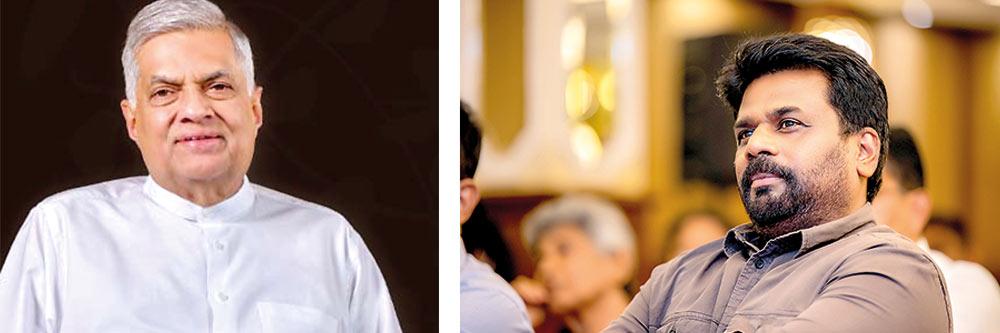
That President Dissanayake is continuing Ranil Wickremesinghe’s policy is a misconception; rather, it’s the IMF dictate.
The group of Opposition political parties which call themselves Joint Opposition seems to have changed the theme of their rally that is scheduled to be held on November 21 at Nugegoda.
Earlier they announced that the rally would be held to protest against the National People’s Power (NPP) government’s suppressive moves against dissenting groups including the Opposition parties. They called some of the government’s actions “Constitutional dictatorship” accusing that the NPP was up to establish a one-party rule in the country.
The allegation of dictatorship came following the arrest of former President Ranil Wickremesinghe in August for allegedly spending public funds for one of his private visits to the UK and the government depriving the former presidents and their widows of their perks and privileges through the Presidents’ Entitlements (repeal) Bill on September 10.
The former Presidents were to collectively take legal action against the government’s move according to the media. Former President Ranil Wickremesinghe was on record as stating that the Opposition would hold 1000 rallies, sathyagrahas and protests across the country against what was called the government’s oppressive measures.
It is not clear if Mr. Wickremesinghe at least remembers his statement now. The Nugegoda rally scheduled to be held this month does not seem to be one of those 1000 rallies; rather, it appears to be aimed at boosting the image of Namal Rajapaksa, the National Organiser of the Sri Lanka Podujana Peramuna (SLPP).
However, now they have softened their stance. Samagi Jana Balawegaya (SJB) parliamentarian Dayasiri Jayasekara and Leader of the Pivithuru Hela Urumaya (PHU) Udaya Gammanpila told the media days ago that the purpose of the meeting was to remind government leaders of their promises which they had given to the people during the last Presidential and Parliamentary elections.
The NPP captured the full capacity of power with their victory in the Parliamentary election held in November last year, about two months after their Presidential election victory. Thus, it is pertinent that the Opposition parties remind the ruling party of promises which have not been fulfilled yet, at a time when they are completing one year in power.
However, it would not be prudent to expect an objective evaluation of the NPP government’s performance from the Opposition as it runs counter to Sri Lanka’s current political culture. On the other hand, an ordinary person would be puzzled to make an assessment on the government’s first year performance, as he has neither benefitted from it in the way promised by the ruling party prior to the elections; nor has he experienced the worst, as prophesied by the Opposition parties a year ago.
In fact, the government’s performance,in the eyes of the ordinary people, has been just to prevent the economy from drifting back to the dark days of the crisis that haunted them three years ago. The cost of living is stagnant throughout the past year with prices of some commodities like rice and coconut having shot up, while the cost of some other such as sugar and flour has drastically plummeted.
Reality in governance
However, the NPP has realised upon coming to power that reality in governance is something far from what is cried from the Opposition benches. Just a week after Anura Kumara Dissanayake was voted into power, the country faced a severe shortage and price hike of rice, prompting the Opposition parties to blame the new president for not finding an immediate solution. When the government chose to import rice to off set the shortage, they criticised the move reminding the leaders of the government their own rhetoric that rice would not be imported under a NPP government.
The government reduced the electricity tariff by 20 percent in January this year, despite its commitment to the International Monetary Fund to implement a cost-reflective pricing mechanism. However, it was compelled to increase the tariff by 15 percent again in June. The Public Utilities Commission of Sri Lanka (PUCSL) declined a proposal by the Ceylon Electricity Board (CEB) to increase the tariff by another 6 percent last month, sandwiching the government between the IMF and the PUCSL.
Although the recent economic crisis was basically the upshot of the mismanagement by successive governments, the immediate trigger of it was the draining of the foreign reserves due to the shortsighted measures by the Gotabaya Rajapaksa government. The current government manages to run the economy just by preventing the reserves from drastically plummeting, amidst reports of inadequate accumulation of foreign exchange.
International financial institutions like the IMF and World Bank have recently commended the government’s economic reforms while warning about the pitfalls lurking ahead. Volumes of foreign exchange from export, tourism, and remittances by migrant workers have continued to increase while state revenue from the Inland Revenue Department, Sri Lanka Customs and the Excise Department is also indicating an upward trend, thanks mainly to the strict reform programme stipulated by the IMF.
The IMF programme was initiated on the request by President Gotabaya Rakapaksa in 2022 and the country saw its implementation in 2023 during the Ranil Wickremesinghe administration with foreign exchange flow also recommencing. This resulted in the considerable easing of hardships suffered thus far by the people, giving the total credit to Wickremesinghe.
Implementing IMF recommendations
In fact, all what Wickremesinghe implemented -- strengthening VAT and income taxes, through rate increases, base broadening measures and cost-reflective energy pricing reforms -- were recommendations of the IMF. They had been included in its 2021 country report published in March 2022, even before Gotabaya Rajapaksa approached the global lender. It is only those measures that would have to be implemented even if Gotabaya Rajapaksa had continued in office. Now, President Dissanayake continues those reforms.
Hence, the notion that Dissanayake continues Wickremesinghe’s policy is inaccurate as there was no Wickremesinghe policy as such to be involved in this process. Rather, it is the IMF programme that both Wickremesinghe and Dissanayake have been continuing.
Although the IMF has guided the country towards macroeconomic stability, people do not feel it, as nothing has changed in their lives, though it has not deteriorated. However, they see the progress or at least a genuine political will in the government’s fight against corruption, drugs and crimes. Eradicating corruption was one of their foremost demands during the Aragalaya in 2022. However, now that their hardships have significantly eased, it is not clear if they are still eager to see a corruption-free country. Their mind could only be read at the provincial council election which the government has pledged to hold early next year.
20 Jun 2026 2 hours ago
19 Jun 2026 6 hours ago
19 Jun 2026 7 hours ago
19 Jun 2026 8 hours ago
19 Jun 2026 19 Jun 2026