25 Apr 2026 - {{hitsCtrl.values.hits}}
 Few agricultural products in the world carry the prestige and recognition of Ceylon Tea. For more than a century, the emerald hills of Sri Lanka have produced a beverage that has travelled from misty plantations to the tables of millions across the globe. Tea has shaped the country’s landscapes, built communities, and created livelihoods for generations. It became not merely a crop, but a national identity.
Yet today Sri Lanka’s tea industry stands at a defining moment in its history. Beneath the global admiration for ‘Ceylon Tea’ lies a quiet, but serious concern; productivity growth has slowed while global competition has intensified. The industry that once powered the nation’s rural economy now faces the challenge of rediscovering its economic strength.
Strong commercial discipline
The roots of this challenge stretch back several decades. Following the restructuring of the plantation sector in the early 1970s, the management model that had once driven productivity gradually weakened. Prior to that period, plantations operated with strong commercial discipline. Replanting cycles were carefully managed, field productivity was monitored closely, and continuous reinvestment ensured that estates remained efficient
economic assets.
Over time, however, the focus of the industry shifted from productivity growth to survival within an increasingly costly operating environment. Labour costs rose, input prices increased, and many plantations struggled to maintain the same levels of reinvestment that had once sustained high yields.
Meanwhile, other tea-producing nations were moving forward with determination.
India recognised early that competitiveness in global tea markets could only be maintained through constant productivity improvements. Through research-led innovations, systematic replanting programmes, mechanisation, and strong institutional support, India steadily improved national yields. Kenya followed a similarly strategic path, building one of the most efficient smallholder-based tea economies in the world through strong cooperative systems and
extension services.
Sri Lanka, despite producing some of the world’s finest teas, saw only gradual improvements in productivity. At present the country produces roughly 280–300 million kilograms of tea annually across about 200,000 hectares, supporting more than one million livelihoods and contributing significantly to export earnings.
Yet production growth has remained largely stagnant over the past two decades.
Even more troubling is the structure of the global tea value chain itself. A substantial portion of Sri Lankan tea continues to be exported as bulk commodity tea. Producers may receive between USD 4-6 per kilogram, but the same tea can eventually reach retail shelves abroad at several times that value once it is blended, packaged, branded, and marketed overseas.
Industry analysts estimate that the tea sector requires a realisation of around USD 15 per kilogram merely to sustain labour, inputs, plantation maintenance, and reinvestment in the land.
This imbalance has constrained investment across the sector and weakened the long-term economic vitality of many plantations.
500 tea cluster villages
It is within this challenging context that Samantha Vidyarathne, Member of Parliament and Minister of Plantations and Community Infrastructure, has introduced a bold and forward-looking national vision for the industry.
The Minister’s goal is clear: increase Sri Lanka’s tea production from approximately 300 million kilograms to 400 million kilograms by the year 2035, while simultaneously transforming the industry into a modern, value-driven agro-industrial sector capable of commanding greater value in global markets.
What makes this vision particularly compelling is that it doesn’t focus solely on increasing production. Instead, it recognises that the future of Ceylon Tea lies in strengthening the entire value chain from the soil where tea is planted to the global markets where it is consumed.
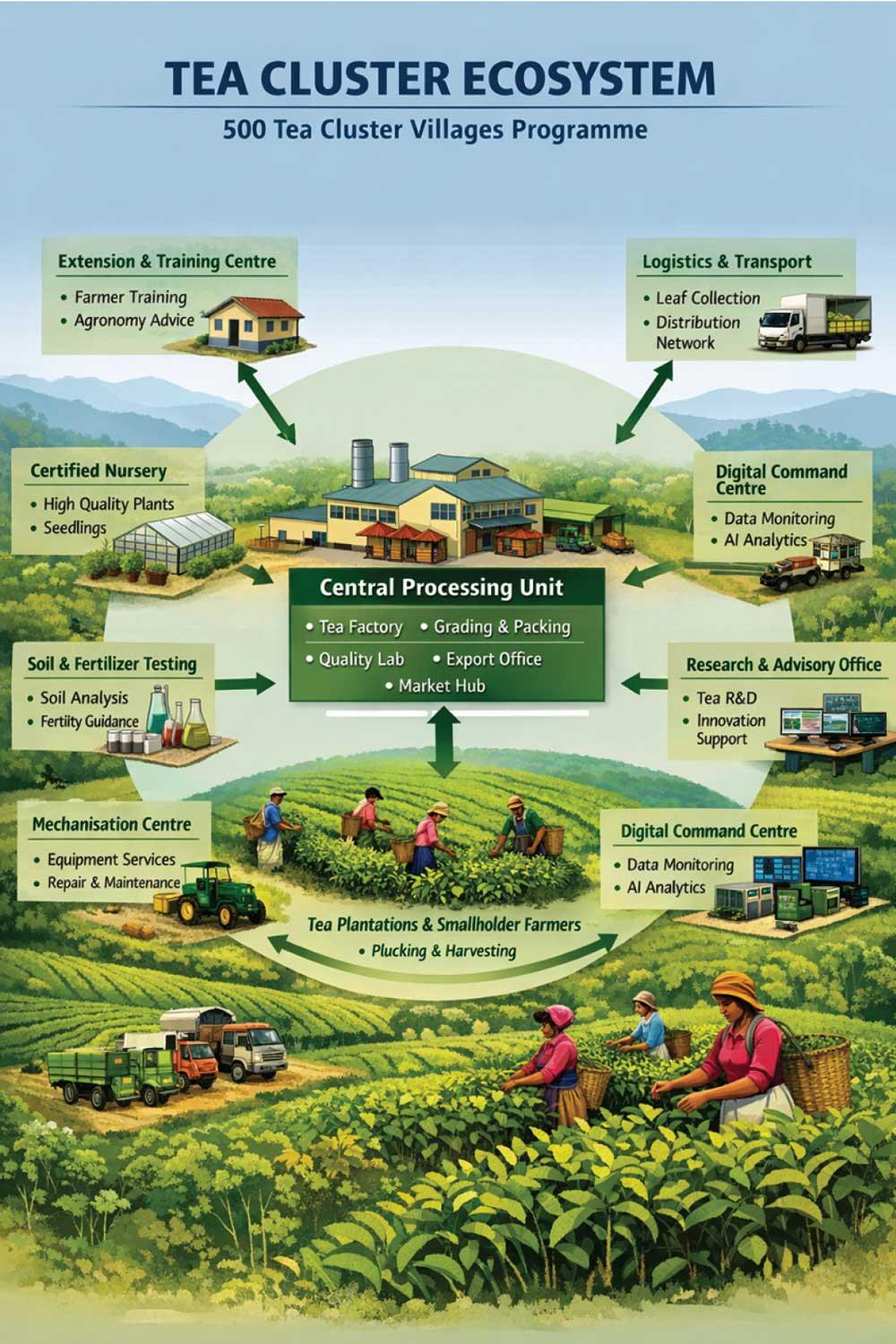
At the centre of this transformation stands the proposed ‘500 Tea Cluster Villages Programme.’
This initiative envisions the creation of a nationwide network of integrated agro-industrial clusters. Each cluster village would function as a dynamic local economic hub linking farmers, processors, research institutions, logistics providers, and export markets within a
coordinated ecosystem.
These clusters would include certified nurseries supplying improved planting material, soil testing laboratories guiding fertiliser management, mini tea factories capable of processing green leaf quickly, modern logistics systems for efficient transport, and digital monitoring platforms capable of tracking plantation productivity.
The goal is simple yet transformative: replace fragmentation with coordination.
At present, the tea industry operates through a web of institutions that often function independently of one another. Production, processing, research, logistics, and marketing frequently occur in isolation. The result is inefficiency irregular leaf supply, underutilised factories, transport delays, and weak traceability systems demanded by modern global markets.
The cluster model aims to unite these components into a single coordinated system, ensuring that every stage of the tea value chain works together efficiently.
But industry experts note that this transformation must be supported by several critical reforms.
Real-time info platform
One of the most urgent needs is the establishment of a national real-time digital plantation information platform. Modern agricultural economies rely heavily on digital monitoring systems that track weather patterns, yields, pest outbreaks, labour productivity, and market prices. Sri Lanka’s plantation sector still lacks such a unified digital intelligence platform.
Without timely data, both policymakers and planters are forced to make decisions with incomplete information.
Equally important is the need for a strong policy framework. Sri Lanka still awaits a comprehensive National Plantation Policy and a modernised National Agricultural Policy capable of guiding the long-term development of perennial crops.
A proposed Sri Lanka Plantation Act 2026 could provide the legislative foundation required to modernize governance across tea, rubber, coconut, and other plantation crops while enabling digital monitoring and productivity benchmarking across the sector.
Another important shift emerging within the industry concerns the identity of the tea grower. For decades, independent producers have been referred to as ‘smallholders.’ Yet many of these growers are in fact entrepreneurial landowners managing valuable agricultural investments.
Increasingly, there is a call to recognise them as Proprietary Planters (PPs) entrepreneurs whose role is central to the future of Sri Lanka’s
plantation economy.
If these reforms accompany the Minister’s vision, the economic impact could be remarkable. Reaching the national target of 400 million kilograms of tea, combined with greater value addition and stronger global branding of Ceylon Tea, could generate USD 4-5 billion in annual export revenue by 2035.
Such growth would strengthen foreign exchange earnings while revitalising rural economies across the Central, Uva, Sabaragamuwa, Southern, and Western Provinces.
Economic priorities
Yet a closer analysis reveals that the numerous challenges facing the tea sector ultimately converge into two fundamental economic priorities.
First, Sri Lanka must restore cost leadership in tea production. Second, the country must achieve value leadership, ensuring that a much larger share of its tea is sold as premium branded products capable of earning at least USD 25 per kilogram in international markets.
Both objectives fall directly within the policy reach of the Ministry of Plantations and Community Infrastructure, which oversees more than forty institutions connected to plantation agriculture.
To achieve cost leadership, the industry must adopt lean production systems that reduce waste and improve operational efficiency. In this regard, the Toyota Production System (TPS) provides a powerful strategic model.
Originally developed for industrial manufacturing, TPS focuses on principles such as Just-in-Time operations, waste elimination, standardised processes, and continuous improvement known as Kaizen. Applied to tea plantations, these principles translate into coordinated plucking cycles, synchronised transport of green leaf, efficient factory operations, and disciplined plantation management.
At the same time, Sri Lanka must pursue value leadership. Instead of exporting bulk tea at commodity prices, the country must focus on premium branded products specialty teas, wellness teas, traceable origin teas, and innovative beverage products that capture higher margins in global markets.
In this sense, the 500 Tea Cluster Villages Programme closely resembles the idea of ‘Toyota Production Villages.’ Each cluster would function as a coordinated economic ecosystem where farmers, processors, logistics providers, and exporters work together within an integrated system supported by shared infrastructure and digital intelligence.
If implemented successfully, these clusters could become the operational engine that transforms Sri Lanka’s tea industry into a modern agro-industrial network capable of producing premium Ceylon Tea for the world.
One of the most visionary elements of the Minister’s strategy is the aspiration to raise per capita income to USD 12,000 annually for each tea-growing family. Under the Tea Cluster model, these families would become shareholders in their own cluster enterprises, enabling them to participate directly in the economic gains of the industry. By giving growers ownership and decision-making power, the programme aims to transform traditional tea farmers into self-managed tea entrepreneurs, creating a powerful case study in rural economic empowerment.
Ultimately, the success of this transformation will depend on the ability of Minister Samantha Vidyarathne and the Ministry of Plantations and Community Infrastructure to align the many institutions under their authority toward a single national mission lower costs through lean production and higher earnings through premium value-added tea. If these two pillars are firmly established, Sri Lanka’s tea industry may yet rediscover the vitality that once made it a global powerhouse.
And if that vision succeeds, the green hills that made the island famous for tea may once again become the foundation of a modern, resilient, and prosperous plantation economy.
(The writer is a Value Chain Management Journalist, Vivonta Green Tech Consultants, Proprietary Planters Alliance (Pvt) Ltd, former Senior Planter, Agricultural Advisor/Consultant at www.vivonta.lk and
www.planters.lk)
13 Jun 2026 1 hours ago
13 Jun 2026 1 hours ago
13 Jun 2026 2 hours ago
13 Jun 2026 2 hours ago
13 Jun 2026 3 hours ago