01 Oct 2025 - {{hitsCtrl.values.hits}}
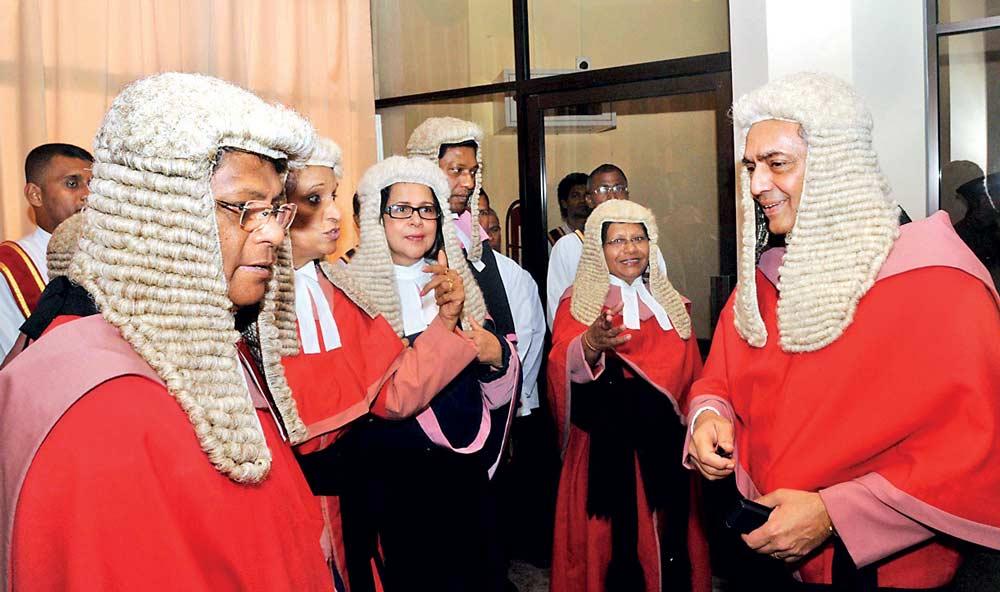
Legal experts suggest judges’ extensive analytical work justifies higher retirement ages compared to other sectors.
FILE PHOTO
 The reason for judges having a higher retirement age may be because the job demands extensive reading, writing and analysis than physical strength
By Kamal Suneth Perera
Since 1991, the International Day of Older People has been observed on October 1 each year, worldwide. The 2025 United Nations International Day of Older Persons is observed under the theme “Older Persons Driving Local and Global Action: Our Aspirations, Our Well-Being and Our Rights”. Therefore, the “retirement age” is an ideal topic to discuss in this context.
By the introduction of the Minimum Retirement Age of Workers Act No. 28 of 2021, which came into law on November 17, 2021, the retirement age of the private sector employees increased from 55 years to 60 years. During the second reading of this Act in the parliament on the November 11, 2021, then Minister of Labour, justifying the new law to increase the retirement age from 55 to 60, stated that unlike the time where the retirement age as 55 years introduced, present Sri Lankan society has an improved health sector and thereby the life expectancy of an average person has increased to 74-76 years of age. Further, the Minister compared the life expectancy and the retirement age of several Asian countries.
The retirement age of public sector employees was 55 years, and depending on the service requirements of the relevant department, employees’ efficiency and employees’ request for extension, some of them were given service extensions, a year at a time and a maximum of five years. But it was never the right of the public sector employees to work after 55 years of their age.
By the Public Administration Circular: 02/2022 issued on January 6, 2022, the age of compulsory retirement of the public officers was increased to 65 years. Minister of Public Services, Provincial Councils and Local Government, by the extraordinary gazette No. 2263/5 issued on January 19, 2022, amended the Minutes of Pensions accordingly.
However, by the Public Administration Circular 19/2022, issued on September 14, 2022, the age of compulsory retirement for public officers was revised and fixed at 60 years of age.
Accordingly, as of now, both the private sector and the public sector have a mandatory retirement age of 60 years.
Article 107(5) of the Constitution of Sri Lanka provides that the retirement age for Supreme Court Judges is 65, and the retirement age for Court of Appeal Judges is 63. As per section 6(3) of the Judicature Act, the retirement age of the High Court Judges is 61 years. As per the Rule made in 1949 under section 2 of the Public and Judicial Officers (Retirement) Ordinance, the retirement age of the Magistrates and District Judges is 60 years.
Accordingly, a Magistrate/District Judge retires at the age of 60 unless he/she get an appointment as a High Court Judge. A High Court Judge retires at the age of 61, unless he/she appointed to the Court of Appeal. Judges in the Court of Appeal retire at the age of 63, unless he/she appointed to the Supreme Court. Judges in the Supreme Court in Sri Lanka retire at the age of 65.
Therefore, it is clear that historically retirement ages of judges were fixed at a higher age than those of public sector and private sector employees in Sri Lanka. It is the same situation in most of the other countries. The reason for judges having a higher retirement age may be because the job demands extensive reading, writing and analysis than physical strength. It may be the same reason as to why the retirement age of academic staff of our universities was fixed as 65 years by section 73 of the Universities Act No. 16 of 1978.
As per the data published by the Economic and Social Commission for Asia and the Pacific, in the year 2000, the age group of 60+ population in Sri Lanka was 10.2% of the total population, and that percentage has increased to 15.8% by the year 2020. It is predicted that by the year 2030, 20% of the Sri Lankan population will be in the age group of 60+.
In the year 2024, the World Health Organization identified Sri Lanka as the fastest ageing country in South Asia.
With regard to the retiring age of apex court judges in other countries, the following can be observed.
England had no retirement age for judges until 1995. One of the famous judges in British History, Lord Denning, was a judge from 1944 until he retired in 1982 as the Master of the Rolls at the age of 83. From 1995, English law came into force requiring newly appointed judges to retire at age 70. In 2021, the Judicial retirement age was increased to 75.
The USA does not have a mandatory retirement age for the apex court judges. Article III of the US Constitution states that these judges “hold their office during good behaviour,” which means they have a lifetime appointment. The Judges are free to retire at the age of 65 onwards, subject to the age and service requirements for retirement provided in section 371 of the Judiciary and Judicial Procedure. The 18th Chief Justice of the USA, William Rehnquist, was serving until he died in 2005 at the age of 80. The last judge to retire from the US Supreme Court was Stephen Breyer in January 2022, at the age of 84. The present Chief Justice of the USA is John G. Roberts, Jr., now 69 years of age. As observed by Francis Shen of the University of Minnesota Law School, in his research “Ageing Judges” published in Ohio State Law Journal [Francis Shen, Ageing Judges, 81 OHIO ST. L.J. 235 (2020)], the average age of federal judges in the USA is sixty-nine years old.
South Africa has a two-fold retirement provision for its judges in the apex court called the Constitutional Court of South Africa. As per section 176 of their Constitution, A Constitutional Court judge holds office for a non-renewable term of 12 years, or until he or she attains the age of 70, whichever occurs first, except where an Act of Parliament extends the term of office of a Constitutional Court judge.
India, as well as Singapore, maintain 65 as the mandatory retirement age for judges, and in December 2022, the Indian Justice Department stated that raising judges’ retirement age may benefit non-performers.
The retirement age of 70 for judges is common in most countries, like Japan, New Zealand, Belgium, Denmark, Ireland, the Netherlands, Norway and Australia.
As per the above data, the retirement age of apex court judges in most of the other countries goes beyond 60 years, unlike in Sri Lanka.
We have noticed in the past that, soon after the retirement of some of the apex court judges in Sri Lanka, they actively and efficiently provide their knowledge and service as diplomats, as members of independent commissions established by the Constitution and in top management in the private sector, including banks. Hence, the conclusion that we could reach is that apex court judges have demonstrated high mental and physical efficiency, even after the present retirement age of 65 years. By taking into consideration all the aspects discussed above, this may be the right time to consider increasing the retirement age of judges in Sri Lanka.
Therefore, by considering all the above aspects, it is desirable to increase the mandatory retirement age of the Supreme Court judges in Sri Lanka to 70 while permitting them to retire early after the age of 65, a situation somewhat similar to Australia.
Similarly, the legislature should consider increasing the retirement age of Court of Appeal judges to 65 from 63, High Court Judges to 63 from 61 and Magistrates and District Court Judges to 62 from 60.
As the present Sri Lankan society has an increasing percentage of 60+ population, while the private sector retirement age was increased to 60 years in the year 2021, and the public sector has 60 years as a mandatory retirement age, this may be the right time for the legislators in Sri Lanka to bring an amendment to the law to increase the retirement age of judges.
The writer is an Attorney-at-Law and has a B.Sc (HRM) Sp., USJ.
13 Jun 2026 1 hours ago
13 Jun 2026 1 hours ago
13 Jun 2026 3 hours ago
13 Jun 2026 3 hours ago
13 Jun 2026 4 hours ago