22 Feb 2016 - {{hitsCtrl.values.hits}}
 oday, our consumption of goods and services often has little to do with our actual contribution to the production of such goods and services. The share of the labour force engaged in agricultural production in post-industrial societies like the USA is less than 5 percent. So, most people are just consumers of food produced by others. In fact, the largest single employer in that country today is the restaurant industry that feeds the vast majority of people on a day to day basis. This situation can be contrasted with primitive societies where most people had to find their food from their natural surrounding and they were literally having a hand to mouth existence. They most probably had no food to waste or engage in over consumption.
Under conditions of globalised capitalism, commodities and services flow across national and regional boundaries in response to consumer demand in many parts of the world. So, the market for a particular commodity or a service can be worldwide. This often means that the potential demand for a particular commodity or a service often far outstrips the supply. This is because of the unprecedented expansion of money supply due to the expansion of financial markets, resulting in the proliferation of all sorts of financial institutions and diverse types of consumer credit. Many people today possess several credit cards. While it is true that one cannot spend more than one’s actual income during a certain period of time, one can certainly spend money that one is yet to be earned thanks to various credit lines available. As a result, there is so much money in circulation today that there is hardly any correspondence between the amount of money circulating in the market and the quantum of actual goods and services produced. It is money that generates the demand for goods and services and therefore, the goods and services tend to flow in the direction of places where money is concentrated. Since financial resources are highly unequally distributed both within and across countries, all sorts of goods and services tend to get concentrated in certain spaces more than in others. The result is the expansion of urban centres in all parts of the world. While urban centres are also the places where wealth is concentrated, they also tend to be the most significant arenas of consumption.
When access to goods and services depends mostly on the purchasing power of people, most people strive to secure as much money as possible. But the potential access to money today has little to do with the actual contribution of individuals to production of material goods and services. In other words, unequal distribution of monetary income both within and across countries gets translated into unequal consumption of goods and services. So, while unequal distribution of food results in the paradox of obesity and malnourishment, differential access to other goods and services such as industrial products, transport, water and energy leads to wasteful consumption on one hand and all forms of deprivation on the other. Increasing demand for goods and services due to monetary expansion is a major driving force behind economic growth in many countries today. There are many institutions and individuals in each country engaged almost exclusively in handling financial resources. They have little or nothing to do with the actual production of commodities and services. Those who have invested in stock markets keep manipulating the stocks they own in order to maximize their profits. Some of them earn so much in profits that they do not know what to do with their money. Many of them naturally invest in more tangible assets such as real estate and may also engage in conspicuous consumption such as global travel, buying private jets, etc. Their lavish expenditure in turn becomes the income of many other people who provide various services.
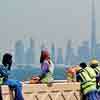
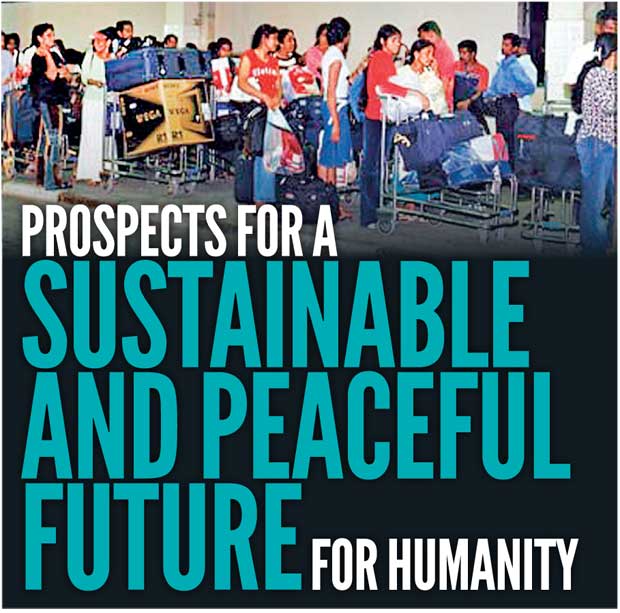
On a global level, the dream of the poorer countries is to sell whatever they can to richer countries. This may include cheap labour, food and raw materials. Many people from Asia travel to oil-rich Middle East countries to provide personal services such as domestic work. This is done often at the expense of their own domestic front. In fact the order they help maintain in the host country often creates disorder at home. But that does not matter to those who enjoy the services provided by the wretched of the earth.
Despite the growing anxieties about climate change, environmental pollution, depletion of non-renewable resources and continuing wasteful consumption, no government in any part of the world is prepared to revisit the often mindless production-consumption equation. Though the new UN sustainable development goals framework demands a transformation of the world to face up the environmental challenges, governments and dominant international institutions seem determined to carry on regardless due to both popular pressure as well as the influence of vested interests. In other words, we continue to live beyond our means in terms of the use and abuse of existing resources. The large urban centres, particularly in the developing world are clearly unhealthy and unsustainable. But what is the alternative ? As is well known, more and more people are moving into these cities as more financial and other resources are concentrated there. Overcrowded neighbourhoods, increasing traffic congestion, crises in waste disposal and public health etc. make life miserable for many. The rich build gated communities and remain largely cut off from ordinary people who often suffer in silence. Rich neighbourhoods are often heat islands due to high and unsustainable energy use. Their abuse of precious water is irresponsible to say the least. On the other hand, given the high density of population in low income settlements and squatter settlements, it is difficult to imagine how better and healthier settlements could be built to accommodate these millions of inhabitants.
For instance, look at the situation in the two largest countries in the world; namely India and China. The leaders in these countries naturally opt for more economic growth, hoping that more economic growth would reduce poverty and provide better living conditions to teeming millions. Yet, socially unregulated growth results in more inequality, more cars, more pollution, more ill health and injustice. In the rest of the world, people are passionately talking about inequality, injustice and violence but the global reality does not seem to change for the better. Persisting problems in many parts of the world such as conflict driven mass migration, brutal sectarian violence, growing income inequality both within and across countries and increasing migration of labour from poor countries point to a socio-political crisis on a global scale. How can people look forward to a shared future under such conditions ?
01 Jul 2026 39 minute ago
01 Jul 2026 2 hours ago
01 Jul 2026 2 hours ago
01 Jul 2026 2 hours ago
01 Jul 2026 3 hours ago