27 Feb 2016 - {{hitsCtrl.values.hits}}
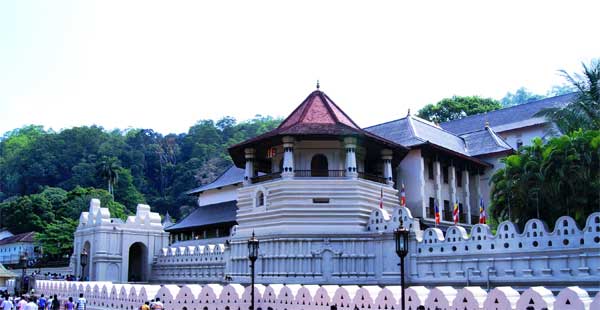
Chaos over the road opposite this sacred place
 President Maithripala Sirisena at a development meeting held in Kandy just three months ago at the Janadipathi Mandiraya announced to Members of Parliament, Provincial Council members and public officers, that the question of opening the road across the Sri Dalada Maligawa should be forgotten. He said “I have heard the Mahanayakes and that is enough.”
The former President Mahinda Rajapakse walked from the main iron gates of the Sri Dalada Maligawa and made a Presidential order that the road parallel to the Sri Dalada Maligawa should be opened only to the Mahanayakes and to the members of the clergy who were in service at the Sri Dalada Maligawa.
Both these representatives of the people knew the pulse of the Buddhist society but a small group of people who are on a prestige battle and kindling uneasiness among the society alleged to be including schools according to a press conference organised by the JHU representative. But a coterie of people are interested in opening the road running parallel to the Sri Dalada Maligawa from Queen’s Hotel Junction to Buwelikada junction, now saying it is a way to Mahiyangana.
As old records shows the way to Mahiyangana was through Katugastota - Madawala -Menikhinna and across old Teldeniya was not a road to Mahiyangana, as there was no road. There was a footpath across the Maha Maluwa.
This particular road was opened by the British when they installed the statue of Sir Henry Ward and named it Ward Street. Otherwise there was only a footpath running across the Maha Maluwa and there was no road according to the paintings of that era. The British were creators of this road which a group is clamouring to be opened and most of them are from outside Kandy. The people in Kandy, with all their hardships, are not interested in opening this road.
 The road was closed before the LTTE blast on the Sri Dalada Maligawa complex in 1998. The participants for this closure were the two Mahanayake’s of Malwatte and Asgiri Chapters Venerable Sirimalwatte Ananda Thera and Venerable Chandananda Palipanne Thera. This closure of the road was not due to the Bomb Blast and its aftermath but as a protection for the Sacred Shrine. The shrine was attacked not only by LTTE, but also during the uprising of the youth. The LTTE cadres had no time to enter the Maligawa, as they blasted themselves before they could enter.
The opening of the road seems to have become a prestigious battle, rather than the necessity of this road to cut across to join the further end of Dharmapala Mawatha. In the meantime this ‘ group ‘ is not only seeking to open the road but alleged to be whipping up the students, according to the Anunayake of Malwatta Venerable Panditha Niyangoda Vijithasiri Thera. There is no doubt that an alternative road should be thought of with the heavy traffic that is pouring into Kandy, during the peak hours.
But, with the new trial run of the traffic scheme introduced by the Kandy Police and the Municipality, it is working well without any major complaints. Therefore the closure of the Maligawa road is not the stumbling block for the congestion of traffic. The Senior Deputy Inspector General of Police in Kandy said “Clear the centre of Kandy- the problem is solved “. That is exactly what has been done.
But, no proper study has been done as to overcome this problem and none has visualised the damage done by the Kandy Municipal Council by allowing to desecrate the beautiful hills around the Kandy Lake to put up haphazard buildings violating the basic requirements governing constructions of buildings in par with the environment.
With these buildings jutting out from the former ever-green foliage coverage giving a sort of prevention to the fumes of petrol, whether they are octane or not is now covered by a concrete jungle. But the blame comes on the “road running parallel to the Sri Dalada Maligawa” Open it scream a group of people who are hell bent on prestige and a political gain to tell those interested in opening the road “there we have done it.”
A Mayor who came to the Economic Conference in Colombo has said that an eight lane traffic built in their country was again congested within weeks. The more any country has vehicles there would be no end to traffic congestion.
The small group of people who are hell bent on opening do not realise the damage that would occur to this ancient structure, like the Pattiruppuwa, due to the fumes of even small cars that would be running along this road, as suggested. Our fume control systems are not fool proof.
Does anyone understand that when a bridge is built or heavy traffic or even light traffic makes its way across the Sri Dalada Maligawa, there are bound to be vibrations. Building any bridge would adversely affect the Pattiruppuwa or the Octagon, due to the building operations. It is this complex that beautifies Kandy. Re-building the Pattiruppuwa in the present shape would be a dream. Many tried to imitate this structure but failed. The man who built the Pattiruppuwa or Octagon died under tragic circumstances and was not allowed to live to construct a structure of this nature.
 This edifice was to have been brought down to be rebuilt after the LTTE blast. All who were involved in rebuilding this “ Gem - of the Kandyan era “ thought that little could be done after the devastation of the Sri Dalada Maligawa in 1989. No one would realise the colossal damage done to this ancient structure by a band of men who knew no mercy nor values of the land they lived in. It is only those who saw the damage on this very day of January 25th 1989 who would realise the gravity. The then Diyawadana Nilame Neeranjan Wijeyratne was between two worlds, one was to know this structure and how it should be rehabiltiated and also how he could answer the “Venice Charter” . In fact this Charter signed by Sri Lanka saved the Pattiruppuwa from being brought down as suggested by many. For over twenty years Diyawadana Nilame Neeranjan administered the Sri Dalada Maligawa and was afraid to trample the norms and standards of the Sri Dalada Maligawa. So he had to find an answer and that answer came in the form of Professor Munidasa P. Ranaweera - the Civil Engineer of the Faculty of Engineering, University of Peradeniya. He played a key role in rehabilitating this ancient structure.
Professor Munidasa thinks that this structure is a “Gem of Kandyan Architecture “ He set about examining the structure with the former Diyawadana Nilame Neeranjan Wijeyaratne and came to the conclsion that the buildng need not be pulled down, but could be rehabilitated. It was then that everyone realised that all the beams of the Pattiruppuwa had rotted and it was wood pulp that they were handling. Had there been no blast of the LTTE, sooner or later the entire roof of the Pattiruppuwa would have come down.
Sri Lanka Ports Authority was handling the repair to the damage to Sri Dalada Maligawa and Professor Ranaweera-a civil engineer was requested to assess the damage to the structure and suggest remedial measures.
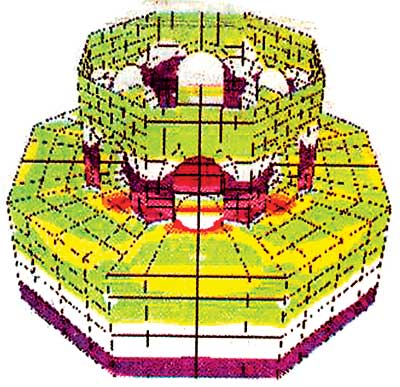
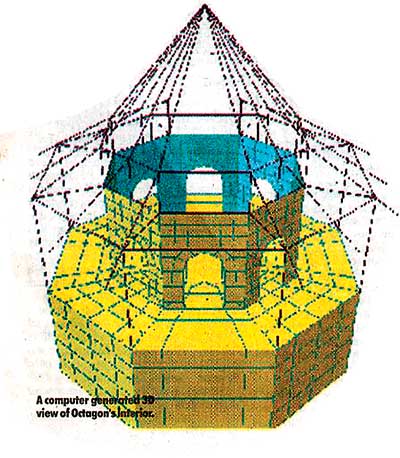
Professor Ranaweera realised that the Octagon was located next to the moat to the West, where it rises from ‘level O’. (as shown in the accompanying inserts ). On the east side of the foundation is ‘ Level 1 “extending to a height of 260’ from level “O” to level “1”. The building was ringed by two 26” inch thick inner and outer walls forming two Octagons sometimes with openings for doors.
The historic Oriental Archive (later turned into an archival library), which is little used is at level “2” it has an inner Octagon composed of 26” thick walls with door openings and at vertices of the outer Octagon of side 182” with eight masonry columns of mean diameter at 29”.
Earlier one Professor E. Walley according to Professor Ranaweera had propagated the theory that earth shock damage from bombs exploded at ground level were confined to the order of two or three times the crater radius. “Professor Walley’s theory has been proven in the Sri Dalada Maligawa bomb blast “said Professor Ranaweera.
The opinion of Professor Ranaweera was that the damage to the Sri Dalada Maligawa was due to pressure and suction at the centre of the explosion. But there has been no visible damage to the foundation of the building according to him. The moat around the Octagon seems to have played a protective role by cutting off transmission or ground waves of the explosion.
It was at this stage that it was advocated to break down the walls of the Octagon which were 26” thick . But those who valued the basic principles of the “Venice Charter “ wanted the minimum of intervention with its structures. Due to this a detailed study of the structures was called for.
J. Heymen, former Professor of Engineering, University of Cambridge who had made a study of the West Tower of Ely Cathedral in the UK and who had also made studies of the behaviour of many ancient masonry structures has laid down the principles governing their behaviour. According to Professor Ranaweera Professor Heymen has found that in many ancient structures there was a precaution against break-down. He has also introduced the concept of background stress, pressure of around 1/1000, of the crushing strength ( which is all that is necessary to avoid the danger of ‘sliding’ and general loss of cohesion of the masonry structures)
The observed damage was confined to the upper part of the Octagon as in the case of most outer sections of the Sri Dalada Malgawa Complex Professor Ranaweera, said
The Pattiruppuwa or the Octagon obliviously needed a major roof repair and only cosmetic repair below level “2”, he said. Opinion was voiced, said Professor Ranaweera “ on the cracked walls and some even advocated the breaking and reconstruction of the 26inch walls “
The question that arises, is whether the Octagon could hold any more vibrations of light or heavy traffic and if there is going to be any building generations, whether it could withstand the severe vibrations. Furthermore the fumes from the vehicles also has to be considered on he entire Sri Dalada Maligawa Complex.
The biggest problem for vehicle fumes is that the surrounding area of this valley where Kandy is situated is structured with concrete buildings allowed by the ‘City Fathers’ and some illegally constructed structures. Most of the overhanging trees are gone and the entire area is cleared for a better view for Tourists of the Lake and the Sri Dalada Maligawa. Who should be blamed for all this pollution ? I leave it to the readers.
01 Jul 2026 7 minute ago
01 Jul 2026 7 minute ago
01 Jul 2026 43 minute ago
01 Jul 2026 2 hours ago
01 Jul 2026 2 hours ago