13 Dec 2025 - {{hitsCtrl.values.hits}}
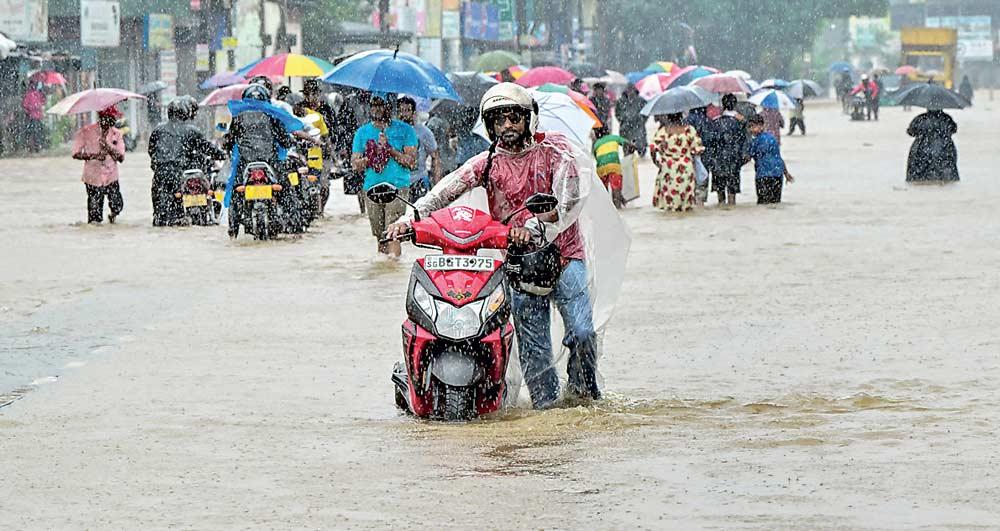
Not everyone told to evacuate are willing or able to do so
The Cyclone Ditwah that was formed in Southwest Bay of Bengal on November 26 and made landfall in Sri Lanka on November 28 has claimed at least 635 lives, leaving another around 200 persons disappeared by December 9. The numbers might slightly rise up.
Around 2.1 million people belonging to about 600,000 families have been affected by the unprecedented heavy rain of over 500 mm in some places, and resultant massive floods in downstream areas of various rivers and landslides in the hill country. Around 250 kilometres of roads, and 35 major bridges were damaged by the floods and landslides caused by the cyclone.
During the same period, on November 26 and 27, Indonesia, Malaysia and Thailand were also hit by another cyclonic storm named Senyarby, according to the regional committee of the World Meteorological Organisation (WMO). It wreaked havoc in Indonesia by killing over 1000 people. Less lives were claimed in the other two countries. The number of affected people in Indonesia and Malaysia was over 1.5 million and 37,000 respectively.
As in every case, many people in Sri Lanka cannot see the disaster except through a political prism. And the Opposition blamed the government on December 1 in Parliament for what they said was lack of preparedness for the disaster, which they said was predicted by the Meteorological Department on November 12. Members of the Samagi Jana Balawegaya (SJB) vowed to sue the government for manslaughter by not taking precautionary action.
SJB member Kabir Hashim on December 1 said in Parliament that the authorities could have minimised the damage caused to the lives and properties had they released water from reservoirs earlier, instead of opening the sluice gates after the heavy downpour caused by Cyclone Ditwah. He stated that the death toll in Gampola alone might be around 1000.
However, When Minister Nalinda Jayatissa requested them to table the official prediction of the department in the House, no response came forth. Then the government ministers accused the Opposition for concealing the prediction which only they might have received, with a view to take political advantage after leaving the people to die. In fact, the Opposition parties, especially the SJB never uttered a word about any prediction till December 1, despite the Parliament having met almost daily for the budget debate since November 12.
The most important fact is that the death toll in floods is significantly less than the number of people killed in landslides which have nothing to do with reservoirs. Therefore, linking death toll with the releasing of reservoir water is baseless. In fact, the real cause for the high number of deaths due was the high intensity of rainfall which the Meteorological Department failed to predict. They predicted a rainfall of over 200 mm whereas it exceeded 500 mm in some places.
As in the past, authorities failed to evacuate the people from disaster prone areas in time. However, they announced the names of such areas and requested people to move to safer places. First, on November 26, 27 and 28, they predicted about high-intensity rainfall and gale force winds, and then warned the people in landslide-prone areas and people living downstream of major rivers to evacuate to safer areas.
However, people were not prepared to do so until the untoward is imminent. This happened every time a disaster was looming. Although they agree with the “philosophical” notion by the authorities and the people on safer ground that properties can be earned but not human lives, they were not prepared to act accordingly. As a fellow victim of floods in the Kelani Valley, this writer too, wanted to believe that it is too early to leave the house until the flood water visited him.
Hedging till the last moment
Primarily, people do not want to leave their hard-earned valuables unattended at a time when they are in danger of being destroyed by the disaster or of being stolen by thieves. They also want to deceive themselves to believe that flood waters would not rise to a level that would harm their valuables or the earth would slip down and fall on their houses.
Interestingly, people tend to feel everything in there is house is valuable when the danger of disaster is less or remote. But with the threat mounting, they are gradually compelled to decide what to take and what to leave behind. Ultimately, when they are prepared to leave the house with only the title deed of the house, certificates and other valuable documents and sometimes the jewellery, it may be too late for a perilous journey to safety.
Another important reason why people are reluctant to leave their homes the face of natural disasters is the difficult question of ‘where to go’ in spite of the philosophical norm ‘life is more valuable than property’. People want to find shelter in a place close to their at risk homes so that they could go back at the earliest possible opportunity. Many people do not find such shelters. Not knowing for how long they may have to be away from home, they are reluctant to go, and many also do not want to stay with relatives or friends due to prestige or because they do not want to be a hindrance to others’ freedom and privacy.
This happened to the writer during the 2016 floods when members of his family left home wading through neck-deep water to a boat that had been organised by a provincial councillor to evacuate flood victims. Although we were upstairs with somewhat confidence, with the power supply having been disrupted, the fear of being cut off from the outside world, especially from our relatives and friends, prompted us to leave. This time we left home when the Kalani river came to our doorstep, but we had to wade through waist-deep water on the way as the road close to Avissawella road is lower than where we live.
Uncertainty of the intensity of the disaster is another issue that stands in the way for the victims to decide their course of action. Following the 2016 massive floods, Kelani River overflowed in our area in 2017 as well and we left home as the authorities warned. However, houses were not affected as the overflowed water ran parallel to the river and rejoined the river downstream. In 2018 too, river overflowed and warnings were issued. We did not leave home but took everything upstairs, as we did in the previous two years. Similarly, we had to carry a part of our things kept downstairs in 2022, and again last year, with warnings, but nothing untoward happened.
Therefore, disaster-hit people would not want to leave homes just because warnings are issued.
20 Jun 2026 2 hours ago
19 Jun 2026 6 hours ago
19 Jun 2026 7 hours ago
19 Jun 2026 8 hours ago
19 Jun 2026 19 Jun 2026