05 May 2025 - {{hitsCtrl.values.hits}}
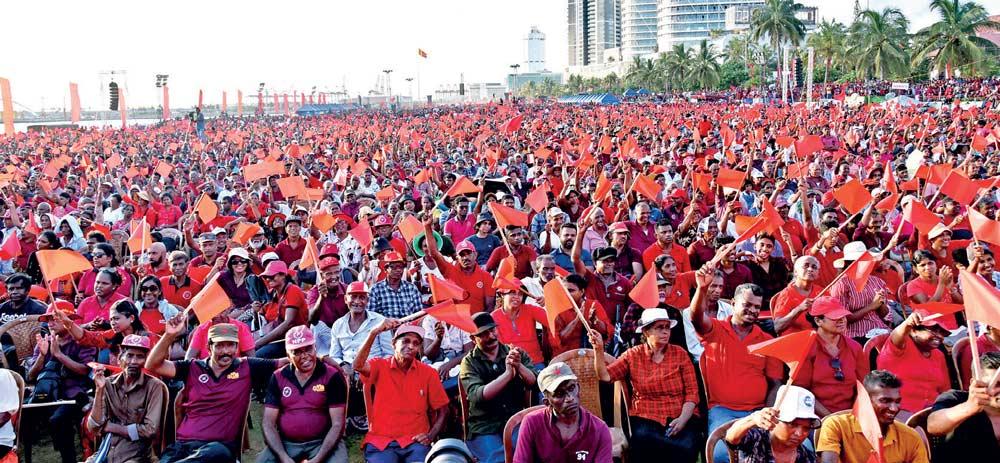
Today’s May Day rallies lack the ideological fire of the past (Pics by Nisal Baduge)
 A.E. Goonesinghe brought vibrancy and mass appeal to workers’ movements
It was during this golden age that trade unionist Bala Tampoe rose to prominence
May Day 1987 remains one of the darkest in Sri Lanka’s political calendar
 Another May Day has come and gone, with the governing party commanding impressive attendance, filling the Galle Face Green for the second time in five years. This robust showing arrives in stark contrast to recent history, when the former President wisely prohibited such gatherings under his “Clean the Green” concept.
“May Day is an alien concept; hence it cannot be declared as a public holiday.”
This was the dismissive reply the Ceylon Labour Party, under the leadership of A. E. Goonesinghe, received from the British colonial government’s Legislative Council in the early 1920s. The sentiment was echoed again in the 1930s by the State Council when newly emerging Marxist parties agitated for recognition of May 1st as a workers’ holiday. But history, as we now know, had other plans.
Despite repeated rejections by both the colonial Legislative Council in the 1920s and the State Council in the 1930s—on grounds that May Day was an “alien concept”—the working class of Ceylon remained undeterred. Their demand was simple: to recognise May 1 as a day of solidarity, a tribute to labourers’ rights and struggles worldwide. These calls were first championed by A.E. Goonesinghe and later taken up with greater fervour by the Marxist movements of the late 1930s and ‘40s. Even after independence in 1948, successive United National Party (UNP) governments, wary of leftist agitation, refused to grant formal recognition. Yet the workers persisted. Undaunted, they took personal leave, forfeiting daily wages, to participate in May Day rallies—marching through the streets with placards, shouting slogans, and demanding justice, dignity, and fair compensation.
This unrelenting commitment by the labour movement helped embed May Day into the cultural and political consciousness of the country. Their efforts culminated in 1956, when Prime Minister S.W.R.D. Bandaranaike, buoyed by a wave of Sinhala-Buddhist nationalism and left-leaning populism, finally declared May 1st a national holiday. It was more than a policy decision; it was a symbolic and political victory that cemented Ceylon’s place within the global fraternity of nations that honoured workers’ contributions. The move was widely celebrated by unions, leftist parties, and working communities, and it marked a turning point in the recognition of labour rights in Sri Lanka’s postcolonial history.
Goonesinghe’s Colourful Legacy and the Rise of Marxists
Goonesinghe, often hailed as the pioneer of organized labour in Ceylon, brought vibrancy and mass appeal to workers’ movements. His rallies were not austere ideological sessions but festive parades filled with baila music and dancing. Yet, this performative populism also made him vulnerable to criticism. Marxist ideologues, whose focus was more on revolutionary change and workers’ rights, saw Goonesinghe’s brand of unionism as lacking class consciousness. In the late 1930s, clashes erupted between Goonesinghe’s followers and the newer leftist parties. Pieter Keuneman, son of a Supreme Court judge and future leader of the Communist Party, recalled an incident where his comrades were physically attacked by Goonesinghe’s goons during a May Day rally.
Despite their differences, both strands of the labour movement—Goonesinghe’s traditional unionism and the more radical Marxism of the LSSP and CP—played instrumental roles in consolidating May Day as a cultural and political fixture.
Red banners and fiery orators
By the 1940s and 1950s, the LSSP and Communist Party had emerged as powerful voices for the proletariat. Red, the symbolic colour of labour, swept through the streets of Colombo each year. Eminent personalities such as Dr. Colvin R. de Silva and the charismatic Dr. N. M. Perera became the poster boys of the May Day stage—articulate, impassioned, and deeply committed to socialist ideals. Workers and intellectuals alike gathered to hear these firebrands speak on wage increases, housing rights, and social justice. Women too participated in large numbers, dressed in red saris and jackets, reinforcing the inclusive character of the movement.
It was during this golden age that trade unionist Bala Tampoe rose to prominence. A fierce advocate for workers’ rights and General Secretary of the Ceylon Mercantile Union (CMU), Bala would become a symbol of uncompromising resistance.
The May Day That Ended in Bloodshed – 1987
May Day 1987 remains one of the darkest in Sri Lanka’s political calendar. In the lead-up to the day, a devastating LTTE car bomb exploded near the Pettah Bo-tree on April 21, killing 122 people and wounding over 200. Public anger surged, and on April 22, student and bhikkhu-led protests erupted outside President J.R. Jayewardene’s residence, demanding state accountability for citizen safety.
Fearing unrest, the government invoked emergency laws to ban all May Day rallies. A full-day curfew was imposed on May 1 and a symbolic celebration date was proposed for May 22. But the left-leaning parties and trade unions, joined by civil society groups under the Maubima Surakeemay Vyaparaya (MSV), refused to comply.
A major gathering was convened at the historic Abhayaramaya Temple in Narahenpita. The LSSP, Communist Party, SLMP, NSSP, and several trade unions participated in defiance of the state ban. A ten-point declaration was adopted, affirming their right to assembly and the sanctity of May Day.
But as the temple crowd began to disperse, a small group of radicals marched onto the streets, chanting slogans and waving placards. Riot police responded first with batons, then rubber bullets, and finally, live ammunition—even within the sacred temple premises. Among the dead was son of MEP’s Vice President and a university student. A second youth also died from gunfire. That day, May Day’s meaning was burned into the national consciousness—not as a celebration, but as a martyrdom for democratic expression.
The entertainment era
The late 1980s saw a distinct shift. President Ranasinghe Premadasa, in an attempt to soften May Day’s revolutionary edge, transformed it into a cultural festival. Renowned Indian film stars and singers were invited to entertain the masses. Crowds were no longer self-mobilised workers, but state-transported audiences. The slogans changed too—from “Workers of the World, Unite!” to renditions of Lambada. The SLFP followed suit, marking a transformation of May Day into a spectacle of political branding rather than working-class solidarity.
Looking back, looking forward
From colonial rejection to curfew defiance, from red-shirted rallies to pop concerts, Sri Lanka’s May Day has evolved—sometimes regressed—in line with its turbulent political history. What began as a rejected “alien concept” became a sacred occasion for voicing the needs of the common worker. Yet, today’s May Day lacks the ideological fire of the past. With the fragmentation of the Left and increasing co-optation of trade unions by mainstream parties, the event has lost much of its original spirit. The slogans are now muffled, the crowds less organic, the urgency diluted. As political parties scramble for media coverage, one wonders: is May Day still about workers, or just another stage for power play?
Still, the legacy lingers—in the memory of Bala defying bans, in the blood spilled at Abhayaramaya, and in the ceaseless chant of a once-unified working class.
The JVP/NPP stands at a critical juncture that demands strategic thinking. Despite their impressive showing, history offers a sobering perspective—filling the green in 2019 translated to less than 4% of votes for AKD at the ballot box. Moving forward necessitates the fulfillment of substantive promises that resonate in citizens’ daily lives, transforming momentary public enthusiasm into lasting electoral support.
(The writer can be reached at [email protected])
05 Jun 2026 8 minute ago
05 Jun 2026 11 minute ago
05 Jun 2026 38 minute ago
05 Jun 2026 55 minute ago
05 Jun 2026 58 minute ago