24 Oct 2025 - {{hitsCtrl.values.hits}}
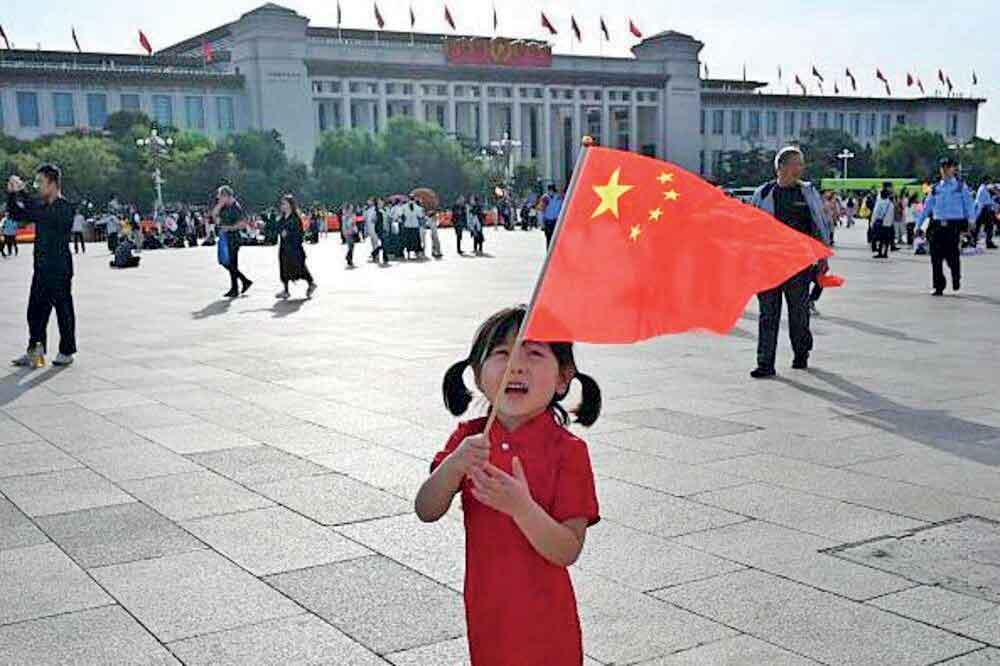
A symbol of pride: Modern China embraces its turbulent past as it stands as a world power, yet the scars of the ‘century of humiliation’ remain fresh in the collective memory

China’s rise to prosperity and the place it holds today as a world power is spectacular. But the road was long and hard. When Chinese President Xi Jinping talks of a ‘century of humiliation,’ he is referring to the chaos that Mao and his followers inherited after four decades of civil war.
But the struggle began long before Mao’s communists consolidated their power and established the People’s Republic of China in 1949. There was another ‘Long March’ which laid the founding stone of Mao’s achievement long before China began its long march to economic prosperity with Deng Xiaoping’s reforms in 1978. But we shall first look at the ‘century of humiliation’ which has left such an impression on China’s current leadership.
China’s Qing dynasty, established by Manchu invaders in 1644, lasted until 1912, when the Xinhai Revolution of October 1911 led to the abdication of the last emperor in 1912. By the 19th century, Qing power had waned, and Foreign colonial powers like Britain, France, Germany, Russia and Japan forced their way in, forcing China to sign unequal trade and territorial treaties. This was known as ‘gunboat diplomacy.’ Britain dominated the opium trade and secured Hong Kong. Chinese opposition resulted in the Boxer Rebellion of 1901. But it was crushed, which meant more concessions for foreign colonial powers.
The towering figure of China’s struggle to get back on its feet is Dr Sun Yat Sen. He wanted to carry out sweeping land reforms through his nationalist Kuomintang party. But he was forced to give in to Yuan Shikai, a leading military figure in the struggle to end Qing Dynasty rule, so as to avoid civil war. Yuan Shikai became president of the Republic of China, and later declared himself emperor. But his rule was short-lived, and China descended into chaos after his death in 1916, divided and ruled by different military leaders in the ‘warlord-era.’
Chiang Kai-shek, who was to rule China from 1925 until the communist victory in 1949, was trained in Japan for a military career. There, he was converted to republicanism by young Chinese revolutionaries plotting to overthrow the Qing dynasty.
Returning to China, Chiang helped to overthrow the Qing, and then fought against Yuan Shikai. In 1918, he joined Dr Sun Yat Sen and his Kuomintang party. They faced the difficult task of re-unifying China now devided among a number of warlords.
Chiang was sent to study politics and military techniques in the Soviet Union. Back in China, he became commandant of the Whampoa military academy. The Chinese Communist Party was established in 1921, and it worked together with the Kuomintang. But tensions rose after Dr Sun’s death in 1925. Chiang didn’t like the communists’ popularity and growing power; he crushed them in 1927 by staging a bloody coup.
Chiang became head of state, heading a Nationalist government with its capital at Nanjing. Some of the warlords were neutralised, but the communists, who had withdrawn to the countryside, forming their own government and army, posed a threat. Chiang also faced an almost certain war with Japan. His reforms remained mostly on paper, and the Generalissimo (as he was now called) decided to give priority to crushing the communists instead of fighting the Japanese. In 1937, he was forced by the military to form an alliance with the communists against the Japanese, but he always saw Mao as his principal enemy.
Mao Zedong (born in 1893, at Shaoshan, Hunan province) was the principal Chinese Marxist theorist and statesman. Young Mao became converted to communism while working as a librarian at Peking University. But his rise to be head of China’s communists was gradual, and it took at least two decades before he became the revered ‘Chairman Mao’ of communist China.
What established him firmly as leader of the embattled communists was the Long March of 1934. This is the longest march for survival by an army recorded in history, and was well documented by American journalist Edgar Snow in his epic ‘Red Star Over China.’
Mao had waged successful guerrilla warfare against Gen. Chiang’s armies. Chiang, seeking to destroy the communist forces for good, encircled them with 700,000 troops in fortified positions. This caused starvation in communist-controlled areas, and hundreds of thousands perished. Mao was removed from his leadership position, but the conventional warfare tactics waged by the new leadership failed, and it looked as if the communists were doomed.
But in October 1934, 86,000 communist troops and 15,000 personnel managed to break through. They travelled 10,000 km, crossing 18 mountain ranges and 24 rivers, fighting much of the way for 368 days.
They marched mainly at night. Disaster struck when Nationalist forces blocked their route across the Hsiang River. After a week’s fighting, the communist army broke through, losing 50,000 soldiers. But Mao’s star was on the rise now, and he was made chairman again. He changed tactics, breaking his force into several columns, taking different routes, and forbade direct assaults on enemy positions.
After enduring starvation, aerial bombardment, and almost daily skirmishes with Nationalist forces, Mao and his 4000 survivors reached the foot of the Great Wall of China on October 20, 1935, where they met friendly forces.
Mao’s idea was to focus on fighting the Japanese, and this strategy worked. Youth from all over China came to join his forces. Gen. Chiang held back his forces, expecting the Americans to fight the Japanese army in China once the US entered World War II, conserving his army to fight Mao’s communists when the Japanese were defeated. The US offered cash, material and air support, but didn’t fight a ground war in China. This made Chiang unpopular with the populace. He was even once held hostage for a few days by a general who disagreed with his policy.
As World War II ended with Japan defeated, China’s civil war resumed, but most Chinese now had more faith in Mao and his communists than in Chiang. In 1949, Gen. Chiang Kai-shek conceded defeat and retreated to Taiwan.
China was now once again united as one country with a stable government, but the road to recovery was still fraught with many obstacles and disasters over the next four decades – direct involvement in the Korean War, the great famine, the chaos of the Cultural Revolution, and the power struggles which came in the wake of Mao’s death.
But the place it has now in the world, directly challenging two centuries of Western hegemony, is a tribute to the resilience of its hard-working people and the vision of its leaders.
13 Jun 2026 50 minute ago
13 Jun 2026 55 minute ago
13 Jun 2026 3 hours ago
13 Jun 2026 3 hours ago
13 Jun 2026 4 hours ago