06 Nov 2025 - {{hitsCtrl.values.hits}}
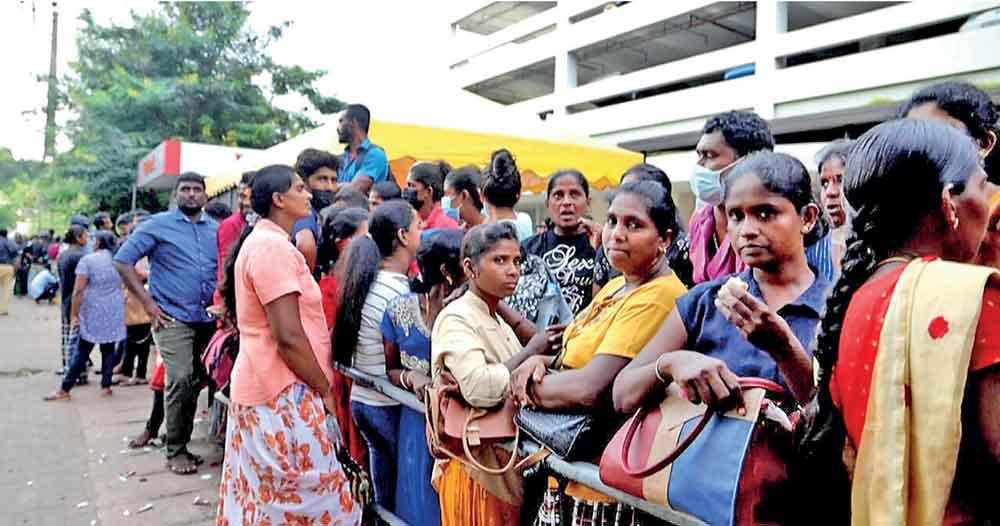
Forming a proper queue is the starting point of accountability
 The incident I am going to relate now may seem unrelated to what follows. But it is related to the theme of this week’s column – the chronic lack of accountability that Sri Lankan society suffers from. Its moral compass is spinning wildly out of control.
I went to the post office to post a registered letter. There was a young man ahead of me. I stood behind him, forming a queue. A young woman came rushing with a big bundle of letters. Not even noticing the queue, she gave the bundle to the postal clerk, ‘do these for me, I’ll be back.’
From the way she spoke, you could see knew the post office staff. The postal clerk interrupted what he was doing to take her bundle, chatting to her all the time. The two of us in the queue were getting ignored.
Just then, a bespectacled man in his forties came in. He moved straight to the counter, ignoring the queue. The young man before me left, and the clerk looked at me. But the bespectacled man who had crashed the queue thrust his letter over the counter, and the clerk took it.
I opened my mouth to protest, but held back. I’ve been through this in queues so often, and you get tired at some point of protesting. I bought my stamps and followed him to the next counter where letters were registered.
There was another customer ahead of the two of us. The man looked at me and smiled. As he looked intelligent, and friendly, I decided on a different approach.
“They are trying to reform the country,” I said, referring to the government’s anti-corruption drive. “But first of all people must learn to respect a queue. Look at that woman who barged in with a bundle of letters!”
I tactfully left out his own intrusion, as I wanted to see what he had to say. His reaction came as a shock.
“She came ahead of you,” he snapped back, putting the blame squarely on me. I told him angrily that I was there before either of them. I don’t want to start arguments in public places, but I felt a great sense of injustice here. “You acted wrong as much as she did.”
The anger was genuine and that made him retreat. He asked me if I wanted to move ahead of him. I told him to go ahead, now that he was at the counter anyway.
In this case, the postal clerk who accepted the letter/letters of a queue breaker too, is at fault. It was his duty to warn queue breakers. Anyone would tell me now that this sort of thing happens every day, and not even worth discussing.
But we have to take note, because these things don’t happen in civil societies such as Malaysia, Singapore, South Korea and Japan. People simply don’t jump queues as it would provoke condemnation. This is where the moral compass starts swinging. Glancing at newspaper headlines over the past few days, I can find more alarming examples.
A woman lawyer arrested for aiding the woman who allegedly handed over a weapon inside the courts to an assassin; a former police HQI disappears after he is wanted for questioning about the loss of a case-property firearm; arrest warrant for a MP who fails to appear in court over a financial issue; a medical officer took 18 unauthorised foreign trips, a teacher arrested after touching the chest of a schoolgirl, and two fishermen dead after drinking from a bottle found floating in the sea! (These are ongoing cases except for the deaths of two fishermen, which is self-inflicted. Accused are innocent till proven guilty by a court of law, and there is no assumption of their guilt in this writing. I’m simply taking them as examples because such cases have become the norm. Our news is flooded with similar stories every day).
Though seemingly unrelated, these stories have a common thread – about people breaking the laws in different ways. Now, one could argue such things can happen in all countries.
I am not in a position to comment about all countries. But I have access online to newspapers and digital media from the South East Asian countries I cited above – Malaysia, Singapore, South Korea and Japan. Crime exists everywhere, and accidents happen. Weird behaviour exists. But I have not found stories of this nature in the media of those countries in the same ratio.
Dysfunctional society
All this points to a high dysfunctional society. We can find similar societies elsewhere, but that is not something to cheer about. It was reported recently that one third of candidates for Phase One assembly polls in the Indian state of Bihar have criminal cases. Twenty seven per cent of these are serious cases such murder and crimes against women including rape.
Bihar is one of the poorest states in India, and the above fact does not mean that it is representative of the whole of India, not any more than the cases cited above represent the whole of Sri Lanka. But, in both cases, they point to a degree of malfunction. Sending people with criminal records or ties to criminals as elected representatives to parliament has been an ever present factor in our politics since the 1980s. But this doesn’t mean that it’s right or acceptable. It’s a malfunction that not just the government and legislators but voters too, must try and put right.
This is not just a matter of education. All of the cited cases are about people with varying levels of education. Even the two fishermen, it can be assumed, have had a basic education given the high literary rate of Sri Lanka. It is a special case because it’s an example of personal irresponsibility of the highest order – drinking the contents of a bottle found floating in the sea. But it is also lack of accountability – first to oneself, and then to one’s social circle. It shows a disturbing lack of common sense and logical thinking. By this argument, every else cited show the same shortcomings, whatever their education levels and social standing, and that includes queue
breakers, too.
08 Jul 2026 18 minute ago
08 Jul 2026 25 minute ago
08 Jul 2026 38 minute ago
08 Jul 2026 46 minute ago
08 Jul 2026 1 hours ago