22 Apr 2026 - {{hitsCtrl.values.hits}}
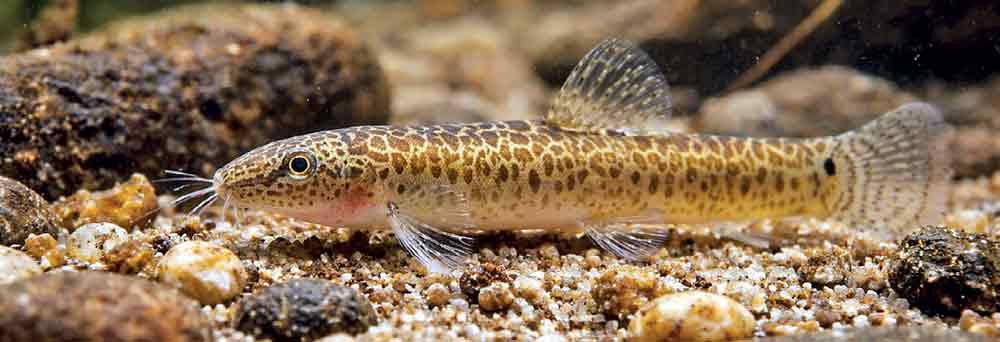
Jonklaas’s Loach

By Anik Jayasekara
 In some Sri Lankan streams, what disappears first is not the water, but our understanding of what still lives there.
If you have ever stood beside a small stream, you will know how quickly this seems to make sense. A glance is usually enough.
Clean or not. Live or ordinary. Worth noticing or not.
We do this without thinking. It feels reasonable.
Small streams encourage it. They look complete. A little water, a few leaves, and everything appears to be in order. But a stream is not complete. It is a process. Each moment, it is quietly deciding what can live there, and what cannot.
And sometimes, within that quiet decision, there is a fish most of us have never heard of.
Jonklaas’s Loach is a small freshwater fish found only in Sri Lanka. It lives in places that rarely draw attention, and even when we know it is there, it is not easy to see. Not because it is rare in an obvious way. But because it belongs to a part of the living world we have, quite naturally, learned not to notice.
Why this situation is unusual?
Some species are visible enough to explain themselves.
This is not one of them.
Jonklaas’s Loach is currently listed as Critically Endangered and protected under national law. That suggests recognition. But it raises a quieter question. What does it mean for a species to be recognised, yet largely unseen?
For this fish, public existence comes through records, assessments and decisions built on them. It exists through description. And once a description settles, it may not always change at the same pace as the stream itself. Sometimes, it simply remains convincing.
Where public understanding starts to fray
What is clearer than its behaviour is where it lives.
Shallow, shaded streams. Slow flow. Leaf debris. Places that do not draw attention. These are not just locations. They are conditions.
Small, easily disturbed conditions that allow a stream to keep doing what it quietly does – filtering water, regulating flow and supporting life.
Most of us do not think about streams this way.
We think of water moving between places.
Which means changes in the conditions that make a stream function can be easy to miss. A species like Jonklaas’s Loach depends on those conditions being intact. Which is why it matters.
Because a stream that can support it often retains key ecological conditions that matter beyond this one species. And those conditions can support processes people rely on, often without realising it. Yet the way we talk about these systems flattens this connection.
A species is ‘threatened’. A system is ‘under pressure’. It sounds complete. Often, it is not. The pattern may be visible. The detail may not. And when detail fades, something subtle happens. We begin to feel more certain than the situation allows, and more disconnected from what is actually at stake.
Grounding in Sri Lankan reality
Many of Sri Lanka’s threatened freshwater species live where people live. Streams pass farms, roadsides, settlements. They are used, managed and changed over time. From the surface, little appears different. Water still flows. The stream still looks like a stream. Which is exactly what makes change difficult to notice. Because by the time it becomes obvious, it is rarely just one species affected.
Expert tension zone
If a species is protected and critically endangered, what do we assume is already in place?
That threats are understood?
That habitats are mapped?
That monitoring is current, and close enough to detect change?
But how often are these assumptions tested? What part of what we “know” comes from present observation, and what part rests on older assessments? Are threats specific to this species, or drawn from broader freshwater patterns? And at what scale are these conclusions made?
Because a freshwater species does not experience a river as a map. It experiences a few metres of stream.
Are we observing at that scale? If not, what might we be missing? If understanding is uneven, what decisions are already being made on that basis? Where do the scales of decision-making and the scales of life begin to diverge? What is measured, and what remains unseen?
At what point does change appear in data, and how much has already shifted by then? If attention is limited, what goes unnoticed? Not by design, but by absence.
And when many roles shape the same system, how are trade-offs between livelihoods, land use and ecological stability actually balanced?
A stream can look unchanged. But what, exactly, is changing within it?
These questions are not raised to assign fault. They reflect systems where knowledge, observation and decision-making do not always move at the same speed.
Why this matters beyond the fish
This is not only a story about a fish. It is a story about how understanding forms, and hardens.
What gets written is repeated. What is repeated becomes assumed. What is assumed begins to guide decisions.
A system can remain physically present while our understanding of it quietly falls out of date. Sometimes, the first thing to degrade is not the system. It is the accuracy of what we think we know.
How the pieces begin to connect
Imagine yourself as a triangle. Your knowledge. Your skills. Your experience. At the centre, your conscience.
On our own, these triangles point in different directions.
A researcher studies data. A farmer observes change. A planner balances land use.
A teacher explains. A community lives with the system.
Each sees something real. None sees all of it.
Which means the system does not fail all at once. It fragments.
SriLankasEndangered.com’s Unity Icon is not about uniformity.
It is about alignment.
When even one part of each triangle turns towards the same purpose, something shifts.
Observations move sooner.
Insights reach decisions earlier.
Small actions begin to overlap.
And when they do, the system responds. Conditions stabilise. Risks reduce. Systems continue to support what depends on them.Helping the stream is not separate from helping people.
It is the same system, seen from different angles.
If this article raises a question, correction or perspective from research or lived experience, you are welcome to help refine the public record here.
www.srilankasendangered.com/respond
(The writer is the current platform steward for www.SriLankasEndangered.com)
(This article is part of a public interest initiative, SriLankasEndangered.com, which works with practitioners to improve public understanding of Sri Lanka’s ecosystems, one story at a time. The project publishes open, evolving features designed to invite expert input rather than close debate, and operates independently of political parties and electoral agendas)
04 Jun 2026 28 minute ago
04 Jun 2026 50 minute ago
04 Jun 2026 52 minute ago
04 Jun 2026 59 minute ago
04 Jun 2026 1 hours ago