28 Mar 2026 - {{hitsCtrl.values.hits}}
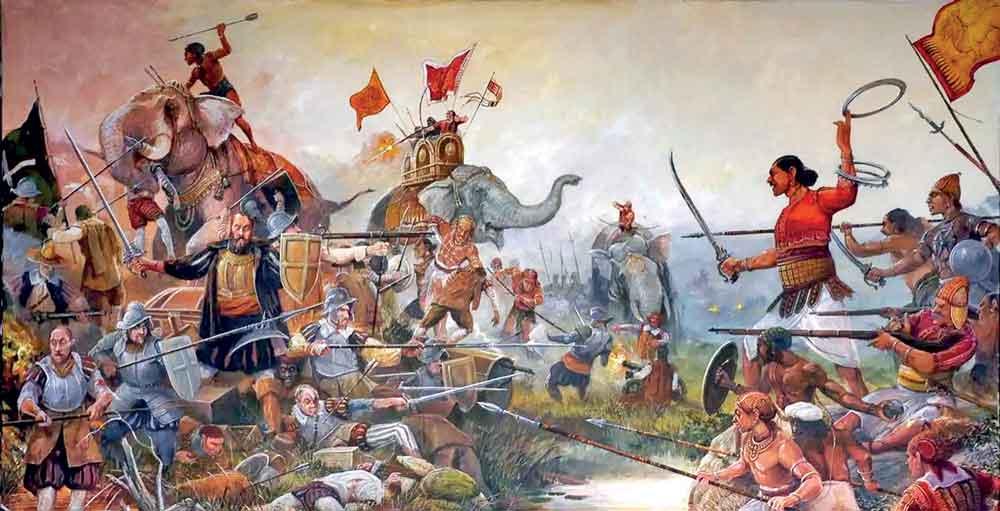
An art by Prasanna Weekakody
 We have seen how Constantino de Sa, perhaps the ablest Portuguese captain general to serve in 17th century Sri Lanka, lost both his life and his army at Randeniwela in 1630. This disaster put an end to Portuguese dominance of the island, though not of Portuguese rule. But the Portuguese dream and avowed policy of conquering the Kingdom of Kandy, and thereby the whole island, never wavered.
While Portuguese military power was considerably weakened by the loss of an able captain general, with more than 600 Portuguese killed, and the desertion of several thousand lascarins, King Senarat was unable to take the Fort of Colombo. The statement therefore continued. By 1632, however, the king was willing to consider peace due to Portuguese successes on land and sea. The Kandyans had been at war for five long years. Even salt was in short supply in the Kandyan Kingdom due to Portuguese blockades. Senarat’s ally Dom Theodosio, who had defected to the Kandyans with his lascarins at Randeniwela, had rejoined the Portuguese.
|
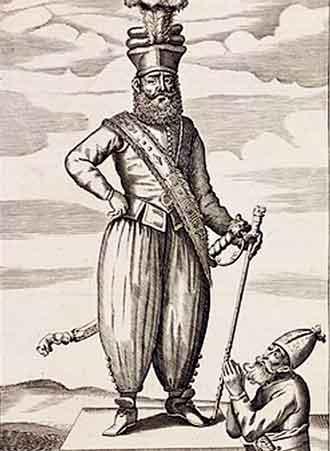
King Rajasingha II (1608-1687) |
But the new draft treaty of 1933 was unfavourable to Senarat, and he rejected it. But the Portuguese too, were now under pressure elsewhere – In India, the Mughals attacked their fort at Hugli in 1632, forcing them to abandon it, and the Dutch captured five Portuguese ships in 1633. When Diego de Mello de Castro arrived in Colombo on November 22, 1633 as the new captain general, the Portuguese were again in favour of war, as holding on to the island was now of paramount importance.
De Mello lost no time in attacking the Kandyans. He put together an army of 400 Portuguese, 1000 Kaffir and Canarese (African) soldiers, plus 5000 lascarins. While the Sinhalese had 16,000 men under Maha Astana (as Senarat’s younger son was known) and Vijayapala (the elder son), but De Mello seized their stockade at Moratenna. The final result was a drawn battle, and Maha Astana who was now king of the Kandyan Kingdom was forced to ratify the unfavourable draft treaty drawn up at Goa, a political victory for the Portuguese. The treaty was signed by Maha Astana, who now called himself Rajasinghe.
This led De Mello to believe that, though the Kandyans were weak, they would resort to war before long. He knew too, how the Dutch were keen to seize the island’s cinnamon trade. He was in favour of war. But opinion in the Portuguese camp was divided on this issue. Many senior officials including the vedor, ouvidor and captain of Colombo thought it would be wiser not to attack Kandy. Kotte remained rebellious, and rebels could threaten Portuguese supply lines when an invasion of Kandy was launched. But De Mello argued that further waiting would weaken the Portuguese position. In this, he was backed by his captain-major. Re-inforcements received from Malacca were due to leave soon. He argued that the Dutch would not attack Colombo and other Portuguese forts without help from Kandy. Therefore, subjugation of the defiant kingdom was the logical choice.
King Rajasinghe tried diplomacy when he learnt about Portuguese plans to invade Kandy. He admitted his Dutch contacts, but blamed the Portuguese for this state of affairs, and declared his intentions for peace. This could have been a delaying tactic, but Rajasinghe sent an Augustinian as negotiator for good measure. De Mello remained unconvinced, and decided to strike an alliance with Rajasinghe’s brother Prince Vijayapala. Such ‘marriages of political convenience’ were common throughout the 16th and 17th centuries on the ‘my enemy’s enemy is my friend’ realpolitik basis.
Vijayapala’s support was crucial since De Melo had only 700 Portuguese soldiers. He had 400 Kaffirs (Africans) and two hundred Canarese, too, but the total was only 1300. Today, the distance to Kandy (112km by road) from Colombo seems insignificant. But there was no constructed road from Colombo to Kandy in the 17th century. Invaders had to take a longer, meandering route through landscapes which blessed the defenders with thick jungle, streams and mountain passes. It was ideal for guerrilla warfare, and Portuguese artillery which was the fulcrum of their military strength proved to be cumbersome and of limited use in this kind of warfare. As British writer Raven Hart noted in his ‘Ceylon: History in Stone,’ the Portuguese had developed a healthy respect for Sinhalese arrows. They always had more muskets than the Kandyans, but arrows could be accurately shot from the same distance through jungle cover, nullifying Portuguese firepower. The flanks as well as the supplies and rear guard of any invading army was always very vulnerable in such hilly terrain.
This is why the 5000 lascarins were so important. But their loyalty was always in question; De Sa lost his army and his life when his lascarins deserted at Randeniwela. The planned invasion called for every available soldier in Colombo, leaving sailors of the fleet to defend the fortress. He had no reserves left.
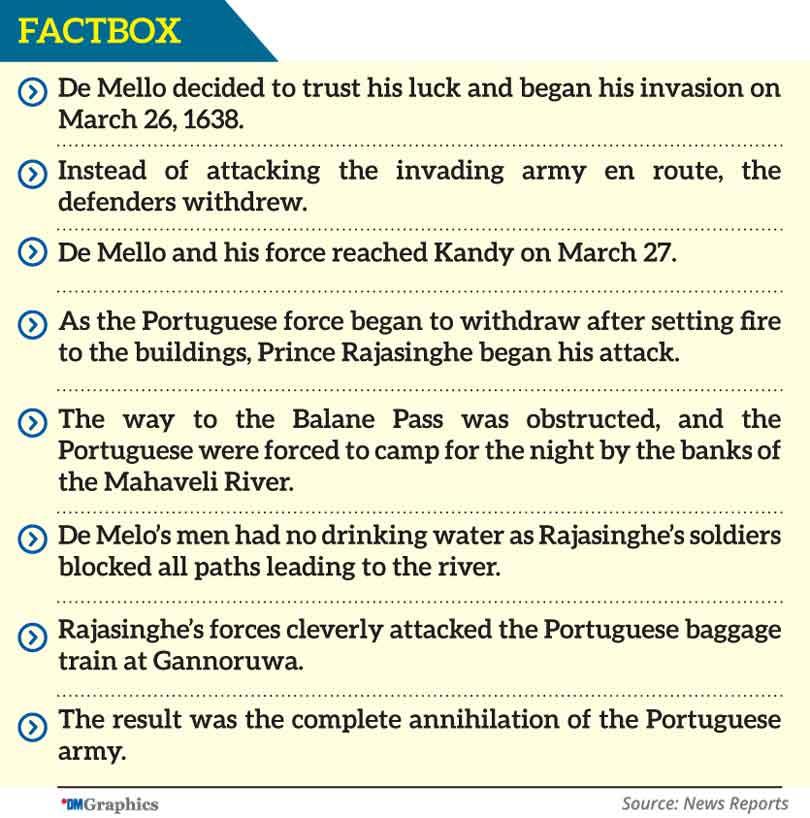
But De Mello decided to trust his luck and began his invasion on March 26, 1638, leaving the Portuguese headquarters at Attapitiya. Instead of attacking the invading army en route, the defenders withdrew, and De Mello and his force reached Kandy on March 27. Prince Rajasinghe had laid his trap brilliantly. As the Portuguese force began to withdraw after setting fire to the buildings, he began his attack. The way to the Balane Pass was obstructed, and the Portuguese were forced to camp for the night by the banks of the Mahaveli River (This location can be seen from the Peradeniya Botanical Gardens). De Melo’s men had no drinking water as Rajasinghe’s soldiers blocked all paths leading to the river.
The next day (March 28, 1638) De Melo sent a message saying he was open for peace talks. But Rajasinghe’s mood had changed. He now had 15,000 men surrounding the Portuguese (including 1000 soldiers from Madura, India), outnumbering it roughly three to one. Vijayapala opted not to help De Melo, as the latter expected. Luck wasn’t on the Portuguese side that way. It rained hard before the battle, making it harder to load and fire their muskets and canon. Rajasinghe’s forces cleverly attacked the Portuguese baggage train at Gannoruwa, cutting their army in two. As the desperate Portuguese tried to reform, the lascarins deserted. They could see the writing on the wall. The result was the complete annihilation of the Portuguese army, with both De Mello and his captain major Batado killed.
Historian C. R. de Silva writes that Gannoruwa was an even bigger disaster for the Portuguese than Randeniwela in 1630. There, De Sa’s army was a long way away from their bases. But in 1638, they were wiped out just 30 miles from their headquarters. Also, in 1630, King Senarat was keen on taking as many Portuguese prisoners as possible as a negotiating card. He took 200 Portuguese as prisoners. But at Gannoruwa, Rajasinghe had burnt his bridges. There were only 38 survivors taken prisoner.
This battle altered the balance of power between the two sides. For the first time, a Portuguese army had been defeated before the lascarins deserted. The Portuguese never recovered from this disaster and never took the initiative again. But Rajasinghe, lacking naval power, had to woo Dutch help to drive the Portuguese out of Sri Lanka, and that’s another story.
02 Jul 2026 32 minute ago
02 Jul 2026 59 minute ago
02 Jul 2026 2 hours ago
02 Jul 2026 2 hours ago
02 Jul 2026 2 hours ago