23 Oct 2025 - {{hitsCtrl.values.hits}}
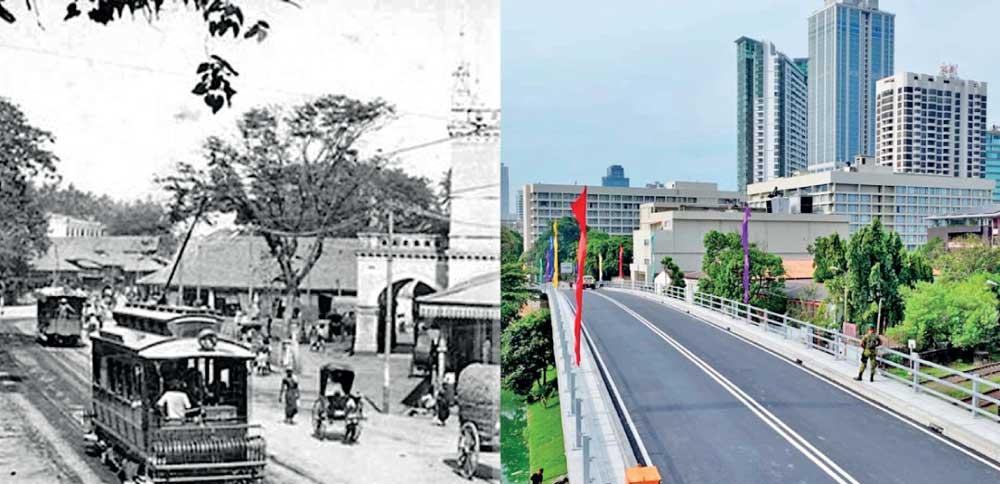
Sri Lanka’s economic development has continuously been sub-par throughout its independent history, despite relatively decent performance in human development indicators
Recent rave social media reviews by Indian visitors about Sri Lanka, especially about our roads and civic sense, might make a Sri Lankan blush. One should agree that such assessments are a subjective experience. But there is also a genuine appreciation, though South Asians in general are good at trash-talking their own countries.
 Also last week, World Health Organization Director General Tedros Adhanom Ghebreyesus, who was in Sri Lanka, lauded the island nation for maintaining social indicators on par with high-income countries, well above its low-middle-income status.
At the same time, Janatha Vimukthi Peramuna (JVP) and NPP tell us that a 76-year curse has ravaged the country —that is, all years since independence minus the one it now presides over the government. Since nothing substantial has been built in the past year, which is indeed too short a timeframe to make a tangible difference, it is fair to say that whatever achievements of human development and basic infrastructure were secured during those ‘76 years of curse.’ Also, interestingly, it is not just the card-carrying JVPers who subscribe to the idea of a ‘ curse’. Some of its most vocal critics of the JVP, too, do—but they view the JVP as the worst curse.
This brings us to ask ourselves whether this loathsome notion of a 76-year curse is real or perceived. And whether it is relative or absolute? And whether it was a collective national experience or a subjective personal political opinion? Perhaps more importantly, whether it was a curse by the people themselves, political parties, or armed groups — be it the JVP, LTTE, UNP, or SLFP (and all its later political manifestations) or whether it is by and large a product of a set of ideas and ideologies?
It is not difficult to agree that, despite its relatively decent performance in human development, Sri Lanka’s economic development has continuously been sub-par throughout its independent history. The average GDP growth rate during the first four decades was 4%. It was around 5% during the Chandrika Kumaratunga presidency (1995-2005), and the only time the country maintained a decent rate befitting an emerging market economy was during the Mahinda Rajapaksa presidency (6.5% annualised growth during 2005-2014), also while fighting a war during its first half. Yet, many observers raise concerns about the source of economic growth during that period, which was primarily due to state-driven infrastructure development funded by foreign loans. They also note the broader macro-economic rout during the corresponding period, such as the perilous decline in tax revenue as GDP%, which hit below 10% by the end of his term, and stagnation of the export basket and decline of exports as GDP%—All the maladies that culminated in the economic collapse in 2022. Yahapalanaya destroyed whatever semblance of growth momentum the Rajapaksa era had, and Gotabaya kicked it down the precipice. A swell of mass disgruntlement and a protest vote brought to power the JVP, which had burnt more buses and post offices than any single government had ever built.
However, Sri Lanka’s economic performance appears as exceedingly depressive- hence the self-loathing notion of a 76-year curse—because Sri Lankans tend to compare it with a small group of top economic performers in the past century—Singapore, South Korea, Hong Kong, Taiwan, and to some extent, Malaysia and Chile. And most of them—Singapore, Hong Kong, and Malaysia — were not desolate, mosquito-infested backwaters then, as some tend to portray them now to fit the growth narrative. They were thriving economic outposts with superior colonial management, well ahead of Sri Lanka when they received independence.
However, if you analyse Sri Lanka against the rest, its performance is average. But, it is still disappointing for we had an economic base and better human capital to leapfrog in development like these few countries did, but we failed.
This brings us to who might be responsible for this relative curse? The JVP is often cited, but its most destructive impact on the country had only a fleeting existence before it was crushed on both occasions. The first in 1971 did not matter much because Sirimavo, with her ruinous quasi-socialist experiment, destroyed the economy anyway. On the second occasion, the brutal crackdown of the JVP could have been turned into a catalyst for economic growth, as Augusto Pinochet or General Suharto did after similar bloody crackdowns. But the contours of multi-party democracy undermined that potential stimulus.
The LTTE and, to some extent, Tamil militancy until the Indo-Lanka peace accord are surely major contributors to the curse. By any conservative account, 25 years of LTTE terrorism deprived the country of 2 per cent of annual growth for two and a half decades. That would mean even with all its other ingrained ideocracies, Sri Lanka could have reached an economic development level on par with Malaysia had it not been the nihilistic terrorist campaign of the LTTE. That should also be a cause for reflection for those like President Anura Kumara Dissanayake, who says he rules, ‘unlike the others, not expecting war’. In fact, others from D.S. Senanayake, to J.R. Jayawardene, believed so until they were taken off guard by militancy. If Sri Lanka is to succeed and be secure, it needs a well-maintained military force and an efficient domestic and foreign intelligence agency.
This brings us to the ideas and ideologies. Even the LTTE is a manifestation, not particularly of a well-established set of grievances, but of a set of hyper-political aspirations ingrained in a Dravidian socio-political culture. That might make one believe part of Sri Lanka’s ‘curse’ or the strength, as some would like to view it, is in its demography- this isn’t the most politically correct articulation of the problem. Still, even good Samaritans in Sweden are now scratching their heads in bewilderment when it was revealed that 30 per cent of its population would be Muslim in 2050 (under a heightened immigration scenario).
However, the LTTE did not exist until 1980. Yet, the first three decades of Sri Lanka’s independence were also its most wasted era. That was when the country had the opportunity to leapfrog in economic growth from a lower base level, as every other successful nation did. Whose fault was that we squandered the opportunity? Integrity of leaders? Like it or not, Sri Lankan political leadership until 1978 was among the least corrupt, in any comparison with their international peers. Without their vision for an equitable society, the country would not have the current achievements in human development, or free education and universal health care. However, almost all of them were guided by a self-righteous conviction to a ruinous economic model: socialism and economic autarky in many forms. And they dabbled in a well-intentioned social engineering process in the hope of rapid mass empowerment. But, they often choose the simplest solutions and easiest path to that end, and sacrifice some of the country’s strengths, such as dethroning the English language. The outcome they produced was the exact opposite of their expectations. Sometimes, it was the most well-intentioned ones, such as S.W.R.D. or Sirimavo, who did the most harm. Every term of the SLFP government was an economic rout. The successive UNP leaders were more free-market oriented, but lacked the conviction and sense of urgency that their counterparts in East Asia had. They were also restrained by mass sentiments unleashed by the left and the SLFP. Now, you could see why all successful economic achievers of the second half of the last century (and even now) were one-party states, and largely autocracies or dictatorships. Even China and Vietnam, the other two high-growth states of modern times, are institutionalised autocracies.
The JVP, unfortunately, follows the same arcane economic model that contributed to the country’s relative loss of economic prosperity. It is rolling back even the most commonsense reform, such as in the CEB. Peel out the slogans, its economic policies lack a vision or conviction. The JVP, a party that was part of the curse, and ideologies that were the central evil of Sri Lanka’s economic rot, form a morbid combination. That is something every Sri Lankan has to be worried about.
Follow @RangaJayasuriya on X.
07 Jul 2026 11 minute ago
07 Jul 2026 24 minute ago
07 Jul 2026 30 minute ago
07 Jul 2026 58 minute ago
07 Jul 2026 1 hours ago