23 Apr 2026 - {{hitsCtrl.values.hits}}
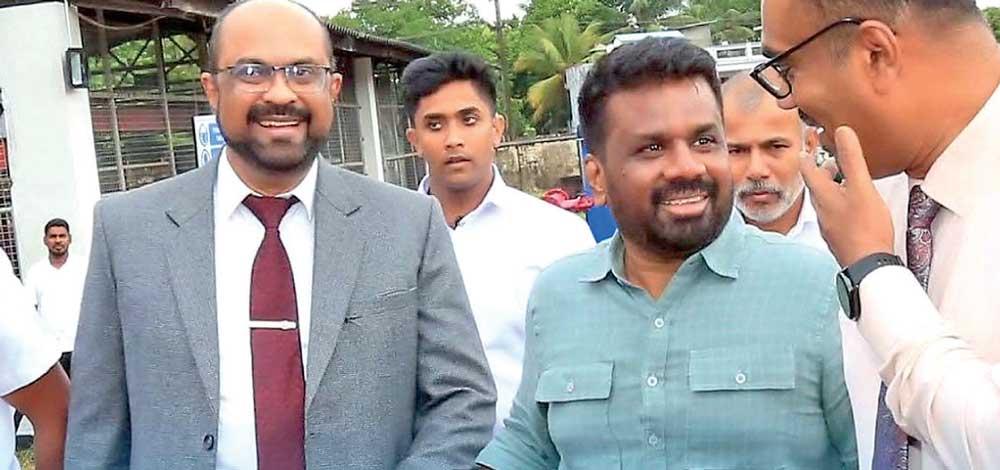
Energy Minister Kumara Jayakody (picture left) has resigned, but his case remains a benchmark test for the NPP government
Flaws in procedures in procurement of 14,000 carrom boards and 11,000 checkers (Damm) boards landed former Sports Minister Mahindananda Aluthgamage and former Sathosa Chairman Nalin Fernando in jail last year. Would a similar scenario take place in the case regarding the coal procurement controversy, landing Kumara Jayakody, the Energy Minister of the National People Power (NPP) government, in prison?
Government ministers have been arguing that no procurement procedures have been violated during the recent coal purchases, and no losses have been incurred by the state, despite several shipments of coal having been found to be substandard by Lanka Coal Company (LCC) (PVT.) Ltd, the state-owned company that is established for the supply of coal for the only coal-fired thermal power plant in Sri Lanka, the Lakvijaya Power Plant in Norochcholai.
The current coal controversy has become a godsend for the leaders of the Opposition parties and the majority of mainstream media that have been eagerly awaiting the NPP to mess up things as it is a novice in governance. They have been gunning for the head of Energy Minister Kumara Jayakody from the very first day they got wind of coal being sub-par.
On top of that, Energy Minister Kumara Jayakody was indicted on March 27 in the Colombo High Court, reportedly on charges relating to financial misconduct -- causing a loss of more than Rs. 8.8 million to the Government while he was serving as the Procurement Manager of the Lanka Fertiliser Company ten years ago.
We might see weekly Cabinet reshuffles if government ministers should resign their posts or the President should sack them whenever Opposition parties demand to do so. However, if the Commission to Investigate Allegations of Bribery or Corruption (CIABOC) files charges against a minister, a government bragging about its moral high ground should act, unless the minister concerned did not resign.
The president’s argument
When journalists questioned about the allegations against Minister Jayakody over his alleged actions at the Fertiliser Company, President Anura Kumara Dissanayake recently argued that if a minister is found to have misused his ministerial powers he would be sacked immediately, indicating that actions would not be taken against Jayakody for his past actions.
In fact, there is a point in it. If a man is rehabilitated or reformed, he should not politically be penalised for his past, though law might take its course. However, the President cannot give an assurance to the country that one is really reformed and the NPP should prove that it is a principled party. Hence, Jayakody should have been removed from the Cabinet, at least once he was indicted.
In the coal procurement case too, the Auditor General cited several flaws in her special report on coal procurement, in spite of ministers assuring in public that no procedure has been violated. Nevertheless, the government deserves credit for this audit report as it is said to have been compiled at the instance of the government through the Committee on Public Enterprises (COPE). Auditor General Samudika Jayaratna in her report stated that she too, had already intended to conduct an examination on the allegations on the matter.
The publication of the audit report should have been another opportunity for the minister to resign as the findings of the report casts doubts on the procedure. Yet, he did not avail it.
However, he rightly resigned or was made to resign along with the secretary of his ministry, Professor Udayanga Hemapala on April 17, the day President Dissanayake appointed a Special Presidential Commission of inquiry to investigate into the alleged irregularities in the coal import process. The three-member fully fledged Commission headed by Supreme Court Justice Gihan Kulatunga would inquire into the coal purchases from 2009, covering the tenures of Presidents Mahinda Rajapaksa, Maithripala Sirisena, Gotabaya Rajapaksa, Ranil Wickremesinghe and Anura Kumara Dissanayake, up to 16 April 2026.
The commission’s mandate
The extension of the mandate of the commission covering the whole period from the inception of coal-based power generation in Sri Lanka, instead of covering the current controversy, is being interpreted by various people in various ways. According to some, the NPP has a mandate to inquire into all corruption and frauds committed during past governments while some others view this as a retaliation against those who criticised the Dissanayake government over the current coal purchase. In fact, despite the Opposition being successful in pressurising Minister Jayakody to resign, the commission process will definitely put many opposition politicians who have been lashing out at the NPP in a fix, as allegations have been levelled against their governments over many issues pertaining to coal procurements. Their own statements made in the past over irregularities in coal procurements are being circulating these days in social media.
Now, they are morally obliged to legally substantiate their arguments regarding the purported flaws in the procedures followed by the current government in importing coal. That, to a certain degree, would be easy for them as many issues they raised have been raised by the Auditor General as well in her report. However, their attempt to morally destroy the NPP would be questioned when the commission starts to deal with the issues that cropped up in the past.
The Auditor General in her report says although an Indian company named Trident Champhar was selected under the long-term procurement to purchase coal for the 2025/2026 season, it had not confirmed its registration as a supplier by paying the registration fee before the due date. And it further points out that Mitra SK South Africa which was appointed by the coal seller with the consent of the LCC (the buyer) to inspect the standards of coal at the loading port did not have the accreditation to inspect coal samples. Yet, Mitra SK South Africa had issued reports for 12 shipments.
In another incident, Taranjot Resources (pvt) Ltd which was selected for an immediate purchase of coal on March 18, this year was a company that had failed to supply gross calorific value (GCV) of 5900 kcl/kg (kilo calories per kilogramme) in coal which is the minimum acceptable level, during the 36 months prior to its registration. These are some of the serious flaws found by the Auditor General appointed recently after a long delay.
Trade Minister Wasantha Samarasinghe in a televised discussion had stated that he did not accept some of the findings in the AG’s report. What he has ignored is that these are facts documented by the Cabinet, state institutions and state-owned institutions.
However, the government still has room to clear its name during the investigative process of the Presidential commission. Transport Minister Bimal Ratnayake stated that losses incurred by the state during coal purchases in the past emerged as profits in the pockets of politicians. Now, the onus is on the NPP government to prove that it was not the case this time.
19 Jun 2026 32 minute ago
18 Jun 2026 4 hours ago
18 Jun 2026 5 hours ago
18 Jun 2026 6 hours ago
18 Jun 2026 6 hours ago