04 Nov 2025 - {{hitsCtrl.values.hits}}
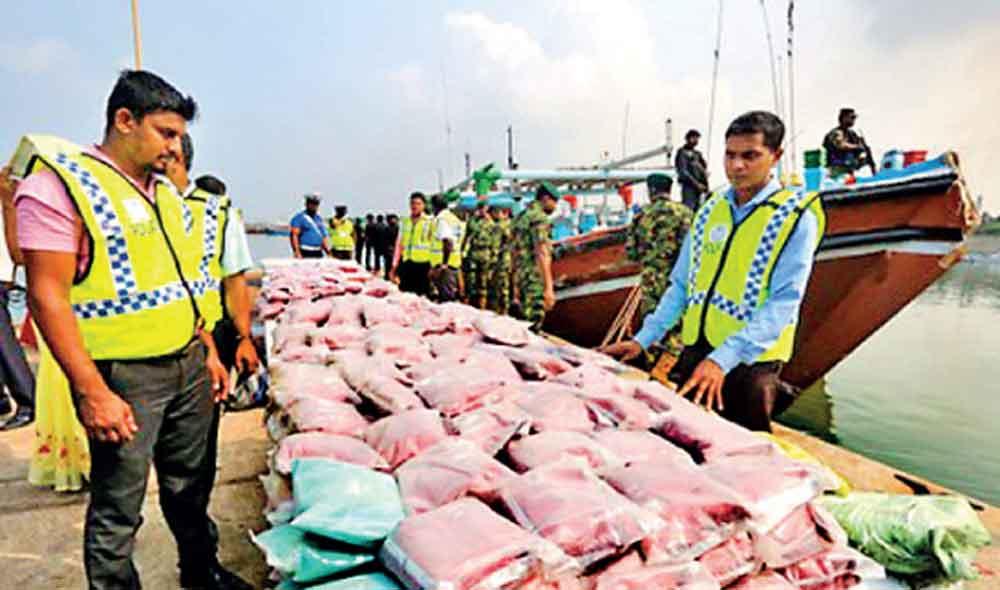
Despite large stocks being detected, narcotics are flooding the country
 President Dissanayake issued an ultimatum to police and military personnel involved in narcotics trafficking: resign immediately or face decisive action without protection. However, these treacherous officers are unlikely to voluntarily come forward. The President must exercise his executive powers to investigate and remove them from service.
Speaking at the Sugathadasa indoor Stadium during the launch of the ‘Nation United – National Drive’ anti-drug campaign, the President warned that a “black state” – a shadow network of corruption and organised crime – has infiltrated government institutions through years of political patronage.
In a shocking disclosure, he revealed that 38 T-56 rifles remain missing from army stockpiles and are now in criminal hands, with a senior army colonel implicated in selling ammunition for profit. Some immigration officers have issued passports to underworld figures, while police officers have sold their own weapons.
The President noted that annual drug seizures of 800-900 kilogrammes represent only a fraction of narcotics flooding the country, fueling a massive black economy and violent turf wars. He announced the establishment of a National Operations Centre coordinating all security agencies, declaring: “There cannot be two states in one country. This battle cannot be won by the government alone – everyone must unite.”
Global Drug Trade Kingpins
The world’s most powerful drug traffickers have built criminal empires worth billions through sophisticated international operations. These figures typically emerge from regions with weak governance, poverty, and strategic geography for drug production or transit routes.
Latin American cartels have dominated cocaine trafficking since the 1970s, controlling vast territories through extreme violence, corrupting government officials, and creating parallel governing structures. Some traffickers amassed fortunes exceeding $25-30 billion, ranking among the world’s wealthiest individuals while destabilising entire nations.
These organisations employ thousands, from farmers growing coca to chemists processing drugs, armed enforcers, corrupt officials, and sophisticated logistics networks. They’ve used commercial airlines, submarines, tunnels, and legitimate businesses as fronts. Some transported tons of narcotics daily at their peak.
Asian trafficking networks specialise in heroin and methamphetamine production, controlling the Golden Triangle and Golden Crescent regions. Middle Eastern and African routes have become increasingly important transit corridors.
Modern cartels operate like multinational corporations with hierarchical structures, diversified portfolios including human trafficking and extortion, and technological sophistication rivaling legitimate businesses. Their legacy includes hundreds of thousands of deaths, endemic corruption, addiction epidemics, and the erosion of state authority, precisely the “black state” President Dissanayake warned about in Sri Lanka.
Public confusion has arisen over the release of red-flagged containers, including two specifically identified by foreign intelligence agencies as containing narcotics or chemicals used in manufacturing methamphetamine and other dangerous drugs. They suspect corrupt elements exist within the state machinery and government.
Types of Narcotics and Their Harmful Effects
Drug enforcement authorities classify narcotics into seven major categories: central nervous system depressants, CNS stimulants, hallucinogens, dissociative anesthetics, narcotic analgesics, inhalants, and cannabis. Each category produces distinct effects on the brain and body, with devastating consequences for users and society.
Opioids and Opiates----Narcotics produce pain relief, stupor, and addiction. Over 100 types of opioids exist, including natural opiates from poppy plants (morphine and codeine), semi-synthetic derivatives, and fully synthetic compounds. Fatal overdoses are common, with signs including constricted pupils, cold clammy skin, confusion, convulsions, extreme drowsiness, and slowed breathing.
Increasing use leads to drug tolerance and physical dependence, addicts require progressively larger doses for the same effects, while withdrawal brings severe physical and psychological symptoms. In 2016, over 42,000 opioid-related deaths occurred in the United States, representing 66% of all drug overdose deaths.
Stimulants, Depressants and Inhalants---Central nervous system stimulants accelerate heart rate, elevate blood pressure, and increase body temperature, producing energy and euphoria. They significantly increase risks of anxiety, paranoia, and psychosis. Inhalants absorb rapidly into the bloodstream, giving immediate highs. Long-term use causes severe liver, kidney, heart damage, or cancer.
Recovery requires comprehensive treatment combining medical intervention, behavioural therapy, and strong family and community support.
How Developed Nations Overcome the Drug Menace
Developed nations have adopted comprehensive, multi-pronged strategies to combat drug trafficking, recognising that this challenge requires sustained international cooperation and integrated approaches addressing both supply and demand.
International Cooperation and Intelligence Sharing
Modern drug trafficking organisations employ sophisticated technology and communications equipment with increased mobility and anonymity, operating as versatile networks that cooperate intermittently while maintaining independence. To counter this, developed nations enhance collaboration among domestic law enforcement agencies and foreign counterparts to strengthen coordination of investigations and intelligence sharing. Countries exchange police information through international organiations including Europol, EMPACT, and Interpol, while maintaining rapid information sharing systems when new synthetic drugs appear on the market.
Many nations emphasise alternative development programmes as a major pillar of global efforts to curb the drug trade. For example, governments work to foster economic development as alternatives to drug crop farming, including developing rural tourism in regions traditionally dependent on cannabis cultivation. These initiatives recognise that addressing the root economic causes of drug production is essential for long-term success.
The United Nations Office on Drugs and Crime assists member states in developing national drug legislation, establishing legal frameworks of reference nationally, regionally, and globally based on three UN conventions on drugs. Nations employ economic sanctions and prosecute persons involved in activities linked to drug trafficking, such as arms trafficking, bulk cash smuggling, and gang activity.
Prevention and Treatment
UNODC promotes prevention strategies directed towards information and knowledge, particularly for youth, allowing them to develop capabilities and make decisions favouring quality of life. On treatment, international cooperation improves responses to drug abuse and dependence through information interchange between countries, using approaches that prioritise respect for human rights and users’ clinical, motivational, and social needs. Multi-year security assistance initiatives promote citizen safety and combat transnational criminal groups. Regional working groups share drug trafficking trends and coordinate investigations, while governments synchronise drug control with HIV prevention and treatment programmes.
Combating Money Laundering
Programmes combat money laundering associated with the illegal drugs market, recognising that disrupting financial flows is crucial to dismantling trafficking networks. Estimated organised crime profits from illicit activities including drug trafficking amount to significant portions of national GDP.
Conclusion
The fight against narcotics demands unwavering commitment from every sector of society through a two-pronged strategy. While police and law enforcement pursue traffickers and dismantle criminal networks, religious leaders, parents, and teachers must fulfill an equally vital role through counselling, mentorship, and early intervention to prevent students from experimenting with drugs and falling into addiction. This prevention approach is critical—as long as demand persists, new traffickers will continually enter the illicit trade to fill the void.
With the Katina season concluding and temples having collected sufficient funds, chief monks can now redirect their focus and resources toward this critical social mission. Only through collective determination, comprehensive rehabilitation, and sustained action can the nation reclaim its future from the grip of drug trafficking and protect generations to come.
[email protected]
21 Jun 2026 2 hours ago
20 Jun 2026 5 hours ago
20 Jun 2026 6 hours ago
20 Jun 2026 6 hours ago
20 Jun 2026 7 hours ago