06 Nov 2017 - {{hitsCtrl.values.hits}}
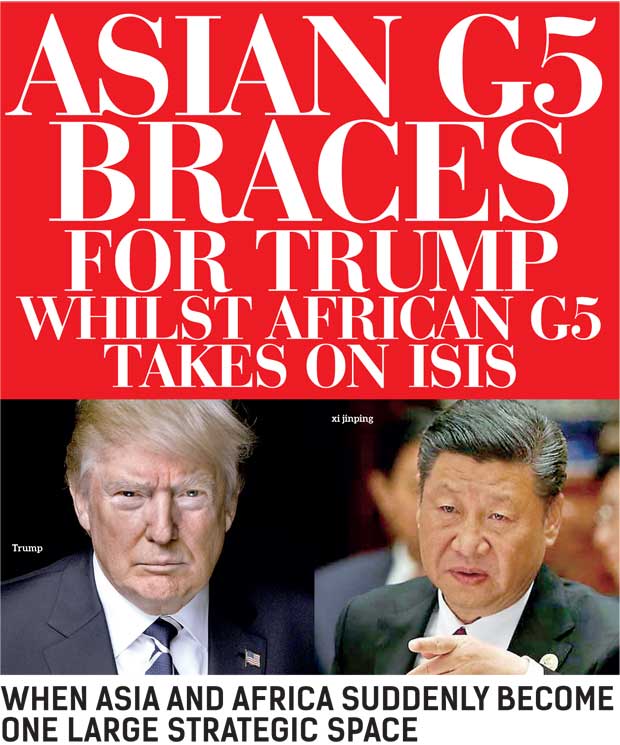
The hallmark of the 21st Century was that whatever stability and narratives that governed the 20th century started to unravel at unprecedented speeds. They also made people question the geographic categories or how geopolitical spatial markers of the 20th century needed
to change.
Thus Asia and Africa suddenly have become one large strategic space, a land and seascape that will clearly play a defining role in global affairs of the 21st Century.
Ahead of President Trump’s first visit to Asia since taking office as President of the United States, a massive American military buildup is taking place across Asia. Especially in the maritime domain with the United States navy deploying three supercarriers to the region.
Trump is set to visit five key strategic Asian states in the context of American foreign policy and security interests. A multitude of analysts argue that he is travelling to Asia with a relative position of weakness given his domestic political battles.
Especially with the intensification of the investigations of Russian collusion into the presidential elections of 2016.
Trump administration seems to be hoping that the unprecedented naval buildup in Asia parallel to the visit, will enable the United States to send a strong message to North Korea as well as China.
It will also be a reassurance to its long-term Allies Such As Japan and South Korea. Yet there are limits to military power and what actual display of weapons platforms can get you. Trump’s first stop in his five nation tour will be Japan, its premier Shinzo Abe has emerged victorious from a snap poll and furthermore his party has cemented a two thirds majority in the Japanese legislature (Diet), which will pave way for a reform of the 1947 Post War constitution of Japan after seventy years led by Premier Abe.
While the Japanese did warm up to Trump initially, Trump’s comments of Japan needing to do more to look after its own interests has irked many Japanese policymakers and public alike.
A key pillar in Japan’s national security policy is its relationship with the United States. Shinzo Abe’s election campaign drew heavily on the nuclear threat from North Korea and he also argued that Japan needed to adapt to the changing geopolitical and security environment. What he argued was that it was time for the Japanese to cease to be a pacifist nation. To achieve that Japan has to rewrite its constitution and get rid of Article 9 on the current constitution which prevents Japan from seeking a military solution to international conflicts.
Abe’s election pledge was woven around combining the threat from North Korea and underscoring the importance of a strong Japan amidst global uncertainties. Thus President Trump will possibly be meeting the longest serving Prime Minister of post-war Japan. Given the shaky political leadership Japan had prior to 2012, Abe’s leadership is providing the Japanese state with much needed political stability. The cost of this stability and implications of a constitutional reform which may change Japan’s security and strategic posture is yet to be seen.
At the moment Abe is on top buoyed by his victory. Trump will feel the heat from all five Asian leaders he will be meeting.
South Korean premier Moon and Trump’s approaches to North Korea are not complementary. Though South Korea is on a full military footing, Moon is keen to resolve the crisis diplomatically, thus Trump’s cavalier approach along with beefed up American military presence may not be the recipe that South Korea is seeking.
President Xi is not just the new president of China, he is morphing into a modern-day Chinese emperor. Trump had hard words on China and the question is can he push the Chinese leader to accept his terms when it comes to global trade, markets and
investment policies.
While Trump is bashing the existing global order and its institutions, Xi is spearheading grand strategy for China which encompasses both geopolitical gains and geo-economic interests. The belt and road initiative (OBOR) is a snapshot into a new China that has regional and global ambitions that are backed by a robust strategic direction.
Trump’s Asia visit is crucial as if he emerges weaker and incapable of pushing American strategic interests in the region will ultimately have a negative impact on the future of American power projection in this strategically important region. The United States is wooing its friends hard, engaging them and locking them in various economic and strategic collaborations.
"While the Japanese did warm up to Trump initially, Trump’s comments of Japan needing to do more to look after its own interests has irked many Japanese policy makers and public alike."
The Asia Pacific Economic Cooperation Summit (APEC) opened yesterday at the high flying coastal city of Da Nang in Vietnam, Trump’s performance will be a crucial factor in this tour.
Vietnam is currently the largest trading partner to the United States in South East Asia and feels it was let down after the faltering of the Trans Pacific Partnership (TPP) which the Trump administration scrapped earlier this year.
In the terrorism radar the truck attack last Tuesday in New York by a lone wolf Jihadist an Uzbek native by the name of Sayfullo Habibullaevic Saipov, dominated the global news streams. Given the recent developments in the Middle East with the spate of ISIS defeats, global attention is turning to Africa. ISIS-inspired and led groups are operating in the Sahel region of Africa has wreaked havoc in the continent. Mali is a key flashpoint which has seen a major French military contingent now battling the insurgents for the last two years.
Early this year the UN Security Council approved a new type of multinational force to be raised by Sahel region countries to counter this transnational terror threat emerging from ISIS affiliates adopting resolution 2359 of 2017. The five nations are Burkina Faso, Chad, Mali, Mauritania and Niger identified as Sahel G5. While there were many setbacks in setting up this structure, the deployments started last week on the backing of funding from the United States and France.
On 4th of October, an ambush of a combined American special forces and a Nigerian military unit which was sent to apprehend Dandou Cheffou the most senior ISIS leader in Niger ended up in disaster. With four American green berets and five Nigerian soldiers dead and many more wounded.
The Pentagon claimed the mission was purely reconnaissance in nature, yet facts are emerging that it was a part of the ongoing kill-capture programs in the war on terror.
The Trump administration is facing serious heat on how the mission unfolded and why the mission commanders failed to provide adequate protection or respond to the situation. Some analysts argue that the Niger incident could possibly become the Benghazi moment for the
Trump administration.
From a Sri Lankan perspective what is clear is that the so-called war on terror and the corresponding transnational terrorism are both existing and clearly thriving in the geopolitical space of the Afro-Asian security sphere. There are concerns from many corners about transnational terrorist movements that may be using the strategic location of Sri Lanka as an advantageous transit node. What is noticeable in the recent developments with ISIS is it is gradually moving away from its the Middle East and North African spaces to the middle of Africa, and to certain Asian locations.
Thus in the next coming decade terror wars may be fought in regions closer to Sri Lanka and there will be security implications the country may have to deal with. I argued in my previous column of the coming danger of Sri Lanka being a crushed State in the middle of a geopolitical conflict, terror transiting may make things even more complicated for a country which dealt with internal terrorism for nearly
three decades.
14 Jun 2026 22 minute ago
14 Jun 2026 1 hours ago
14 Jun 2026 1 hours ago
14 Jun 2026 1 hours ago
14 Jun 2026 2 hours ago