23 Dec 2016 - {{hitsCtrl.values.hits}}
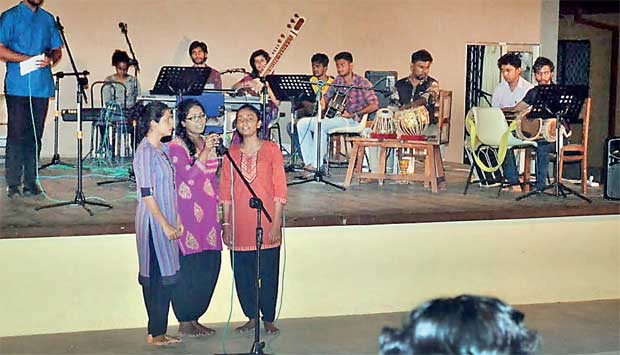
 The Faculty of Performing Arts of the Kelaniya University hosted a very interesting evening of music and discussion on Thursday Dec. 01.
Curated by violinist and lecturer in music Chandana Ruwan Kumara, students and staff of the faculty performed ten songs, and invited song writer Sunil R. Gamage to discuss each, with an analysis of the traditional folk poems and melodies which had inspired them.
The traditional verse was sung first by individual singers or choruses, followed by an analysis by Gamage. This was followed by the popular song inspired or influenced by it, sung again by students or lecturers and backed by an eight member orchestra of students playing keyboards, acoustic guitar, sitar, tabla, traditional drums and other percussion instruments.
Gamage began by explaining that the folk song formed the basis of what he termed ‘apey kama’ (translated loosely as our heritage or the uniqueness of our culture), based on Sinhala Buddhist values and traditions. The Sinhala sarala gi tradition has many songs celebrating simple village values based on the dual pillars of the village tank and Buddhist temple, and related topics such as patriotism and maternal love.
A song based on the well-known Buddhist narrative verse Wessanthara Kavya was discussed first. Gamage said that this work belongs to the genre known as ‘welapum gi’ or lament, giving as a modern example Nanda Malini’s song ‘Thuru liya matha pipi kusume wana sampatha amma’, inspired by the Yashodharawatha which belongs to the welapum gi tradition.
Then he went on to discuss the song ‘Kandulu Hela Nembiliyata Sahal Garana Amma’ by Deepika Priyadharshani Pieris (lyrics by Rev. Rambukkana Siddhartha and music by bandula Wijeweera) inspired by the Wessaanthara Kavya. The verse was sung by a first year student and accompanied by the orchestra, followed by Deepika’s song.
Gamage further explained that this song is set to a metre derived from traditional lullabys (Nelavili Gi) set to a metre of six matras (syllables) per line.
Next, examples from the Bambara Gi tradition were discussed. This tradition has its roots in our Adivasi (aboriginal) culture and its bees’ honey hunting traditions from Monaragala, Badulla and Ampara districts. The traditional example chosen was sung by a student, from the point of view of a honey collector who is abandoned by his brother at a critical point. The modern song chosen was Wasantha Madurangani’s Sandasami Mung, sung by a female student and chorus of six. In general, the rendition of all these songs by students was excellent, and they were ably backed by the orchestra. The tradition of Hatan Kavi was discussed. This is a prolific tradition which saw its flowering during the colonial period as the kingdoms of Kotte and Kandy waged war against the Portuguese and the Dutch. Ehelepola Hatana and Kunsthanthinu Hatana are well known examples which celebrate battles, victories as well as tragic events such as the massacre of Elehepola Kumarihami and her children as ordered by King Sri Wickrema Rajasinghe.
The poet Ratna Sri Wijesinghe wrote the song Bimbara Asunaka based on events mentioned in the Ehelepola Hatana, though the melodic inspiration came from Parangi Hatana. The historical massacre is related here to an actual event about a young Buddhist monk arrested and tortured by the police as a suspect in the 1971 JVP rebellion. It was sung by Gunadasa Kapuge.
‘Bimbara Asunaka’ recalls the epic 1818 Uva-Wellassa rebellion against British rule but is placed in a modern context, protesting the sale of this historic battleground to multinational companies.
This was followed by Chandana Ruwan Kumara quoting at length from an article written by the poet on the appalling hardships endured by the inhabitants of Uva-Wellsassa due to the scorched earth policies followed by the British to quell the rebellion.
Examples from the extensive tradition of Wannams (dance-recitals) were discussed. Gamage showed how singer Rohana Beddege was influenced by the Tisara Wannama (dance of the peacock) in his ‘Malsara Belma Hela’ song. Though it was derived from the Tisara Wannama, Gamage showed that it was very close to the tradition of Raigama Raban Gi recited while playing the rabana. The demonstration was enlivened by dancing.
The Kolam tradition strongly evident in the Badulla district, Wanni Hathpaththuwa and the littoral was discussed. After a demonstration of the Jasa Kolama, the song ‘Lenchina Mage Nangiye’ sung by Sunil Edirisinghe and written by Ratna Sri Wijesinghe and influenced by Jasa Kolama was sung and discussed.
Kada Thira Helima is a dance tradition used in the exorcism rituals known as Bali Shanthi Karma, and is derived from Buddhist literature. During the ritual, a curtain is drawn between the patient and the exorcist, hence the term ‘kada thira.’ The verses are sung during the ritual called Nethra Pinkama.
Nanda Malini’s ‘Sulanga Visin Igillila’ was the modern song chosen as an example derived from this tradition.
The Asna Kavi tradition was discussed next. Kuveni Asna and Dambadeni Asna are well-known examples, and the former is better known. It narrates the tragic tale of Princess Kuveni who helped Prince Vijaya to defeat her own people and was betrayed by him in turn.
According to legend, Kuveni curses Vijaya with ‘divi dosa’ whereby he is stricken by a nightmarish vision of a leopard attacking him and mauling his face and eyes. Legend has it that King Pandukabhaya too, suffered from the same curse, and the healing ritual known as Kohomba Kankariya was initiated to free him of it. The related Shanthi Karma dance was performed by three students, and the verses sung by another student. ‘Thaniwela Maa Thaniwela’ sung by Nanda Malini and written by Madawala S. Ratnayake has been inspired by this tradition, and was performed here by a senior female lecturer.
A song from the Suramba Valliaya said to belong to the Kolam tradition was discussed. These verses were sung by low-caste rodiya women wearing masks as a way of entertaining themselves. Now such performances can be seen in low country dances but without masks.
The modern example chosen was ‘Thunyama heena deka deka motadai gedara Hinda’ by Nirosha Virajini.
Finally, Nanda Malini’s ‘Ruk Aththana Mala Mudune’ was sung and discussed. Gamage said it was not directly related to any wannam but Nanda Malini has adapted certain elements from the Ukusa Wannama to create a beautiful and moving song. Her song is about a mother and son awaiting the father’s return from home, whereas Ukusa Wannama describes the habits and qualities of hawks. It was sung by another lecturer.
This was an informative and entertaining evening of music and lecture and one hopes Ruwan Kumara and the Faculty of Performing Arts can hold similar events in future.
27 Jun 2026 31 minute ago
27 Jun 2026 55 minute ago
27 Jun 2026 2 hours ago
27 Jun 2026 2 hours ago
27 Jun 2026 2 hours ago