07 Jan 2026 - {{hitsCtrl.values.hits}}
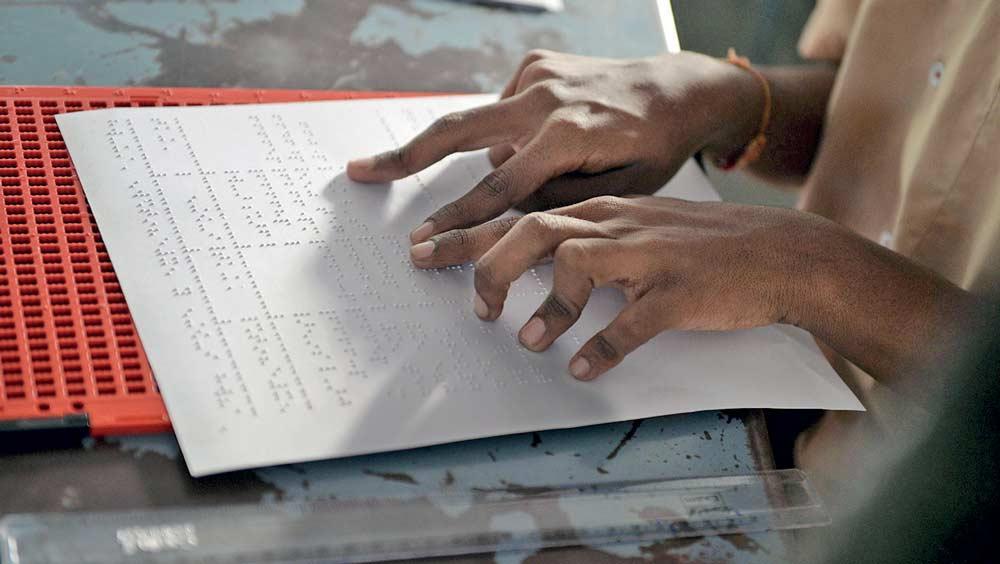
Braille is far more than raised dots on a page; it is a gateway to independence, education, and dignity
 Research consistently shows that blind individuals who are literate in Braille have significantly higher employment rates than those who aren’t
The importance of Braille is firmly anchored in international human rights frameworks, particularly those advanced by the United Nation
Braille is a means of communication for persons who are blind and partially sighted
World Braille Day itself was officially proclaimed by the UN General Assembly in 2018
“Literacy is a bridge from misery to hope.” — Kofi Annan
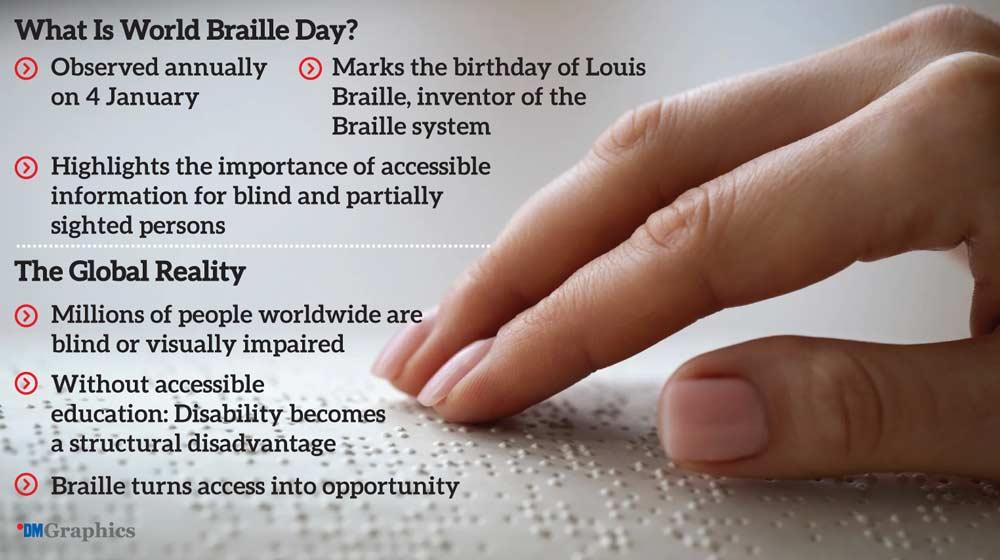
 Every year on 4 January, the world observes World Braille Day, a day dedicated not merely to a system of reading and writing, but to the fundamental idea that access to information is a human right. Marking the birthday of Louis Braille, the inventor of the Braille system, this day draws global attention to the importance of Braille is a means of communication for persons who are blind and partially sighted. In an increasingly digital and fast-moving world, World Braille Day reminds us that inclusion is not automatic it must be designed, protected, and continuously advanced. More than a symbolic commemoration, the day serves as a call to action for governments, international organizations, and societies to ensure that no one is left behind simply because information is inaccessible.
Braille is far more than raised dots on a page; it is a gateway to independence, education, and dignity. For millions of blind and visually impaired persons worldwide, Braille enables literacy, which in turn unlocks opportunities for employment, political participation, and social inclusion. Research consistently shows that blind individuals who are literate in Braille have significantly higher employment rates than those who aren’t. This highlights a crucial reality: without accessible education, disability becomes a structural disadvantage rather than a natural condition.
Across countries, Braille has played a transformative role in personal and collective empowerment. In the United States, for example, organizations such as the National Federation of the Blind actively promote Braille literacy through early childhood education and adult learning programmes. In India, where a large population of visually impaired persons live in rural areas, braille presses used in schools have been instrumental in ensuring access to textbooks, religious texts, and legal information. These experiences underline a shared global lesson: when Braille is supported through public policy and social commitment, it becomes a powerful equalizer.
The importance of Braille is firmly anchored in international human rights frameworks, particularly those advanced by the United Nations. The UN Convention on the Rights of Persons with Disabilities (CRPD) explicitly recognises Braille as a means of communication and obligates states to facilitate its use in education, public services, and information dissemination. World Braille Day itself was officially proclaimed by the UN General Assembly in 2018, signaling global recognition of Braille’s role in achieving inclusive development.
Sustainable Development Goal 4
UN agencies such as UNESCO and UNICEF have consistently emphasised inclusive education, aligning Braille literacy with Sustainable Development Goal 4, which seeks to ensure inclusive and equitable quality education for all. In countries like Finland and Sweden, where inclusive education policies are robust, Braille is integrated alongside assistive technologies, ensuring that visually impaired students learn in mainstream environments without losing access to specialised tools. These models demonstrate how international norms, when translated into national practice, can meaningfully transform lives.
Different regions approach Braille inclusion in ways shaped by their social, economic, and political contexts. In Japan, technological innovation has enhanced Braille accessibility through refreshable Braille displays and tactile signage in public transport systems. Railway stations, elevators, and sidewalks include Braille and tactile paving, reflecting a societal commitment to universal design.
In contrast, many countries in the Global South face challenges such as limited funding, lack of trained teachers, and insufficient production of Braille materials. Yet, inspiring initiatives continue to emerge. In Kenya, community-based organizations work with government schools to produce affordable Braille textbooks locally, reducing dependence on costly imports. Similarly, in Brazil, public libraries have expanded Braille collections and digital talking books, reinforcing the idea that accessibility must extend beyond classrooms into public spaces.
These case studies reveal an important continuity: while resources may differ, the recognition of Braille as essential to equality is increasingly universal. World Braille Day thus becomes a shared global moment, connecting diverse national experiences under a common ethical commitment.
The rapid digitalisation of information has introduced both new opportunities and new risks for Braille users. On one hand, screen readers, audio books, and artificial intelligence have expanded access to information. On the other hand, there is a growing misconception that audio technologies can replace Braille altogether. Experts and advocacy groups caution against this assumption, arguing that listening is not the same as reading. Braille literacy remains crucial for understanding spelling, grammar, mathematics, and complex texts.
Countries such as Germany and Canada have addressed this challenge by integrating Braille into digital platforms through refreshable displays and accessible e-learning systems. The UN has repeatedly emphasized that technological progress must be inclusive by design, not retrofitted after exclusion has already occurred. World Braille Day therefore urges policymakers to ensure that digital transformation strengthens, rather than sidelines, Braille literacy.
In a world that increasingly celebrates innovation, World Braille Day serves as a reminder that true progress is measured by inclusion. The observance challenges societies to reflect on whose voices are heard, whose knowledge is valued, and whose access is prioritised. It also highlights the intersection between disability rights, education, gender, and poverty, particularly in contexts where visually impaired women and children face compounded barriers.
Importantly, the day is not only about blind and partially sighted persons; it is about the kind of world we choose to build. A world that accommodates Braille is a world that values diversity, empathy, and human dignity. Through schools, public institutions, workplaces, and digital spaces, the presence of Braille signals a commitment to equality in its most tangible form.
World Braille Day, observed on 4 January, is both a celebration and a responsibility. It celebrates the resilience and ingenuity of the blind community and honours Louis Braille’s legacy, while also reminding states and societies of their ongoing obligations. From UN conventions to local classrooms, from high-tech cities to rural villages, Braille continues to shape lives by turning access into opportunity.
As the world moves forward in pursuit of sustainable and inclusive development, Braille must remain central to conversations about education, rights, and accessibility. On this day, the raised dots of Braille stand as raised voices—calling for a future where no one is excluded from knowledge, participation, or hope simply because the world failed to make space for them.
04 Jun 2026 5 minute ago
04 Jun 2026 8 minute ago
04 Jun 2026 34 minute ago
04 Jun 2026 37 minute ago
04 Jun 2026 42 minute ago