14 Oct 2025 - {{hitsCtrl.values.hits}}
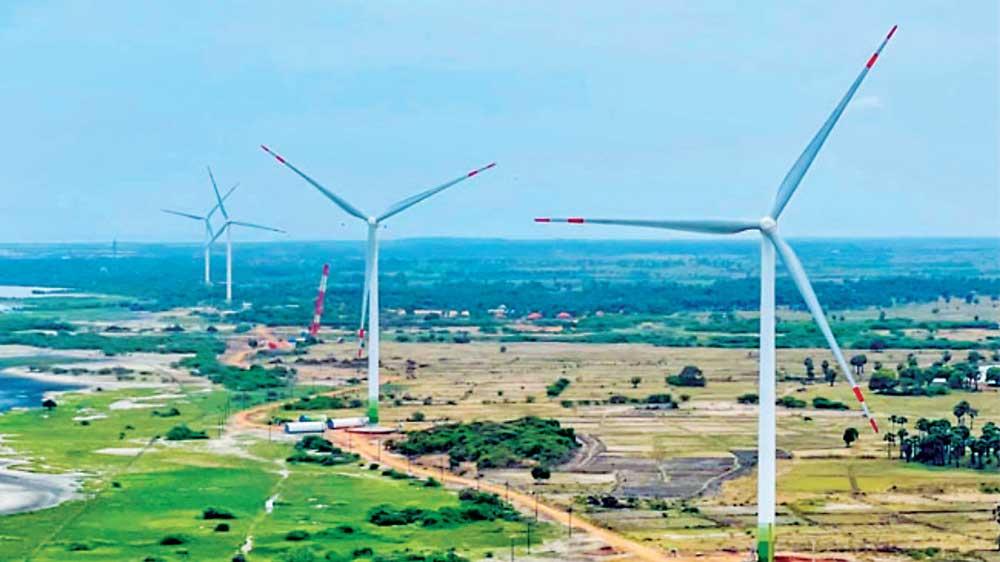
People of Mannar Island are grappling with the impact of major wind power projects on their land and livelihoods
By Mirudhula Thambiah
In Keeri village on Mannar Island, S. Vijithan remembers the simple act of buying water as a child. “Our family bought a pot of drinking water for Rs. 20, and my mother would cook white rice from it because the water was so pure and tasty,” he recalled. Today, that same water is undrinkable — black, yellow, and foul-smelling — forcing villagers to buy water from outside just to survive. Nearby, in Naruvilikulam-Vankalai, S. Sebanesan, Leader of the Rural Development Society of his village, watches families struggle with a different toll. “Many pregnant women in our village have left to other places because of the noise of the windmills. Children who used to study well are now suffering from headaches and eye problems.
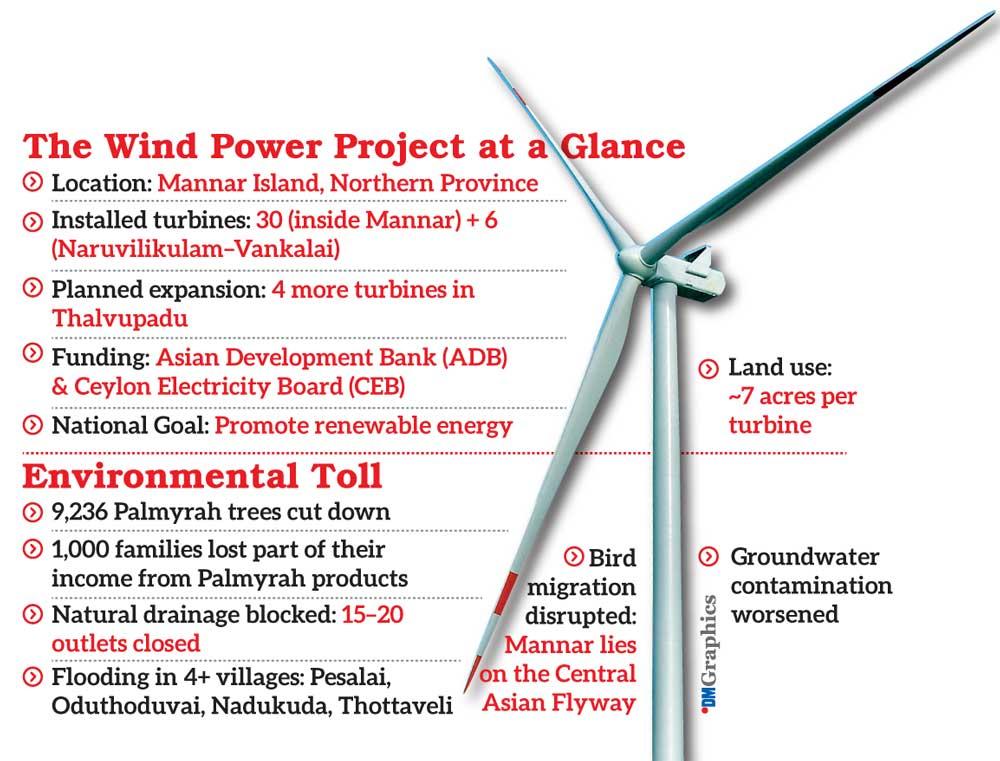
“We have been appealing to all the authorities from the regional level to the centre, but all have ignored our claims. They always treated us like illiterates. Whenever we raised issues in meetings, we were discouraged”
- S. Sebanesan, Leader of the Rural Development Society
“Inside Mannar, 30 turbines have been installed, and six more at Naruvilikulam-Vankalai. Initially, residents didn’t raise objections, but once roads were built for the turbines, natural drainage was blocked”
-S. Vijithan, Representative of the Karunilam Movement in Mannar“All 14 wind turbines should be completely removed from the island, permission should not be granted for any sand mining, and the impact caused by the 36 turbines must be addressed,”
- Fr. Santhiyoga Marcus, President of the Mannar Citizens’ Committee
People being treated for high blood pressure have moved to other houses because they couldn’t live here,” he said, his voice heavy with frustration.
More than 70 days into their peaceful protest, the people of Mannar Island are grappling with the impact of a major wind power project on their land and livelihoods. Residents and local activists report environmental strain, flooding, and rising health concerns, while authorities maintain that the project is crucial for advancing the nation’s renewable energy goals. The dispute underscores the delicate challenge of pursuing development while safeguarding local communities and natural resources; this issue highlights the tension between progress and preservation that resonates far beyond this small island.
Noise, health and displacement
Sebanesan has been trying to stop the project since its inception. “We have been appealing to all the authorities from the regional level to the centre, but all have ignored our claims. They always treated us like illiterates,” he said. “They said we don’t know the value of resources, development, or anything. Whenever we raised issues in meetings, we were discouraged. Those who took the limelight in protests now stay silent when we protest at the village levels. When they installed turbines in our village, we gathered the people and staged a protest, but most of those who are now protesting hide themselves,” he added. Sebanesan also highlights the environmental and agricultural toll. “Karisal and Puthukudiyiruppu are the highest regions from sea level on Mannar Island. Those areas never experienced flooding. Drumstick trees are perishing because of flooding. Mannar Island is completely inundated during floods. I have paddy lands — before the turbines were installed, I harvested around 55 bags per acre, now only 25. Coconut cultivation has also been affected. All our cultivations have suffered. There are houses within 180 yards of the turbines. My extended family lives within 150 yards, and some visit hospitals regularly for treatment. The noise is too much to live with,” he added.
Protecting the fertile land
S. Vijithan, Representative of the Karunilam Movement in Mannar, explained the origins and meaning of their name, “Karu means fetus and Nilam means soil or land. It symbolises fertile soil, a place where life can grow. Our movement is about protecting this land for future generations — it is not about black soil, as some have said,” he added. The movement began as a campaign against sand mining, which they saw as a threat to the island’s long-term environmental health. Over time, the team also joined protests against the wind power project, citing mounting concerns about its local impact. “Inside Mannar, 30 turbines have been installed, and six more at Naruvilikulam-Vankalai. Initially, residents didn’t raise objections, but once roads were built for the turbines, natural drainage was blocked,” he said.
The disruption has led to persistent flooding in villages including Pesalai, Oduthoduvai, Nadukuda, and Thottaveli — some areas remain submerged even seven months after heavy rainfall. The movement highlights other environmental and social concerns as well. “Palmyrah trees, around 9,236 as officially recorded, have been cut. Around 1,000 families depend on these trees for their livelihoods.
Bird migration patterns have been disrupted, and groundwater quality is deteriorating. Keeri villagers, who once sold filtered well water, are now forced to buy drinking water due to contamination caused by flooding,” Vijithan said. He also questioned the location and scale of the turbines. “Scientifically, wind speeds along the coast are enough for turbines to operate efficiently. There is no need to install them on the island itself. The turbines inside Mannar are three times larger than elsewhere and are dug 40 feet deep.
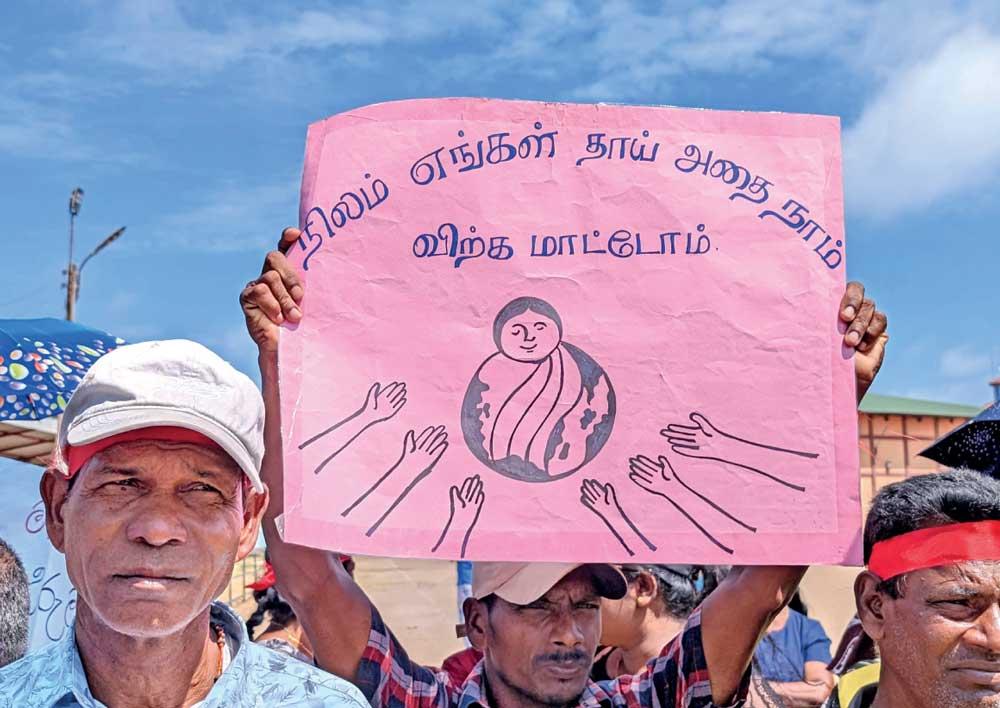
A protester holds a sign which reads “We will not sell our land.”: Women and children demand justice and environmental protection against harmful wind projects
The impact on local soil, water, and ecosystems is enormous,” explained Vijitha. He said that residents have demanded that future turbines be installed outside residential areas, citing noise pollution and health issues. At Naruvilikulam, turbines were placed just 300 metres from homes, this is far closer than the recommended 2 km, causing distress among pregnant women, the elderly, and heart patients. Negotiations with the Energy Minister have resulted in plans to limit installation to four turbines in Thalvupadu, though flooding and compensation concerns remain unresolved. Vijithan emphasised that the movement is not opposed to electricity or development. “We have had enough. We support sustainable energy, but it must not come at the expense of our land, livelihoods, and health. There are many alternative sites outside the island where turbines could be installed without causing harm,” he said.
Voices of dissent
The concerns have resonated across Mannar Island, prompting collective action from residents and organised groups. Leading these coordinated efforts, President of the Mannar Citizens’ Committee Fr. Santhiyoga Marcus, emphasises the broader community perspective. Fr. Marcus outlines the committee’s demands clearly, “All 14 wind turbines should be completely removed from the island, permission should not be granted for any sand mining, and the impact caused by the 36 turbines must be addressed,” Echoing similar concerns, President of the Federation of Community-Based Organisations in Mannar District V.S. Sivakaran said that the people feel their democratic rights have been overlooked in the decision-making process surrounding the wind power project. “We have been engaging in a democratic struggle for many years against the installation of wind turbines and the extraction of mineral sands. Despite several rounds of discussions with ministers and even the President, the people’s sentiments and lived experiences were disregarded,” Sivakaran said. He added that the Federation is considering seeking legal action if the grievances of the affected communities continue to be ignored, emphasising that the matter concerns not just the environment, but also the sovereignty and fundamental rights of the people of Mannar Island.
“We filed a case a few days ago against ilmenite mining by two companies. About one-third of the island was under water when we visited in January. If they remove the service road or put adequate culverts, the flooding can be resolved. But without remediation, no new project should move forward”
- Hemantha Withanage, Chairperson of the Centre for Environmental Justice“Mannar people aren’t against windmills. But these turbines shouldn’t be erected on Mannar Island itself. Technically and environmentally, it’s not suitable. The installations can be moved to other parts of the district”
- Eng. Robert Peiris, Expert Representing Mannar Region
 |
| Women and children demand justice and environmental protection against harmful wind projects |
As the debate continues, Founder of the Mannar Women’s Development Federation Shreen Saroor believes that what is unfolding in Mannar today is the result of long-standing missteps by successive governments that failed to safeguard the island’s fragile environment and its people. “This situation has arisen because of the mistakes different governments have made in the past,” she said. “It goes back to the COVID-19 lockdown period when Mannar’s resources were completely abused. The government at the time allowed private interests to extract soil and erect windmills on an ad-hoc basis, without any proper planning or consultation with the people,” she added. Saroor explained that the present outcry is a culmination of years of frustration. During the lockdown, she said, a foreign company had drilled holes in Mannar’s soil in search of titanium, taking samples while the country was closed. “Nobody was consulted,” she said. She noted that the manner in which the windmills were built disregarded both environmental realities and human settlements. Many of those living near the sites are families displaced by the war—people who rebuilt their lives through small-scale farming and fishing. The installation of turbines she said, has disrupted both livelihoods and ecology. “If titanium mining begins in Mannar, there won’t be a Mannar left for us,” she warned. For Saroor, the people’s protest is not merely about opposing development — it is about protecting their right to survive on their land. “If anyone wants to develop the North, it must be people-centric and done in consultation with the community. After everything they endured during the war, they cannot afford to lose their land again,” she added.
Technical insights
While activists and community leaders raised environmental and social concerns, engineers studying the area stress that the issue isn’t about rejecting renewable energy altogether.
Eng. Robert Peiris, an expert representing the Mannar region who has been studying the project, said the Asian Development Board (ADB) and the Ceylon Electricity Board (CEB) had conducted extensive studies between 2015 and 2017 to identify the country’s wind power potential. “According to a study by the U.S. National Renewable Energy Laboratory (NREL) Sri Lanka is capable of producing around 20,740 MW of wind energy,” he explained. “Out of that, the Northern, North-Western, and Central provinces together can contribute roughly 4,000 MW,” he added. He noted that Mannar was one of the sites selected for its consistent wind speeds, but warned that its fragile geography hadn’t been properly factored into the ongoing projects. “Mannar Island is not rocky land; it’s a sand dune,” he said. “Nearly 60 percent of the island’s population lives on land below sea level, and the construction of access roads and turbine foundations has disrupted the island’s natural drainage systems,” he added. He pointed out that during the first phase of construction, more than 15 to 20 natural drainage outlets leading to the sea were blocked, creating stagnant water and flooding during the monsoon. “In some areas, water stagnated for three to six months. Murunga trees and home gardens were destroyed. Even toilets overflowed,” he recalled. Despite the damage, Peiris emphasised that locals were not opposed to renewable energy. “Mannar people are not against windmills — we support green energy and national energy policy,” he said. “But these turbines should not be erected on Mannar Island itself. Technically and environmentally, it’s not suitable. The installations can be moved to other parts of the district,” he added. Peiris said his stance was based on field data and long-term studies. “I support wind power development,” he said. “But not in a way that destroys the very land and livelihoods it is meant to empower,” he added.
Chairperson of the Centre for Environmental Justice (CEJ) Hemantha Withanage said his organisation had long raised concerns about both the Mannar wind power project and ilmenite sand mining in the area. “We filed a case a few days ago against ilmenite mining by two companies,” he said, adding that the case targets the Geological Survey and Mines Bureau (GSMB), the Central Environmental Authority (CEA), and the Coast Conservation Department. He explained that CEJ had earlier submitted a seven-page comment on the 2022 Environmental Impact Assessment (EIA) for the wind power project, pointing out that “issues like flooding and social impacts were completely ignored,” Withanage said. “It’s done just to get approval, not to ensure safeguards. People are never consulted,” he added. He noted that while the first 100 MW wind project funded by the ADB had included mitigation for bird migration, flooding had become a “major issue” since the service roads were built. “About one-third of the island was under water when we visited in January,” he said. “If they remove the service road or put adequate culverts, the flooding can be resolved. But without remediation, no new project should move forward,” he added.
Meanwhile Vanni District Parliamentarian Selvam Adaikkalanathan said that the installation of each windmill requires about seven acres of land, raising serious concerns for the already limited space on the island. “Even if these turbines are set up on private property, they will still come up among the people,” he said. He warned that the land would be unusable after 25 years and expressed fears over saltwater intrusion. “We already bring drinking water from Murunkan. If the rest turns saline, our people will suffer,” he added, urging the government to shift future windmills outside the island to protect its environment and community.
“Mannar is the main pathway for migrant birds entering Sri Lanka through the Central Asian Flyway,” explained the Vice President of the Mannar Birds Club Marynathan Edison “The area where the wind turbines are being built lies right in the middle of this route. Collisions are already occurring—not just with the turbine blades, but also with the high-tension power lines that cut across the Ramsar wetland in Vankalai Sanctuary. These structures were never here before, and now they’ve become dangerous obstacles for the birds that depend on this passage every year,” he added.
The impact extends to Mannar’s coastal communities. Noor Mohamed Aalam, Secretary to the Mannar District Fishermen Cooperatives, said that the four proposed turbines could affect 35–40 fishing families. “Since the windmills were installed, our harvest has decreased. A basket full of fish has reduced and is barely enough for a family,” he complained. Aalam said that while other factors may play a role, many fishermen now see the project as the main cause and believe the government should assess the impact scientifically. He urged a compromise stating, “Apart from the four turbines, the rest should be installed outside the island”. On September 29, the Mannar District came to a standstill as protests held in solidarity against the wind power project led to tensions between police and demonstrators. Police said legal action was taken against eight protesters, who have since been released on bail.
No new wind power projects in future-Mannar DS
However, District Secretary of Mannar, K. Kanakeshwaran, said President Anura Kumara Dissanayake and the Bishop of Mannar Gnanapragasam Anthonypillai had discussed the issue last week. “The President clarified that two ongoing projects — the 20 MW project and a 50 MW project— will proceed within the approved period,” he said. “He also assured that in the future, no new wind projects will be allowed within Mannar Island, and all forms of sand mining or mineral activity will be prohibited,” he added. Kanakeshwaran said that the two approved projects will continue without further interruption.
Failed to contact minister
Meanwhile, Daily Mirror’s attempts to contact Minister of Energy Kumara Jayakody and Minister of Environment Dr. Dammika Pathabendi to raise queries on these issues were unsuccessful.
12 Jun 2026 10 minute ago
12 Jun 2026 17 minute ago
12 Jun 2026 21 minute ago
12 Jun 2026 24 minute ago
12 Jun 2026 32 minute ago