20 Jan 2026 - {{hitsCtrl.values.hits}}
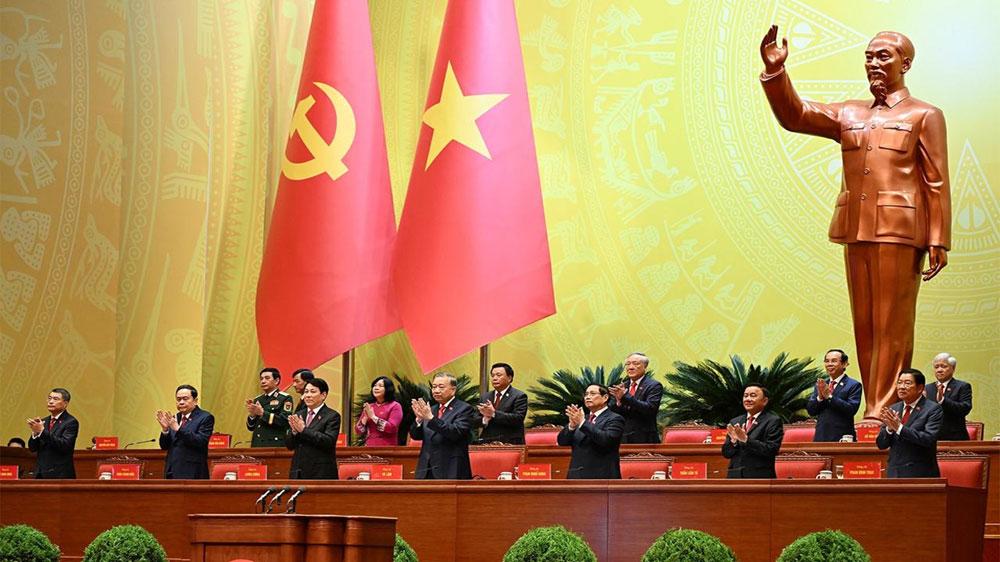
Viet Nam’s ruling Communist Party has gathered for its five-yearly National Congress, a pivotal event that will define the leadership and economic trajectory of Southeast Asia’s fastest-growing economy. For observers in Colombo and beyond, Hanoi’s success offers a compelling proof of concept: that disciplined socialist governance can flourish alongside aggressive global integration.
The 14th national congress of Viet Nam’s ruling Communist Party is now in progress to pick new leaders and set targets for the country’s economy which is the fastest growing in Southeast Asia. Actually, it is held every five years for the selection of party leaders and to make decisions on foreign and economic policy matters of Viet Nam.
Around 1,600 delegates from the Communist Party will approve policy documents for the next five years and elect a new Central Committee of roughly 200 members. Of the 200 elected Central Committee members, 17 to 19 members of the Politburo - the Communist Party’s top decision-making body - will be chosen, including the general secretary.
As Viet Nam, a one-party state, convenes its National Congress, Sri Lanka’s attention is inevitably drawn to Viet Nam’s economic success story, especially as the country is now governed by a political force which is rooted in leftist ideology.
Ruling JVP in Sri Lanka, by its actions, has shown interest in communist structure of governance but it has embraced market-oriented economic reforms. In Viet Nam, policy continuity has helped propel economic growth. It is today a honeypot for foreign investments.
In fact, over 80 years, Viet Nam, under the leadership of the Party Central Committee, President Ho
Chi Minh, and, directly and regularly, the Politburo, Secretariat, and successive General Secretaries, has achieved historic victories. These include national independence, reunification, and the building of socialism, transforming the country from a poor nation into a developing country deeply integrated into the global community, with impressive economic growth, and increasingly improved living standards for its people.
Since its founding in 1930, the Communist Party of Viet Nam has convened 13 National Congresses. Each Congress has been associated with different political tasks, yet all have marked important milestones in the Party’s and the nation’s development. Building on the success of previous Congresses, the 14th National Congress of the Communist Party of Viet Nam (14th Congress) is a major political event of decisive significance for Viet Nam’s future development in the new era.The 14th Congress which is in progress at the moment not only reviews the development path of the past five years and defines goals and tasks for the next five years, but also shapes strategic thinking, vision, and development orientations for the country through the mid-21st century. In the post -13th National Congress period, Viet Nam has made giant strides.
Macroeconomic stability was maintained, with inflation, public debt, and budget deficits effectively controlled. The trade balance consistently recorded a high surplus. Average GDP growth for 2021-2025 was approximately 6.3% per year, among the highest globally. By 2025, GDP exceeded US $ 510 billion (1.47 times that of 2020), and per-capita income reached about US $ 5,000, placing Viet Nam among upper-middle-income countries. Growth quality improved, and the economic structure shifted positively toward modernization as the shares of industry and services increased.
Many long-standing weak projects and inefficient economic organizations were resolved; infrastructure was expanded synchronously, with numerous large-scale, key national projects put into operation. The private sector was facilitated to develop further, becoming an important driver of the economy, with several large private corporations emerging and attaining international competitiveness.
Cultural, human, and social development made significant progress, with notable advances across many areas; social security and people’s living standards improved markedly. Policies on comprehensive human development were implemented in a substantive manner. Viet Nam’s Human Development Index (HDI) rose significantly (to 0.766, up 14 places, ranking in the “high” category), while its Global Happiness Index ranking climbed 33 places to 46th out of 143 countries.
Education and training underwent fundamental reforms; science and technology, innovation, and digital transformation were promoted. Economic growth became more closely linked with social progress and equity; welfare and social security received strong attention. The material and spiritual well-being of the people improved clearly, with the poverty rate declining sharply from 4.4% (2021) to 1.3% (2025), meeting the goal of “leaving no one behind.” The health system developed positively, effectively controlling epidemics and mastering many advanced medical technologies; private health care expanded; health-insurance coverage reached 95.2% of the population (up from 90.9% in 2020), and average life expectancy reached 74.8 years (including about 67 healthy years).
National defense and security capacities were further strengthened; national independence, sovereignty, and territorial integrity were firmly safeguarded; social order and safety were ensured. The Party and State invested in building the People’s Army and People’s Public Security into revolutionary, regular, elite forces moving step by step toward modernization, with a number of services, arms, and units advancing directly to modern standards.
Viet Nam has consistently pursued a foreign policy of independence, self-reliance, peace, friendship, cooperation, and development, while diversifying and multilateralizing its external relations. External activities took on a pioneering role, helping maintain a peaceful and stable environment and opening up an unprecedented development landscape for the country.
Party diplomacy, State diplomacy, and people-to-people diplomacy were carried out comprehensively and in a well-coordinated manner, achieving notable results. Relations with countries and partners — especially major powers, strategic partners, and traditional friends — were deepened, stabilized, and grew in a sustainable manner.
Party building and rectification achieved breakthrough outcomes.
Party discipline was strictly enforced; the fight against corruption, wastefulness, and negative practices was intensified with very strong political determination, with “no forbidden zones, no exceptions.” The Party’s leadership and governance methods continued to be renewed, becoming more scientific, democratic, effective, and efficient. These achievements affirmed the unity, consensus, and high determination of the entire Party, people, and political system in building a clean and strong Communist Party of Viet Nam, earning broad support and high appreciation from the cadres, Party members, and the public.
The Congress has set out an ambitious development agenda, aiming to transform Viet Nam into an upper-middle-income country with modern industry by 2030 and a fully developed, high-income economy by 2045. Policy-wise, the Communist Party of Viet Nam continues to anchor its strategy in a “socialist-oriented market economy,” combining political control with economic openness. Viet Nam’s success suggests that socialist politics survives not through resistance to markets, but through the disciplined use of them to deliver economic results.
04 Jun 2026 8 minute ago
04 Jun 2026 11 minute ago
04 Jun 2026 37 minute ago
04 Jun 2026 40 minute ago
04 Jun 2026 45 minute ago