08 Sep 2025 - {{hitsCtrl.values.hits}}
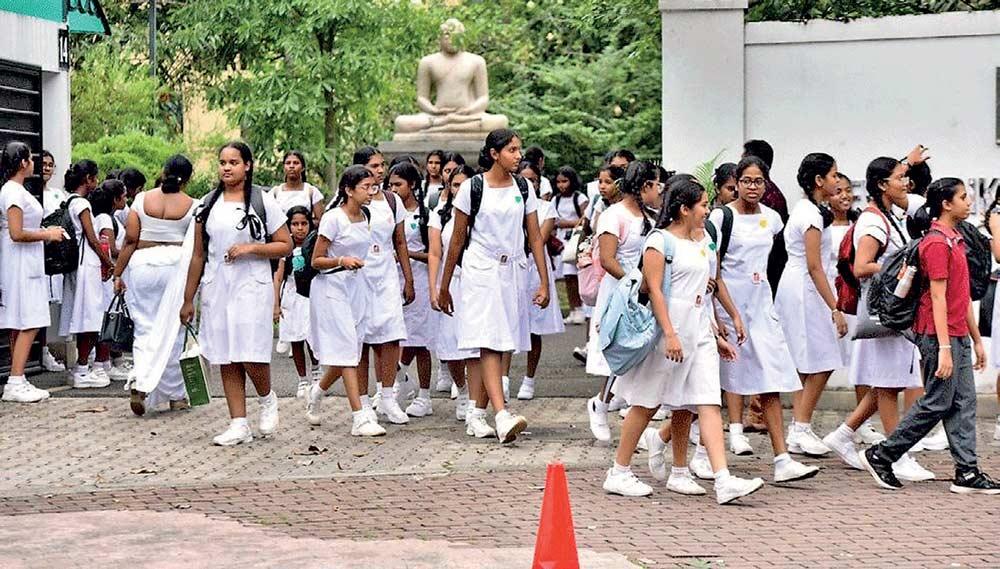
Reform 1-Though the government harps on education reforms, they have left teachers, students and parents uncertain about how these reforms will actually be implemented and whether the government will address the deep-rooted challenges facing the education system
By Mirudhula Thambiah
A month ago, a student of a leading school in Homagama took her life. The death is reportedly linked to exam pressure and this is not an isolated tragedy. Over the years, similar incidents have underscored how Sri Lanka’s exam driven education system places unbearable weight on children. After taking office in 2024, the government unveiled a fresh set of education reforms, promising to transform Sri Lanka’s education system by reducing exam pressure and adopting new guidelines. But teachers’ unions, principals associations and experts warn that proposals largely drawn from plans drafted by previous administration remain incomplete, top-down, and poorly consulted. This has left teachers, students and parents uncertain about how the reforms will actually be implemented and whether the government will address the deep-rooted challenges facing the education system.
Government’s promise for change
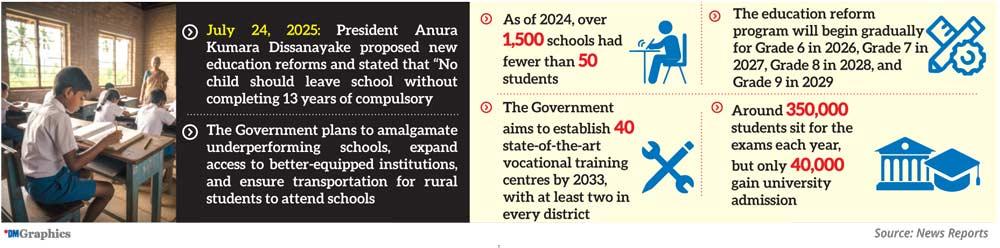
On 24 July 2025 President Anura Kumara Dissanayake during the adjournment debate on the proposed new education reforms stated, “No child should leave school without completing 13 years of compulsory education”. As of 2024, over 1,500 schools had fewer than 50 students. “Some rural schools operating with as few as two or three pupils and a teacher is a serious misuse of public resources,” President added. Thus, he noted the Government plans to amalgamate underperforming schools, expand access to better-equipped institutions, and ensure transportation for rural students to attend schools that offer quality education and social engagement. He stated that the Government aims to establish 40 state-of-the-art vocational training centres by 2033, with at least two in every district. These centers will blend technical education with modern facilities and digital integration to ensure employability in a rapidly evolving job market.
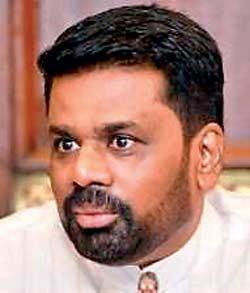
 “Some rural schools operating with as few as two or three pupils and a teacher is a serious misuse of public resources”
-President Anura Kumara Dissanayake
The education reform programme will begin gradually for Grade 6 students in 2026, Grade 7 in 2027, Grade 8 in 2028, and Grade 9 in 2029. By 2029, students will be guided to identify their interests and strengths to pursue specialised pathways, be it history, agriculture, or technology, rather than being channeled into a narrow set of careers.
While highlighting outdated teaching practices and the needs of modern students, President Dissanayake proposed that all educators undergo mandatory professional development every five years.
Beyond new textbooks
Meanwhile, Prime Minister and Minister of Education Dr. Harini Amarasuriya on 26 July stated at an event in Ratnapura that reforms to education are not merely the introduction of a new textbook, but a transformation of the entire system. “We have long advocated for an education system that does not burden children, parents, or teachers,” she noted.
She added that there are several major issues within the current system, especially the pressure placed on children by the exam-centered structure, the resultant stress on parents, and the demanding social consequences created by the competitive nature of the system.
Five pillars of reform
The government proposal outlines its roadmap for reshaping schools across the country. The proposal is built around five pillars, such as Curriculum Development, Human Resources Development, Infrastructure and Administrative Reforms, Assessment and Evaluation and Public Awareness and Promotion.
Teachers and Principals unions push back
However, General Secretary to the Ceylon Teachers’ Union (CTU) Joseph Stalin said that the reforms completely ignore the core problems faced by students and teachers. “Our education system is entirely exam oriented. The whole system is based on examinations and students face massive competition. We saw the tragic case of a student from a leading school in Homagama who died due to exam pressure. But the proposed reforms do not indicate any solution for this,” he said.
Stalin highlighted what he called a ‘tuition mafia’ that dominates students’ learning, with many skipping schools altogether to attend classes. “At the Ordinary Level Exam and Advanced Level Exam, students depend entirely on tuition. Schools have been sidelined. Yet these reforms don’t say how this issue will be addressed,” he added.
Criticising the Grade 1 admissions, Stalin recalled that Kannangara Education Reforms of 1943 promised equal access to education, and added “Now there is no equality”. He continued to say that the reforms provide no solution to the competition that exists to enroll students into Grade 1; this competitive environment present in the admissions to 36 schools.
Stalin accused the government of sideling voices of teachers. “They don’t discuss issues with teacher unions. Instead, they talk to tuition teachers. When we posed questions, they had no answers. For example, they are extending school hours until 2pm and changing subject periods from eight to seven. Whom did they consult,” asked Stalin. He warned that if there is no dialogue, his union would reject such reforms. “We want education reforms, but not this,” he added.
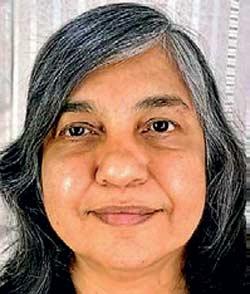 “In the past, teacher training was intensive, institutions such as National Colleges of Education and teacher colleges were rapidly upgraded and materials were prepared simultaneously. By contrast, the current reforms appear to rely on a highly centralised, top-down approach”
- Dr. Tara de Mel, Former Secretary to the Ministry of Education
General Secretary of Sri Lanka National Principals’ Association Mohan Parakrama Weerasinghe stated that school principals remain in the dark about the newly proposed education reforms. “We don’t know what they are really doing. There is no roadmap and no clear direction. They are introducing modules, but they haven’t explained where this system is meant to lead us. We are completely unaware,” he said. He emphasised that education reforms should address the pressing challenges in the sector, but so far, no clarity has been provided.
Highlighting the pressure faced by students studying for the Advanced Level Exam, he noted that around 350,000 students sit for the exams each year, but only 40,000 gain university admission. “The remaining 300,000 must start all over again. Tuition dominates the system. Families are collapsing financially and their health suffers because money is spent on tuition instead of proper nutrition. There is no solution for these issues in the reforms,” Weerasinghe added.
He also underscored the lack of vocational education. “Those 300,000 students who don’t enter university would need vocational pathways, but Sri Lanka simply doesn’t have the resources to accommodate them,” he added.
Weerasinghe flagged the potential confusion in the implementation of reforms. “When Grade-6 subjects are extended, Grade 7 through 11 remain in the old syllabus. Only one bell will signal the end of each subject and initially only students in Grade 6 will follow the new system. How will this affect other grades? We don’t know,” he said.
Recalling previous reform rollouts, he noted the absence of a pilot model. “The last time reforms were implemented; they started in Grade 13 with 40 schools as a model. The following year, it expanded to 157 schools and eventually reached all 455 schools. This time, no such model has been mentioned. We are expected to accept reforms without seeing how they work in practice,” he explained. Despite the uncertainty, Weerasinghe said that principals continue to support meaningful reforms and maintained that it is vital. “But we expect reforms that have weight, that are clearly thought through,” he added.
Ground-level realities ignored
Following the principals’ concerns, Advisor to the Ceylon Tamil Teacher’s Union Sara. Puvaneswaran echoed the call for ground-level consultation. “The system has been failing students for decades. For 20 years we have proposed international models, but our suggestions were ignored,” he noted.
Puvaneswaran welcomed the government’s efforts under Prime Minister Dr. Harini Amarasuriya, but warned that practical realities are being overlooked. He questioned the plan to extend school hours to 2pm, noting that many village schools function only until 1.30pm and some do not provide lunch. “Children from remote areas may struggle with longer hours, inadequate meals and transport issues,” he added.
He pointed out that reforms cannot focus solely on urban schools. “Many village schools, especially in the North, East and Upcountry face unique challenges. Any meaningful reforms must take their realities into consideration,” he said.
Meanwhile, General Secretary of the People’s Teachers’ Union, Nelson Mohanraj raised concerns about the new student assessment system, warning that it could open the door to favouritism and discrimination.
Refering to teacher training, Mohanraj questioned whether the current timeline was realistic. “They are providing training only now, and we doubt whether proper preparation can be done in four months. Teachers of Grades 1 and 6 may end up trapped in the same school due to transfer restrictions linked to training,” he added, warning of practical difficulties.
He opposed the proposal to replace textbooks with digital modules, saying it would disadvantage plantation and rural children. Mohanraj stressed that these children will not have access to digital and technology related resources.
Lessons from past reforms
Former Secretary to the Ministry of Education Dr. Tara de Mel observed that although the reform process was initiated in 2019, as of 2025, it still remains in the planning stage, with comprehensive outcomes expected only by 2029. This means that more than half of today’s school-going population will not benefit from these initiatives. Had the planned pilots from 2026 included all grades rather than a select few, a far greater number of students could have been reached, according to Dr. De Mel.
She noted that major reforms typically require extensive preparation. “For example, ahead of the 1999 Education Reforms, an entire year was devoted to piloting primary reforms in one district. “In the past, teacher training was intensive, institutions such as National Colleges of Education and teacher colleges were rapidly upgraded, and materials, including textbooks were prepared simultaneously. By contrast, the current reforms appear to rely on a highly centralised, top-down approach, with little scope for empowering individual schools or teachers to innovate and adapt to local contexts. This lack of decentralization is likely to slow down effective and timely implementation,” she added.
Dr. de Mel emphasised the importance of teacher preparedness and acceptance. “Teacher buy-in is critical for the success of any reform. With a teacher workforce of approximately 241,000 spreads across nine provinces and 99 education zones, ensuring adequate preparation is a major challenge. While the introduction of a modular system, credit allocation, and tracking of learning hours is promising, the effectiveness of implementation depends on whether teachers, especially those in the most remote areas can access high-quality training,” she said.
She stressed that for teachers to truly accept these reforms they must not only be trained in the technical aspects, but also be given a clear understanding of the underlying principles and the specific responsibilities expected of them. “Without this clarity, the reforms risk being viewed as externally imposed directives rather than meaningful improvements to teaching and learning,” she added.
She was critical of the education reforms stating that they are ambitious and introduce significant changes to the system. “Success will depend on whether teachers, principals, and in-service advisors are fully aligned and adequately supported. Practical hurdles at the ground level are inevitable in the initial years, as stakeholders adjust to new expectations and practices,” she said
Dr. de Mel stated, however, that several gaps are noticeable. The reforms make no provision for equipping students to engage with fast-evolving technologies such as Artificial Intelligence (AI).
She noted that by 2029, when full implementation of reforms are expected, multiple global technology cycles will already have passed. “Lessons could be drawn from countries such as Singapore, South Korea and China, which have integrated digital literacy and technological adaptability into their education systems at pace,” Dr. de Mel noted.
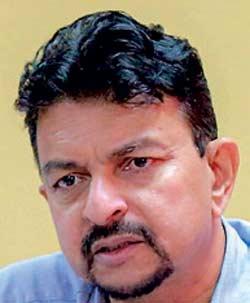 “I think that is a good method because under the current education system students will have to memorise it. But hereafter they will have to study the modules followed by assessments. Therefore, the burden will be comparatively reduced”
- Deputy Minister Mahinda Jayasinghe, Chairman Parliamentary Sub-Committee on the Establishment of the Education Council
She pointed out that equally concerning is the absence of measures to address child nutrition. Without dedicated funding for a daily nutritious meal, learning readiness and equity will be compromised.
Furthermore, extending class periods to 50 minutes does not account for the cognitive profiles of Generation Alpha (born 2010–2024) and Generation Beta (post-2025), who typically demonstrate shorter attention spans. These oversights may significantly undermine the reforms’ effectiveness on the ground, she concluded.
Efforts to reach Dr. Amarasuriya and Deputy Minister of Education Dr. Madhura Seneviratne to address queries regarding the reforms proved unsuccessful.
“We don’t know what they are really doing. There is no roadmap and no clear direction. They are introducing modules, but they haven’t explained where this system is meant to lead us. We are completely unaware”
- Mohan Parakrama Weerasinghe, General Secretary Sri Lanka National Principals’ Association
However, addressing criticisms connected to education reforms introduced by the government, Chairman of the Parliamentary Sub-Committee on the Establishment of the Education Council Deputy Minister Mahinda Jayasinghe stated, “We are not going to implement the same thing. This is an ongoing system and we want to change it and that is exactly why they are planning to adopt the module system. Students will have to cover 10 hours to complete one module. Every module will have assessments. I think that is a good method because under the current education system students will have to memorise it. But hereafter they will have to study the modules followed by assessments. Therefore, the burden will be comparatively reduced,”
According to Deputy Minister Jayasinghe, on August 29, a meeting was held with the participation of Prime Minister Amarasuriya as the Minister of Education, Deputy Minister of Education Dr. Madhura Seneviratne, the committee headed by Prof. O.G. Dayaratne, National Education Commission and the Public Service Commission to discuss legal requirements and matters relating to the establishment of the education council. “A report in regard to the establishment of the council will be prepared in order to legalise it. Anyway, it will take some time to approach the Attorney General’s Department. Once the report is submitted on 25 September, discussions will be held with all stakeholders to establish the council as soon as possible,” he added.
He observed that the Education Council will regulate the education sector in Sri Lanka. Once the council is established the standard of teachers, their education qualifications etc will be implemented by it. “It is similar to the medical council that regulates doctors. Only those who register under the medical council can practise anywhere. They will also have to renew their registration within a specific period, similarly the teachers are required to register under the educational council to obtain licenses. All education sector officials will have to register,” he added. He concluded by saying that the government will hold meetings with various stakeholders including teachers’ unions this week to discuss the proposed reforms.
08 Jun 2026 33 minute ago
08 Jun 2026 41 minute ago
08 Jun 2026 1 hours ago
08 Jun 2026 1 hours ago
08 Jun 2026 1 hours ago