18 Feb 2026 - {{hitsCtrl.values.hits}}
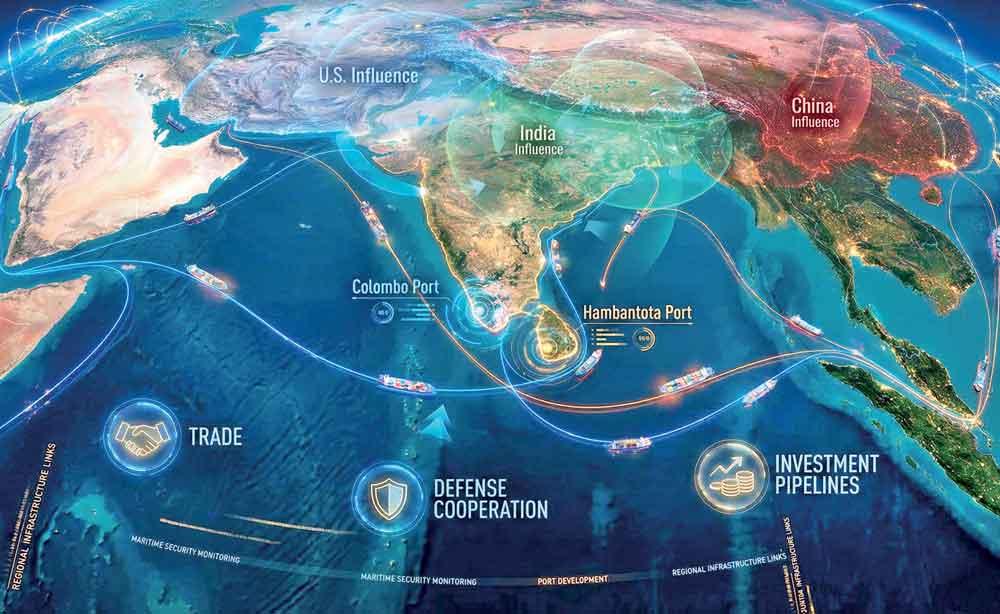
 Given the country’s economic realities, Sri Lanka is unlikely to reset relations in China’s favour at present, and any attempt would attract close scrutiny from both the U.S. and India.
For the Left-leaning NPP, this is not an ideological realignment but a pragmatic convergence in response to the country’s harsh economic realities.
Sri Lanka has always featured prominently in the U.S. Indo-Pacific strategy, regardless of who is calling the shots in Washington, D.C.—Democrats or Republicans. Economic ties, with the U.S. being Sri Lanka’s largest export destination, along with human rights and democracy, have also remained key areas of focus.
However, under President Donald Trump, the strategic aspect of the relationship appears to have become more prominent.
The U.S. involvement in human rights and democracy was hampered during the Trump administration, which curtailed USAID, the main funding arm for NGOs carrying out such activities in Sri Lanka.
The National People’s Power (NPP) government, under President Anura Kumara Dissanayake, has moved away from ideological rigidity and instead strengthened ties with the U.S. under practical considerations.
For the Left-leaning NPP, this is not an ideological realignment but a pragmatic convergence in response to the country’s harsh economic realities.
When the Trump administration attempted to lever age tariffs, Sri Lanka adopted a compromise—a carefully considered, pragmatic approach weighing political and economic impacts.
On November 14, the Sri Lanka–United States Defence Memorandum of Understanding (MOU) was signed to strengthen defense cooperation under the State Partnership Programme (SPP) between Sri Lanka’s Armed Forces and the Montana National Guard, alongside the U.S. Coast Guard District 13.
The U.S’s assertive strategic approach became clearer when Ambassador-designate Eric S. Meyer said Washington would prioritise maritime security, economic reforms, and countering China’s growing footprint in Sri Lanka.
“Sri Lanka sits astride some of the world’s busiest shipping lanes, with two-thirds of the world’s seaborne crude oil regularly transiting its waters,” Meyer said.
“Its strategic location makes it a focal point for U.S. efforts to promote a free and open Indo-Pacific.”
This position was reinforced by Paul Kapur, Assistant Secretary of State handling U.S. ties with South and Central Asia.
In a briefing before a subcommittee in the U.S. House of Representatives on February 11, he said Bangladesh, Nepal, Maldives, Sri Lanka, and Bhutan’s strategic locations give them outsized importance but also make them vulnerable to coercion.
“Defense cooperation with the United States helps them protect their borders and waterways against encroaching powers. Carefully targeted investment can provide these states with high-quality, transparent, non-coercive support for critical infrastructure like ports, telecom networks, and energy projects, helping them avoid the dangers of debt-trap diplomacy,” he said.
The U.S. clearly intends to monitor China’s growing involvement in the region. China has already secured a foothold in Sri Lanka through the Hambantota Port and investments in the Colombo Port City.
Traditionally, Sri Lanka has maintained healthy ties with China despite occasional differences. The NPP government, however, is shifting focus more toward India and the United States.
Given the country’s economic realities, Sri Lanka is unlikely to reset relations in China’s favour at present, and any attempt would attract close scrutiny from both the U.S. and India.
South Asia, comprising India, Pakistan, Bangladesh, Sri Lanka, Maldives, Nepal, and Bhutan, is vitally important.
India alone has a population exceeding one billion and occupies a subcontinental landmass. A hostile power dominating South Asia could exert coercive leverage over the global economy, which the United States seeks to prevent.
This U.S. stance can help Sri Lanka attract much-needed investments to develop infrastructure. Defense cooperation, targeted investment, and diplomacy are the primary tools the U.S. employs in South Asia.
According to Kapur, defence cooperation includes military sales and transfers, co-development of systems, and joint exercises.
Targeted investment combines U.S. seed funding, American technology, and private industry. Diplomacy involves structured engagement between senior leaders, ad hoc responses to emerging challenges, and strategic messaging to support initiatives. These tools help partners build strategic capacity, enhance prosperity, and protect sovereignty, outcomes that also make America safer and more prosperous.
Sri Lanka’s economy is currently tied to the IMF-led reform program, limiting the government’s policy autonomy. The NPP has therefore chosen a cautious approach toward China, mindful of external pressures. Under the present U.S. course of action, Sri Lanka will be further hesitant to deepen ties with China.
Sri Lanka’s strategic location is a unique advantage that can be leveraged for the country’s benefit. By exercising pragmatism, sound judgment, and firm decision-making, Sri Lanka can navigate the complex geopolitical and economic challenges it faces.
Of course, it can leverage its location. Sri Lanka sits at the crossroads of the Indian Ocean, along some of the world’s busiest shipping lanes. About two-thirds of global seaborne crude oil passes nearby, and major maritime routes connect East Asia, the Middle East, and Europe. This makes it naturally important to global powers like the U.S., India and China
It should remain transparent and neutral to extract economic, technological, and security benefits without becoming overly dependent.
Ports such as Colombo and Hambantota position Sri Lanka as a crucial hub for trade, energy transit, and regional logistics.
To leverage it effectively, the country must practice pragmatic diplomacy, maintain economic prudence, and strengthen domestic institutions.
At the same time, it is equally important for Sri Lanka to link up with middle powers such as Australia. Also important are ties with Japan, a country that can help Sri Lanka strike a balance between Asia and the West.
08 Jun 2026 4 minute ago
08 Jun 2026 2 hours ago
08 Jun 2026 2 hours ago
08 Jun 2026 2 hours ago
08 Jun 2026 2 hours ago