07 Jan 2026 - {{hitsCtrl.values.hits}}
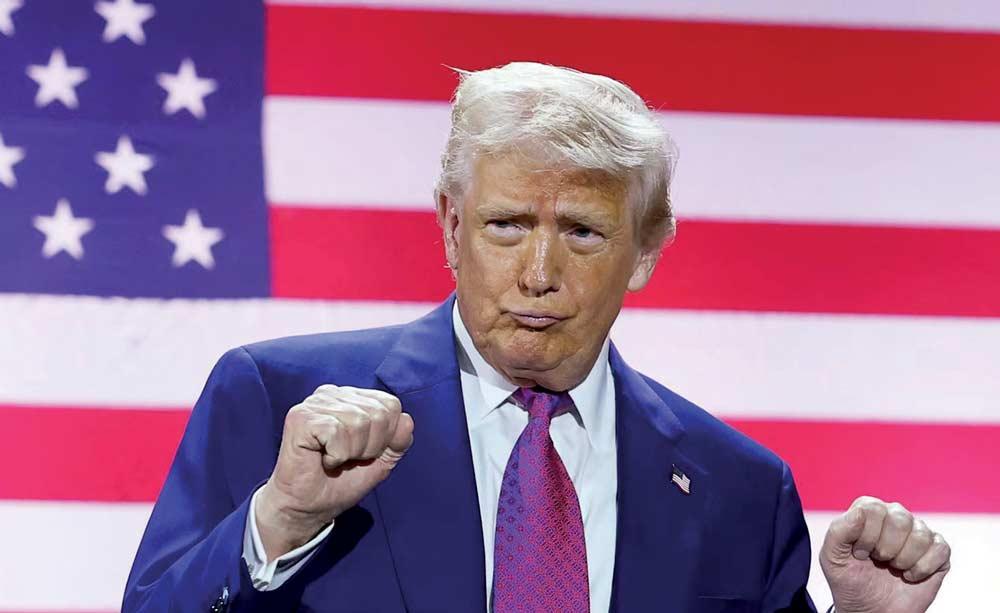
Trump didn’t kidnap Maduro and his wife to restore liberal democracy in Venezuela. He is only the latest manifestation of the long-established American tradition of destabilising Latin America to further its own interests
 Venezuela has abundant natural resources including large reserves of oil, but US sanctions have reduced their output
Trump accused Maduro of flooding the US with narcotics, an accusation without foundation
No one has accused Maduro, his wife or their close circle of plundering the country’s wealth
 S President Donald Trump’s decision to kidnap Venezuelan President Nicolas Maduro makes us wonder if Hollywood is running the United States. It’s an unprecedented cowboy act of derring-do.
Venezuela is the sixth largest country in South America (over 555,000 square miles), wedged between Colombia, Brazil and Guyana, roughly the size of Pakistan, but with a relatively small population of 28.4 million people. It has abundant natural resources including very large reserves of oil, but US sanctions have reduced its output to less than one per cent of global oil production over the years.
Trump accused Maduro of flooding the US with narcotics, an accusation without foundation. Bolivia is the region’s principal cocaine producer, and Venezuela is only a transit country. The real reasons for the outrageous American action lies in oil, and Trump’s avowed goal of ‘Making America Great Again’ (MAGA) which includes (among many other things) attacking left-wing bulwarks in Latin America and countering the global reach of the Chinese-Russia nexus.
He started with American universities, vowing to wipe out liberalism. Venezuela logically looms bigger in the same firing line.
Let’s look at the cons first. There is no question that the rule of Nicolas Maduro, the chosen successor of the charismatic Hugo Chavez, was heavy handed. Under him, Venezuela slid into authoritarianism. Maduro took over after Chavez died in 2013. Since 2016, nearly eight million people have left the country citing economic hardship, food and medicine shortages and political instability. Most, though not all, fled to the U.S. and Trump says this is another reason why he wanted to remove Maduro from power. But there is no evidence that Maduro was deliberately sending drug gangs to the US, as Trump accuses.
No one has accused Maduro, his wife or their close circle of plundering the country’s wealth. Maduro’s net worth is estimated at $2 million, while that of his wife Cilia Flores (a lawyer and politician) is estimated at between $ 2-4 million. This hardly suggests drug money or plunder. There are Sri Lankan politicians who have undisclosed assets worth more, though we don’t have oil wells.
Before 1958, Venezuela was governed by a military dictatorship led by Colonel (later General) Marcos Pérez Jiménez. He was ousted in a coup on January 23, 1958, which led to the re-establishment of democracy. Since then till the early 1990s, Venezuela was a stable liberal democracy, unusual in Latin America where military coups and dictatorships were common. But, according to the V-Dem Democracy indices in 2023, it was the third least electoral democracy in the continent.
But Trump didn’t kidnap Maduro and his wife to restore liberal democracy in Venezuela. He is only the latest manifestation of the long-established American tradition of destabilising Latin America to further its own interests.
Starting with the Banana Wars and the annexation of Puerto Rico, the US has carried out many government changes and interventions, usually involving the Central Intelligence Agency (CIA). Guatemala (1954), Bolivia (1964, 1971), Ecuador (1963), Chile (1973), as well as the Bay of Pigs invasion of Cub in 1961 involving Cuban exiles are well-known examples. There were numerous attempts to assassinate Fidel Castro.
Military coup
The most notorious of these interventions is undoubtedly the US-backed military coup against the elected left-wing government of President Salvador Allende in Chile, which resulted in thousands of cases of abduction, torture and murder.
In 1976, Chilean dictator Agusto Pinochet’s secret police planted a car bomb in Washington D.C. and killed Orlando Leletier, former Chilean ambassador to Chile, and his American colleague Ronnie Moffit, as part of Operation Condor to silence critics in exile. This could not have happened without the knowledge of American secret services and the White House. Gerald Ford, a Republican, was the US president.
For all his authoritarianism, Maduro’s Venezuela isn’t Pinochet’s Chile. There are no reports of death squads at work or torture as an official policy.
Republican or Democrat, US policy on Latin America has always been vehemently anti-left. It was Democrat Richard Nixon and his national security advisor Henry Kissinger who authorised the CIA coup in Chile. It was Democrat John F. Kennedy who authorised the Bay of Pigs invasion.
Since the 1990s, Washington has found a better way to cripple countries than military coups – sanctions. While Maduro is to blame for a tight-fisted grip on Venezuela, it is clear that US-imposed sanctions have been instrumental in crippling Venezuela’s oil-based economy. Today, Venezuela’s oil production is less than a third of what it was a decade ago.
Historians have argued that US sanctions imposed in the 1930s forced Japan to enter the Second World War. After the invasion of Ukraine, Russia survived sanctions only because of Chinese help, and the US and its West European allies were not in a position to block all Russian shipping on the world’s oceans. Russia has a powerful, nuclear-armed blue water navy.
Venezuela has had no such luck. Due to the US Navy’s ‘total naval blockade’ of the Caribbean starting 2025, oil tanker traffic suffered, though it didn’t stop entirely. Traditionally, oil has given more than half of Venezuela’s revenue.
The plan has always been to remove left-wing governance from Venezuela, and bring the nationalised oil industry under American control. This was US policy no matter who was in the White House. But Donald Trump has done the unprecedented by brazenly kidnapping a head of state, and his wife to the bargain, in his ‘regime change’ exercise.
Russia was painted as the world’s No. 1 black sheep after the invasion of Ukraine. Ukraine was on the verge of defeat at the start of this year, but the EU has bankrolled the war with a $9 billion loan to Ukraine. What if Putin had ordered the Ukrainian president and his wife kidnapped before the starting the war?
China is known to kidnap political opponents and activists in foreign countries, but the victims are Chinese nationals. What if China kidnapped the president of Taiwan and his wife and put them on trial in Beijing on trumped up charges?
The whole concept is preposterous. As far as I can determine, no head of state was kidnapped as ordered by another head of state since the 20th century. This is a cowboy act and sets a dangerous precedent. Nicolas Maduro is not someone with an international arrest warrant on his head for crimes against humanity. His authoritarianism is something for the Nicaraguans to resolve. Instead of making America great again, Donald Trump has made it look dangerous, unhinged and ridiculous in the world’s eyes.
04 Jun 2026 6 minute ago
04 Jun 2026 9 minute ago
04 Jun 2026 35 minute ago
04 Jun 2026 38 minute ago
04 Jun 2026 43 minute ago