26 Jan 2026 - {{hitsCtrl.values.hits}}
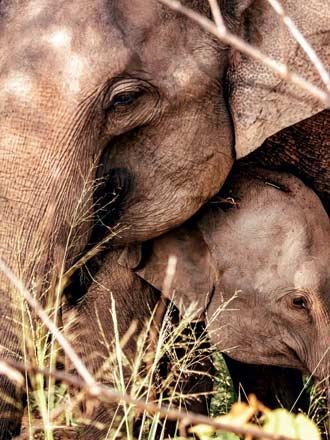
 Sri Lanka is one of the few countries in the world where a large, free-ranging elephant population lives in such close proximity to dense human settlement – not inside isolated reserves, but across working landscapes shaped by farming, roads, railways, irrigation systems and villages
By Anik Jayasekara
|
Unlike in many countries, Sri Lanka’s elephants have not been fully fenced into protected areas |
|
The website has been designed as an interactive platform |
Mankind cannot survive on its own. Coexistence matters, especially with nature. In a world that continues to cut down trees, kill animals and pollute surroundings, innovative initiatives are needed to educate people on the importance of environmental conservation. Sri Lanka’s Endangered is one such project that aims to raise awareness about various endangered animals in Sri Lanka and related topics that would allow anybody who visit their website to understand their part in this conservation process.
Led by Anik Jayasekara, the team behind www.srilankasendangered.com is building a public-facing platform that connects credible environmental knowledge with everyday understanding. Built on insights from environmentalists, wildlife experts, activists and professionals in the field, each article is treated as a living piece, designed to evolve through expert insight and real-world feedback.
Anik affirms that this is not another case of overwhelming people about various environmental issues that exist in different parts of the country. But rather, a platform that allows people to read about different animals, environmental issues and understand what they could do to make a change. As a first step, the platform invites you to register if you are interested to become an advocate.
Once you register, you will receive one email every week about an animal, with related images taken by Sri Lankan wildlife photographers and “simple, expert-advised actions you can take to help.” According to the website, these articles are “short enough to read before your tea cools, but powerful enough to change how you see this island”.
The website has been designed as an interactive platform, inviting conservationists, organisations, photographers, experts, teachers, parents, volunteers and anybody interested in wildlife to contribute with their insights to continuously improve content to make it more accurate and interesting for people. The platform is also open for anybody to volunteer as a writer, accountant, translator among others to improve its outreach.
Mahendran who applied to be a Data Analyst said that the idea to help Sri Lanka’s endangered animals has never crossed his mind before. “But once I saw the volunteer post, I wanted to give it a shot. I just want to get exposed to a world where people get together and work for a good cause. I am pretty sure that one day I can go to bed thinking that, I have done my part and my best to protect the motherland and animals,” he added.
In an attempt to familiarise the concept among readers, Sri Lanka’s Endangered will publish a series of articles in the Daily Mirror fortnightly.

Sri Lanka’s elephants are navigating decisions our plans were never designed to answer.
It is just after midnight in Sri Lanka’s dry zone. The air is still enough and sound carries far. A matriarch elephant pauses at the edge of a railway line. She does not rush. She does not retreat. One foot presses lightly onto the steel. It vibrates – not loudly, just enough to be felt. Somewhere beyond the bend, a horn sounds. Distant, but approaching.
This moment is not unusual for the elephant. But It is unusual for us.
Why This Situation Is Unusual
Sri Lanka is one of the few countries in the world where a large, free-ranging elephant population lives in such close proximity to dense human settlement – not inside isolated reserves, but across working landscapes shaped by farming, roads, railways, irrigation systems and villages.
Unlike in many countries, Sri Lanka’s elephants have not been fully fenced into protected areas, and much of the population still moves through a shared human landscape. Their historical routes still intersect with human infrastructure built decades – sometimes centuries – after those elephant routes were established.
What makes this situation globally rare is not just coexistence, but continuity: elephants are still trying to move through spaces that humans now actively manage.
Where Public Understanding Starts to Fray
When incidents occur – a train collision, a damaged crop, a sudden encounter – they tend to dominate headlines. These moments are dramatic, tragic and highly visible.
But visibility can distort understanding. Railway-related elephant deaths, while highly visible, are widely understood among field practitioners to represent only one part of a much broader challenge, which also includes habitat fragmentation, food competition, fencing decisions, land-use planning and long-term displacement pressures.
The risk is not that the public cares too much, but that care becomes concentrated on the most striking events, rather than on the most influential drivers.
The Expert Tension Zone
This is where the conversation becomes uncomfortable – and where expert voices matter most. Are elephants “adapting” to human systems, or are they being forced into narrower, riskier choices? When infrastructure cuts across historical elephant movement routes, is the failure ecological, logistical or institutional? Do short-term mitigation measures reduce long-term risk – or quietly shift danger elsewhere?
And when elephants survive in fragmented landscapes, does survival alone indicate success, or does it mask unseen stress, altered behaviour and cumulative loss?
These are not abstract questions. How they are answered shapes where fences are placed, how corridors are interpreted, what risks are tolerated and which trade-offs are considered acceptable. (For general readers: Many of these decisions happen far from public view – but they influence everyday encounters on farms, roads and railways.)
These questions are raised not to assign fault, but to reflect the complexity practitioners encounter when ecological systems intersect with human planning.
Touching the Ground: A Sri Lankan Reality
Field officers, farmers and wildlife staff across multiple regions quietly acknowledge a shared reality: encounters between elephants and people are not rare, nor confined to protected zones. They occur along cultivation edges, irrigation lines, seasonal pathways and infrastructure corridors –- often in places that do not appear on conservation maps, but exist vividly in lived experience.
In some districts, this includes fencing and land-use decisions aligned to administrative boundaries rather than continuous forest blocks -– a mismatch field practitioners say elephants do not recognise. This grounded understanding rarely reaches national conversation in full.
Why This Matters Beyond Elephants
Public understanding of elephants influences more than wildlife outcomes. It shapes how children learn about coexistence, how communities assess risk, how journalists frame responsibility and how future planners inherit today’s assumptions. What is written now – and left unchallenged – often becomes the reference point for classrooms, newsrooms and policy discussions years later.
This Story Is Still Being Written
This article is intentionally incomplete, not because the facts are unclear, but because public understanding improves when expertise is invited, not assumed. What appears in public articles today often becomes the reference point for students, journalists and policymakers tomorrow. By remaining open to correction, context and lived experience, this piece is designed to improve over time – not to fix a single moment in print.
This article is part of a public-interest initiative, SriLankasEndangered.com, which works with scientists, educators, photographers and communities to improve public understanding of Sri Lanka’s ecosystems – one story at a time. The project publishes open, evolving features designed to invite expert input rather than close debate.
Add to public understanding
If this article raised a question, nuance, correction or perspective shaped by research, field work, planning or lived experience, you’re welcome to respond here:www.srilankasendangered.com/respond
Insights are reviewed editorially and help refine how this issue is understood over time.
Meet the people behind the work
Researchers, practitioners, educators, planners and others working close to Sri Lanka’s environments who wish to share their journey, experience or perspective – and enable responsible connection with journalists, educators and communities – are welcome here:
www.srilankasendangered.com/experts
This space prioritises clarity, credibility and long-term contribution.
Teachers, parents and children
For educators and families looking for fun, age-appropriate material that supports classroom discussion and home conversations – without alarmism or fear:
www.srilankasendangered.com/kids
Designed for reading aloud, shared learning and curiosity-led discussion.
Photographers and visual storytellers
Photographers interested in contributing images that support accurate, long-term public understanding – with care for ecological context, timing and impact – can explore responsible ways to participate here:www.srilankasendangered.com/click
Images are treated as context, not decoration.
Organisations and initiatives
For organisations, researchers and initiatives working across Sri Lanka’s landscapes, waters and communities:
www.srilankasendangered.com/orgs
A shared ecosystem is easier to navigate when good work is visible and connected.
Everyone else
For readers who simply want to learn, explore and share at their own pace:
No donation requests. No pressure. Just understanding.
The elephant at the railway line does not see borders, budgets or headlines.
She feels vibration, remembers pathways and decides – one careful step at a time.
Whether our understanding keeps pace is still an open question.
The writer is the platform steward of
www.srilankasendangered.com
13 Jun 2026 10 minute ago
13 Jun 2026 20 minute ago
13 Jun 2026 55 minute ago
13 Jun 2026 1 hours ago
13 Jun 2026 2 hours ago