18 Mar 2025 - {{hitsCtrl.values.hits}}
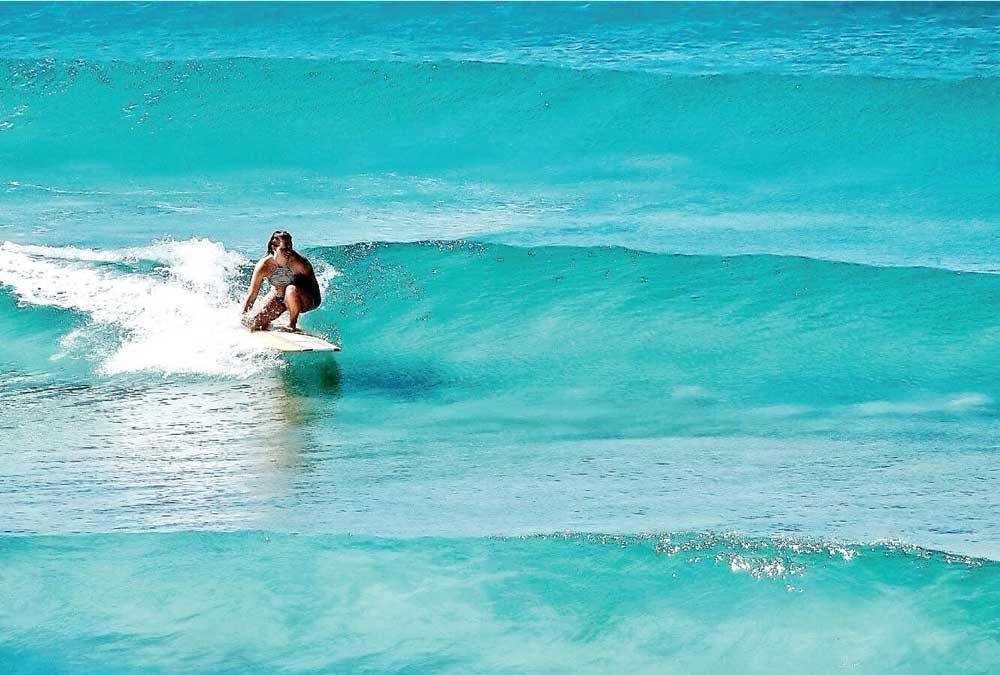
Sri Lanka is a potential destination for Israel tourists as it is a surfers’ paradise
Over tourism in the form of backpackers and tourists who patronise establishments run by their own communities are becoming a threat to Sri Lanka’s sovereignty and culture. This had been evident with recent incidents being reported from down South. The Daily Mirror has received credible information of at least two incidents where Israeli tourists had gone to the extent of warning locals to discontinue their parties while parties done by these tourists had been taking place beyond the designated time limit given by the government. With loud music and multiple events hosted at environmentally sensitive locations, these tourists have already become a nuisance to villagers. Concerned parties question whether prior approval was sought from government authorities before hosting these events and why law enforcement authorities have been keeping mum over the aggressive behaviour and reported incidents of assault on locals by these tourists.
- The country is coming out of an economic crisis and tourism is an avenue that could be used to generate revenue. But we’ll be killing the goose before it lays the golden egg if we just go after the numbers
- Srilal Miththapala, Tourism and Sustainability Specialist
- Sri Lanka is now being called Bali 2.0 on social media. But authorities should now look at attracting high end tourists. Tourism is a good revenue generator, but there has to be long-term sustainability. So many tourists are moving out of Bali due to over tourism
- Dewni Aluthwatte, Professional in development sector
- They are patronizing their own places; they dine at Israeli restaurants, they go for Israeli parties, stay at hotels run by Israelis and since some of this money is siphoned off straight to Israel, Sri Lanka is not benefiting from it
- Jeana De Zoysa, member of the Free Palestine Movement, Sri Lanka
Consequences of over tourism
According to official statistics, over two million tourists arrived in Sri Lanka in 2024. But researchers opine that over tourism would be a bane to the country if not managed properly. According to expert observations, the fact that the authorities are looking for quantity than quality would not support the country’s economy. “Sri Lanka is a small island and we have to protect our pristine beaches, ecosystems and other vulnerable natural assets,” said Srilal Miththapala, tourism and sustainability specialist. “The country is coming out of an economic crisis and tourism is an avenue that could be used to generate revenue. But we’ll be killing the goose before it lays the golden egg if we just go after the numbers,” he warned.
Researchers therefore believe that Sri Lanka should analyse whether backpackers actually contribute to the country’s economy. “Sri Lanka is now being called Bali 2.0 on social media,” said Dewni Aluthwatte, an experienced professional in the development sector. “But authorities should now look at attracting high end tourists. Tourism is a good revenue generator but there has to be long term sustainability. So many tourists are moving out of Bali due to over tourism. The tourism industry should now look at capping the numbers and improve on high spenders. We need to research and analyse whether backpackers actually spend when they travel here,” she added.
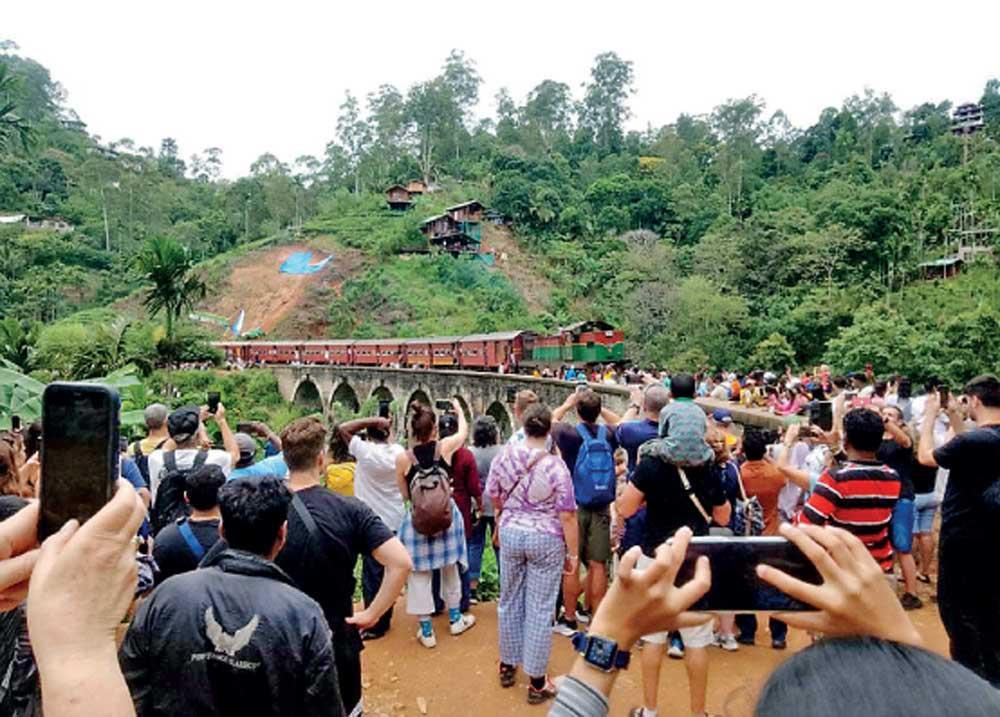
An influx of tourists spotted at the Nine Arch Bridge, Ella. Experts caution that over tourism could have little impact on the country’s economy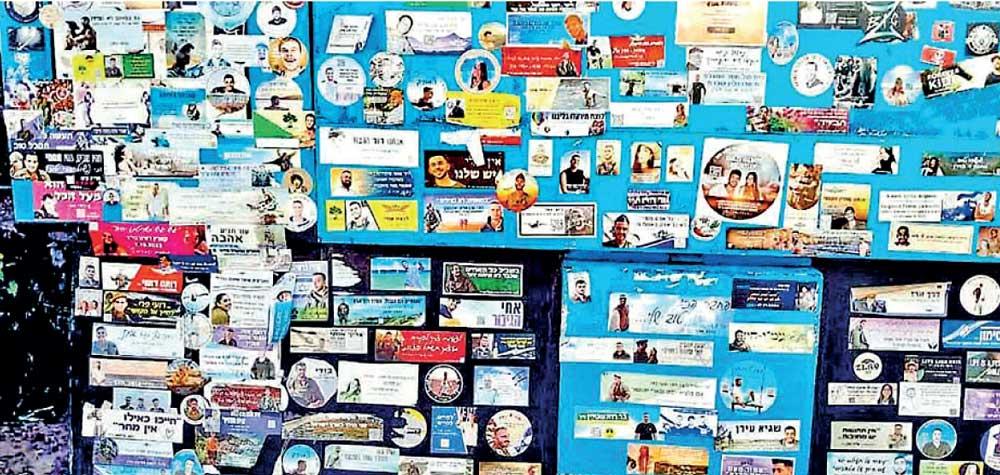
Images of Israel citizens who have died in the Gaza conflict showcased in Arugam Bay, Sri Lanka
Look for the high end tourist,
warn experts
Miththapala further proposed solutions to manage tourists such as increasing prices of tickets at national parks. “What is happening now is that tourists visit national parks for the sake of it because it is listed on their itineraries. But following a research done on 10 countries to find out the tourist carrying capacity it was revealed that Sri Lanka’s overall tourist footfall is 36 tourists per square kilometre, which is moderate compared to other destinations,” he added.
He further said that over-crowding at hotspots such as the Yala National Park and Sigiriya is already affecting visitor experiences. “Poor management of these locations is leading to localised over tourism, indicating that the country must proactively address potential future challenges. From our analysis it was clear that, in general, an average tourist foot fall of about 65-70 tourists per km2 is the threshold that a country can accommodate safely, without experiencing overtourism. Applying this benchmark to Sri Lanka (65,000 km²), the estimated maximum carrying capacity would be 4.2 to 4.5 million tourists annually. Therefore we could look at giving more experiences to these tourists and looking at ways to generate more revenue,” he suggested further.
Miththapala explained that with more tourists entering the country it also brings about a cultural change. Tourism hotspots such as Galle, Matara, Hiriketiya and Ahangama are flooded with tourists, but it is a known fact that they also come for the drugs, booze and parties. Another issue is the fact that many of these tourists who work here evade taxes. Some overstay their visas and certain businesses popup overnight with no regulations whatsoever. “We need to take examples from countries such as Bhutan that have managed to preserve their culture while becoming a haven for tourism. Having more backpackers won’t help the economy. It would be difficult to control them on the long run and we need to protect our culture. We are not promoting our country in a way that it appeals to the high end tourist. This is what the government should be doing now,” he added.
New wave of Western imperialism?
In 2017, during a visit to Singapore, Prime Minister Benjamin Netanyahu announced his plans to expand relations with Asia. According to geopolitical analysts such as Jacob Abadi, Israeli’s motivation to seek recognition and acceptance in Asia is due to ‘garrison state diplomacy’ – a type of diplomacy that occurs when a country is surrounded by hostile neighbours and becomes internationally isolated.
Israel’s relations with Asian countries — except for Burma and Singapore, which established relations in 1953 and 1969, respectively — date back to the fall of the Soviet Union. Formal relations with India and China, for instance, began in 1992. The relationship between Sri Lanka and Palestine, particularly the Palestine Liberation Organization (PLO), can be traced back to 1971, when the left-wing Sri Lanka Freedom Party led by Sirimavo Bandaranaike promised to close down the Israel embassy in Sri Lanka in support of the Palestinian cause. This decision came about in response to Israel’s violation of UN Security Council Resolution 242. For decades, Sri Lanka has maintained a consistent position on Palestine and has been voicing concern over the situation in Gaza. At the height of the armed conflict, Israel provided military equipment to the tri-forces and Sri Lanka re-established diplomatic ties with Israel after year 2000. Ironically, Sri Lanka has also continued sending thousands of its workers to Israel, for employment in farms and in the construction sector since the height of the Gaza conflict.
Case study - Israeli occupation
in Sri Lanka
Last year, the Daily Mirror reported how businesses run by Israeli tourists are becoming a threat to locals. Many of these businesses have been established with local partners. Many areas in down South such as Ahangama, Hiriketiya and Unawatuna are dominated by these tourists. According to researchers, the influx of Israeli tourists to Sri Lanka began in the last five years, particularly since October 2024 because many Israelis were banned from entering other holiday destinations like Maldives, Malaysia and 14 countries. “One of the reasons they like Sri Lanka is because they like to surf,” said Jeana De Zoysa, member of the Free Palestine Movement, Sri Lanka.
The Daily Mirror learned that many of these individuals are overstaying their tourist visas and continue to engage in businesses. The government therefore has a responsibility to follow these issues and ensure it doesn’t happen. De Zoysa further claimed that those coming to the country and going back as tourists are also supporting each other. “They are patronizing their own places; they dine at Israeli restaurants, they go for Israeli parties, stay at hotels run by Israelis and since some of this money is siphoned off straight to Israel, Sri Lanka is not benefiting from it. I don’t think this justification of Israel helping Sri Lanka in tourism actually works. Historically, Sri Lanka has supported Palestine in every UN resolution, condemned actions done by Israelis against Palestinians. But we are allowing them to travel here freely. We don’t know how it happens,” she added.
It has also been observed that despite all these issues, their businesses are being guarded by the Police while Chabad Houses (Israeli religious places of worship) are being guarded by STF round the clock. One individual questioned the purpose of having places of worship in other countries unless they are permanently residing in a country. The Daily Mirror reliably learned that most foreign-run businesses and Israeli establishments have employed Israeli military officers from the Israeli Defence Forces. De Zoysa further said that these people don’t seem to be coming here to assimilate, learn the languages or integrate into the Sri Lankan way of life. “They are picking up this Western model of tourism and dropping it in our country. Locals can’t even afford to dine in Israeli establishments,” she added.
There have been numerous instances when Israeli people have been displaying really intense aggression in Sri Lanka towards locals and other tourists. “One example is that in the surf culture, there are certain rules and etiquettes which are known globally in the surf community. Israelis are some of the few people that surf in the South and East Coast of the country, but they don’t respect these rules. There’s an etiquette or rule which gives priority to locals on the waves because it’s their surf. Israelis don’t respect that and they even get into fights with other tourists in the water. These videos are being shared virally on social media and Sri Lanka is getting a bad reputation globally because they are making the surf culture so aggressive, violent and tense. In the long run Israelis are bad for our tourism because they are creating a bad reputation for Sri Lanka,” she added.
Countries such as Cyprus and Goa have been overrun by Israel tourists. In September 2024, when the US Embassy in Sri Lanka issued a security alert over a possible attack on Arugam Bay and the East Coast of Sri Lanka, Sri Lankans had mixed reactions towards Israel tourists. Some tourism ventures depend entirely on Israeli tourists. Following the security alert, the government increased security at Chabad houses. The Daily Mirror learned that many Israeli tourists work on business visas which are illegal. With business visas they could operate a business from home. But these activities are neither regulated nor monitored. Many locals are also in the habit of leasing their lands and commercial spaces for Israeli tourists without weighing the consequences. Even though it is illegal to work on a tourist visa in Sri Lanka, it has been observed that unlicensed Israeli businesses mushrooming across the country.
Despite these incidents and threats to citizens in tourism hotspots, Sri Lanka is continuing to expand diplomatic ties with Israel. For example, Sri Lanka’s gem industry is striving to achieve an ambitious export target of $2 billion by 2025, seeking international collaborations to boost exports, tourism, and digital trade. In this effort, Israel has emerged as a key partner, offering opportunities for Sri Lankan gem traders to integrate into its well-established diamond industry.
On vacation
The Daily Mirror made several inquiries to confirm the presence of IDF officials in Sri Lanka employed in tourist establishments. A Defence Ministry official told this paper that usually IDF officers are sent on vacation to a destination of their choice after a mission.
In January this year, Prime Minister Dr. Harini Amarasuriya said in Parliament that the government would crack down on illegal activities carried out by Israeli tourists. Responding to a query on Israeli tourists running illegal businesses in the country, Dr. Amarasuriya assured that it had been identified as a problem and that steps will be taken to discuss about these issues and stop these activities. But by March the situation has aggravated to a point where locals are now feeling the heat of the influx of Israeli tourists for instance. The Daily Mirror on several occasions attempted to get a response from authorities regarding violent incidents that had been happening in the South. An email was sent to Dinesh Rodrigo, Honorary Consul of Israel to Sri Lanka to inquire about these incidents to which this paper had received no response at the time this paper went in for publication. Attempts made via calls and text messages to contact Foreign Affairs Minister Vijitha Herath, Deputy Minister of Tourism Prof. Ruwan Ranasinghe proved futile.
03 Jun 2026 03 Jun 2026
03 Jun 2026 03 Jun 2026
03 Jun 2026 03 Jun 2026
03 Jun 2026 03 Jun 2026
03 Jun 2026 03 Jun 2026