06 Jun 2025 - {{hitsCtrl.values.hits}}
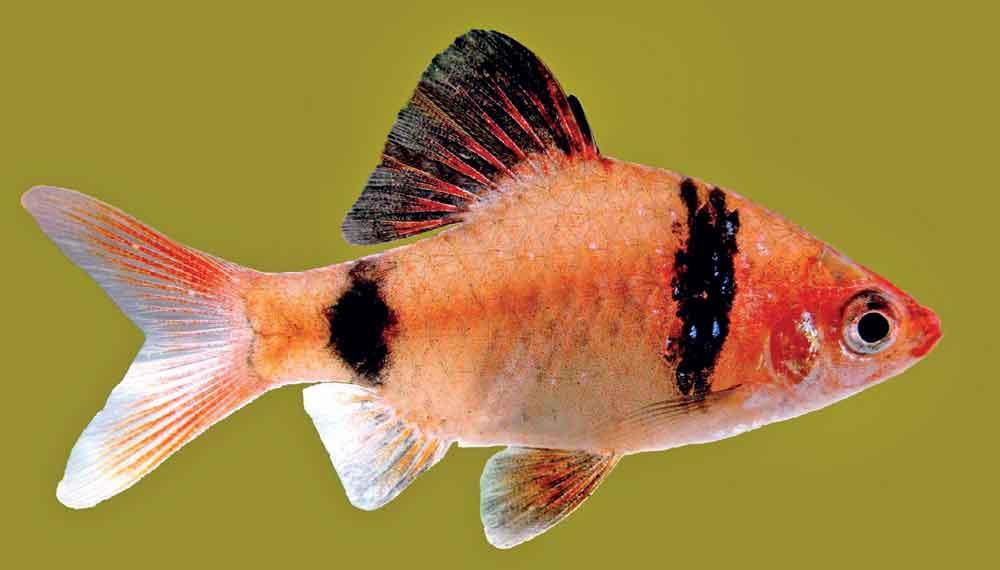
The Bandula Barb plays a crucial role in biodiversity as a ‘narrow-range endemic,’ meaning its presence is limited to just one small region and is not found anywhere else globally
One of the most significant conservation initiatives taken by the government in view of the World Environment Week was the declaration of the Nikkandupola stream in Galapitamada in the Warakapola Divisional Secretariat as a conservation zone and sanctuary. This is because a 2.5km stretch of stream in this area is home to the Bandula Barb (Pethiya bandula or Jayanthiya), a tiny freshwater fish species that is found nowhere else in the world.
Initial identification
This small reddish-gold fish was initially identified by renowned ichthyologist Dr. Rohan Pethiyagoda in 1991. It was first spotted in an aquarium at the home of Rodney Jonklass around 1987. Jonklass named the fish Bandula Barb because these specimens were given by Ranjith Bandula, an ornamental fish collector. In order to do away with the confusion as to whether it was a cousin of the Bulath Hapaya (Pethia nigrofasciata) and upon speculating whether it would be a new species, Dr. Pethiyagoda conducted research with Maurice Kottelat. His research led to a groundbreaking revelation that this fish species was, in fact, a new species to science. This was later confirmed in 2012 through DNA analysis done by Dr. Madhava Meegaskumbura at Peradeniya University.
Speaking to the Daily Mirror about its discovery, Dr. Pethiyagoda recalled that soon after he brought the attention of local villagers to this unique little fish, they joined together to protect it and prevent its exploitation, for example, by the ornamental-fish export industry. “Secondly, the Department of National Zoological Gardens successfully initiated a captive breeding program. As a result, an ex situ population of the species has been maintained at the Dehiwala Zoo for many years now. The award of formal protection to the area in which the fish occurs will provide the third pillar of that effort,” he said.
Dr. Pethiyagoda further said that Sri Lankans are coming increasingly to appreciate and value the unique biodiversity of their country. There is now a growing desire to conserve the entire richness of the natural world for future generations without allowing even a single species of plant or animal to become extinct, especially as a result of human activities. The Bandula Barb is an important element of that biodiversity, especially because it is a ‘narrow-range endemic’, meaning that it is found only in one small region and nowhere else in the world,” he underscored.
Looming threats
Speaking about threats to freshwater fish species, Dr. Pethiyagoda said that pollution of waterways and the loss of shade on riversides are probably more important threats as far as fish are concerned. “That said, we now have more exotic species of fish in Sri Lankan waters than endemic ones. It is almost impossible to eradicate exotic fish, so there’s little point in trying to address that threat, especially since successive governments have not placed any restrictions on the import of problematic species from overseas. In fact, given that the fisheries agencies have introduced so many species already, the government itself is part of the problem,” he claimed.
A Critical Step for Endemic Freshwater Fish Conservation
When asked what the government should do to protect the continuity of conservation zones declared in this nature, Dr. Pethiyagoda said that protected areas are irrelevant to most fish. “Offhand, I can’t think of a single species of freshwater fish that is confined to a protected area. Waterways exist as a network of streams and rivers, thousands of kilometres long, radiating from the highlands to the sea. Conventional “protected areas”, therefore, have little meaning to aquatic organisms. What is more important is establishing or maintaining natural vegetation on stream and river reservations. Nevertheless, for narrow-range “micro-endemics” such as the Bandula Barb, a protected area around its habitat could help minimise threats, so this is an important step,” he added.
Speaking further about its endemicity, conservationist and founder of Leopocon, Sethil Muhandiram said that the population of this freshwater fish species has declined dramatically, from an estimated 2,000 individuals in 1991 to fewer than 100 in a 2024 survey, largely due to habitat degradation caused by construction, pollution, and illegal collection for the ornamental fish trade.
He said that the newly declared sanctuary in Galapitamada aims to reverse this trend. “This move builds on over two decades of conservation work, beginning with a joint resolution by IUCN and the Ministry of Environment at the 2004 IUCN World Conservation Congress. A formal Conservation Action Plan was adopted in 2008, with implementation beginning in 2013. One of the key achievements was the establishment of an “insurance population” in Warakapola in 2014. This initiative, supported by the Department of Wildlife Conservation, Forest Department, and local communities in Hapugoda, Alpitiya, and Rabbidigala, helped create a foundation for sustainable species recovery,” he said while adding that the declaration of a sanctuary aligns with Sri Lanka’s obligations under the Convention on Biological Diversity and that it is a crucial safeguard for this unique freshwater ecosystem.
Addressing vulnerabilities
In addition to protecting the Bandula Barb, the government also declared five forests in Galle, Kegalle and Moneragala as protected areas, most notably the Nilgala Forest Complex. On June 1, 2025, the Department of National Zoological Gardens launched Sri Lanka’s first artificial insemination program for leopards at the Pinnawala Open Zoo. As such, Sri Lanka’s status as a global biodiversity hotspot is reinforced by these bold conservation actions.
Muhandiram further said that the declaration of new forest reserves and wildlife sanctuaries contributes to the protection of vital ecosystems, while scientific breeding programs strengthen species survival strategies. “Key institutions such as the Department of Wildlife Conservation and the Forest Department operating under frameworks like the Fauna and Flora Protection Ordinance of 1937 have been central to these efforts, working closely with international organisations and local communities,” he added.
Yet, challenges remain. “The Bandula barb’s habitat is still vulnerable to pollution and land-use changes, requiring continuous monitoring and local stewardship. The leopard breeding programme’s long-term success will depend on habitat conservation, genetic management, and the potential for reintroduction into the wild,” Muhandiram underscored.
However, sustainable conservation models, such as the community-led efforts in Warakapola, demonstrate the importance of inclusive, ground-level engagement. “As Sri Lanka looks ahead, continued public support, adequate funding, and strong international partnerships will be essential to secure the future of its natural heritage,” he added.
Apart from declaring the home range of the Bandula Barb and its surrounds as a sanctuary, the government has taken steps to ensure that this stretch of stream is least polluted due to anthropogenic factors. “On one side of this stream are paddy fields, and on the other side are home gardens. So we are looking at ways to implement organic farming in its immediate surroundings so that this stretch of stream wouldn’t be polluted by fertiliser discharge,” said Deputy Environment Minister Anton Jayakody.
The Daily Mirror learned that the local environment organisation has taken the lead in ensuring that the home range of the Bandula Barb won’t be disturbed under any circumstances. “We are looking at ways to minimise threats to this freshwater fish species due to soil erosion as well. Community engagement is paramount at this point as they are the guardians of this freshwater fish species,” Jayakody said while adding that the government will look at conserving more endemic freshwater fish species in future. Additional reporting by Shantha Chandrasiri
20 Jul 2026 3 minute ago
20 Jul 2026 1 hours ago
20 Jul 2026 2 hours ago
20 Jul 2026 2 hours ago
20 Jul 2026 2 hours ago