03 Aug 2018 - {{hitsCtrl.values.hits}}
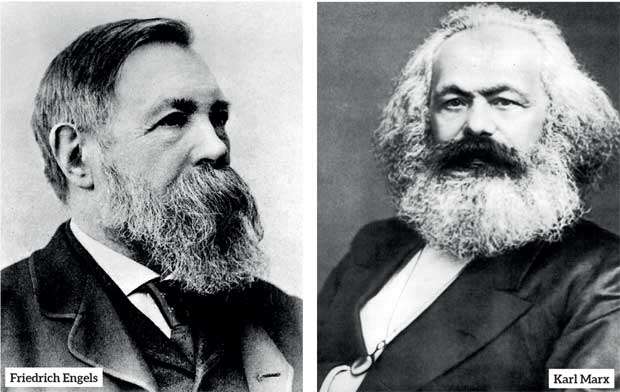


arl Marx and Friedrich Engels simplified history into a series of class struggles rooted in the conflict between the many and the few. From the few, the dominant philosophies of the West, including humanism and liberalism, had been summoned. What commentators batting for both these philosophies forget is that these ideologies were the products of mass exploitation on the one hand and privileges for the minority on the other. The many had no philosophy or system of thought which they could claim as theirs. The closest that Europe got to in those days to such a system of thought was the utopian socialism of Henri de Saint-Simon, Charles Fourier, and Robert Owen and the Protestant Reformation and the rise of the rebel, peasant sects (as with Thomas Müntzer and the Anabaptists). It was with Marx and then Engels that capitalism bred its own antithesis, as rational, as scientific, and as Judeo-Christian.
"Engels argues in his introduction to the English edition of Socialism: Utopian and Scientific that British society, initially materialist, moved away from materialism as the industrial bourgeoisie rose to power"
Engels argues in his introduction to the English edition of Socialism: Utopian and Scientific that British society, initially materialist, moved away from materialism as the industrial bourgeoisie rose to power.

Science and industry had conspired to make them rich, but the materialism which had uplifted them horrified them when it became obvious that it could be used to rationalise the movement against them. No, this article is not about Marxism, materialism, or capitalism. It is about how these perspectives help explain the multidimensionality of class struggles in societies such as ours.
What explains the deterioration of the class struggle in Sri Lanka? The rise of neo-liberalism? The stunting of the Left movement? The self-contradictoriness of that same Left movement, not to mention the culture of self-aggrandizement privileged by the movers and leaders thereof? My contention is that it is a combination of these factors, plus the fact that we have seemingly misconceived the lower depths of our society in both classist and ethnic terms. Marx argued that “it is not the consciousness of men that determines their existence, but their social existence that determines their consciousness”, he may have inadvertently passed over the other non-social factors that make us the flawed human beings we are. He conveniently left out the personal, which I think is as important as, if not more important than, the social in explaining the stratifications which continue to assail our society, not just in Sri Lanka. The personal explains why the Left movement failed and why it flounders even now. History is not a series of class struggles only; it is a history of movements that rise to address those struggles, only to fall back in the face of compromise and expedience.
|
In my opinion, the Left is still a force to reckon with, but in the hands of various forces that can hardly be considered sympathetic towards it, it has been distorted to such an extent that I can no longer view the world as one giant stage on which the workers of the world unite against their masters |
Contrary to what Engels imagined, the revolution did not transpire in Industrial Britain, and that because of a host of factors he did not take into account (most prominently, the parliamentary system, which despite its failures distinguished British society from the more autocratic monarchies of continental Europe). Revolution had to take place in a society far removed from Marxist ideals, in Russia, where capitalism had not fully been rooted and where the urban proletariat had to be rescued from the clutches of the idiocy of the rural peasantry. It was not Marxism that heralded the beginning of Communism, it was Leninism, and even that splintered in later years to the excesses of Stalinism, which finally was rejected through glasnost and perestroika. Historians and scholars who romanticise the Revolution naturally forget it was achieved at an enormous cost. Marxists did not reject the tools of capitalism. They found in them the path towards their utopias. The cost of communism was, therefore, no different to the cost of capitalism, industrialisation, and imperialism. As Isaac Deutscher correctly surmised, Stalin “found Russia working wooden ploughs and left her equipped with atomic piles.” The shift from the one to the other entailed great human suffering.
Necessary? Perhaps. It would have been impossible to be a moderate in those hard, divisive times, as the Mensheviks and the Social Democrats found out soon enough. But revolutions, whether industrial or communist, have a habit of perpetuating certain myths, and these myths have their peddlers. History is but the version we read, and the version that is written is the ideology of the person authoring it. Marxism bred its prophets, and those prophets evolved to dogmatists who still dream about perfect societies. Sri Lanka is no stranger to these dogmatists. They exist and they write.
In Sri Lanka, the classist aspect of Marxism (which was, I think, the only aspect that was truly Marxist) morphed into an ethnic reading of Marxist tenets. This was largely a result of Western revisionist scholarship segmenting classism into gender relations and ethnic polarities, and this process of segmentation conforms to the model proposed by the eminent Czech jurist Karl Vasak, in 1979, whereby the notion of human rights evolved through three generations, from the bourgeois notion of “liberty, equality, and fraternity” during the French Revolution, to the notion of economic and cultural freedoms informed by the Civil Rights Movement (in turn informed by the left movement in the United States), to the unilateralist notion of self-determination facilitated by the rise of human rights law (in particular, the 1972 Stockholm Declaration and the 1992 Rio Declaration). Classical Marxism, unlike classical liberalism, had no place in the new world order, and the eighties, which saw foreign-funded NGOs hijacking leftist parties the world over, mangled Marxism as we know it. Distortion was the name of the game. In the end, the class went out of the picture, and in came ideologies pertaining to ethnicity and self-determination and separatism.
I prefer to view history, not as a series of class struggles, but as a series of processes which are formed to ameliorate the ills of the world. Philosophies can only take us that far, and being a product of industrialisation and Judeo-Christian values, it was doomed to be as materialistic, as reliant on the desire to satisfy human wants, as capitalism. It wasn’t just Nalin de Silva who contended that Marxism was as Judeo-Christian as Christianity, which was supposedly opposed to it. It was also Regi Siriwardena, who can hardly be called an anti-Christian Sinhala Buddhist chauvinist (not that Nalin is a chauvinist as some scholars paint him), who diagnosed Marxism as follows: “Poverty is certainly an unmixed evil, which crushes both body and spirit, and it should be eradicated, but the viable alternative to it isn’t unlimited plenty.” There lies the problem of Communism: it sought to create a perfect universe but succeeded in creating a replica of the society it sought to combat, creating its own class hierarchies between the multitude and the officials. Marxism promised to somehow bring down the corridors of power, and it was revolutionary, but human beings eventually came to prefer evolution to revolution, and capitalism, after it passed its exploitative peak (not that it isn’t exploitative today), coincided with Western democracy to create societies that ran on such an evolutionary streak, preferring gradual reform to radical change.
Today the overwhelming driving force in the world is not capitalism, not communism, but nationalism. Marx discounted it, and so did the industrialists of the 18th century, but even with free trade and even with the Soviet Union, the world could not contain it. People misquote Engels’s contention about the “idiocy of rural life”, but then again, there was never really anything to misquote. The meaning was clear: the aim of perfect societies was to salvage itself from agricultural backwardness through technological progress. Such an attitude discounted nationalism, which was seen as the bedrock of agricultural societies, though as the Russian experience shows, even the peasants had ambivalent responses towards it. Nationalists thus could not be counted on to further the objectives of Marxist societies, and it was here that the prophets of communism failed: the 20th century brought together trade unionism, trade blocs, and free trade in a way that upended the anti-nationalist diatribes of Marxist tenets. The workers of the world may unite, but they continue to be swayed by other, older passions. You saw it in Trump’s America and you saw it in Kim Jong-Il’s North Korea. You even saw it in revolutionary Russia, which would in later years channel Great Russian Chauvinism.
"What explains the deterioration of the class struggle in Sri Lanka? The rise of neo-liberalism? The stunting of the Left movement? The self-contradictoriness of that same Left movement, not to mention the culture of self-aggrandizement privileged by the movers and leaders thereof? My contention is that it is a combination of these factors"
I mentioned at the beginning that Marx passed over the personal, when he contended that the social predetermined the consciousness of human beings. In one sense, that is the flaw of Marxism from which all other flaws follow. In the final analysis, we can, therefore, say the following: that in projecting history as a series of struggles between the many and the few, the prophets of Marxism, Leninism, and all those other -isms failed to account for the dynamism and the imperfections of individuals. The few are as susceptible to compromise as the many.
In my opinion, the Left is still a force to reckon with, but in the hands of various forces that can hardly be considered sympathetic towards it, it has been distorted to such an extent that I can no longer view the world as one giant stage on which the workers of the world unite against their masters. On the contrary, I see in the leaders of trade unions, at least a great many of them, the same seekers of vested interests that those masters are. I am being heretical here, yes, but recent events, particularly in Sri Lanka, do bear me out.
17 Jun 2026 2 hours ago
17 Jun 2026 2 hours ago
17 Jun 2026 3 hours ago
17 Jun 2026 3 hours ago
17 Jun 2026 4 hours ago