11 Oct 2025 - {{hitsCtrl.values.hits}}
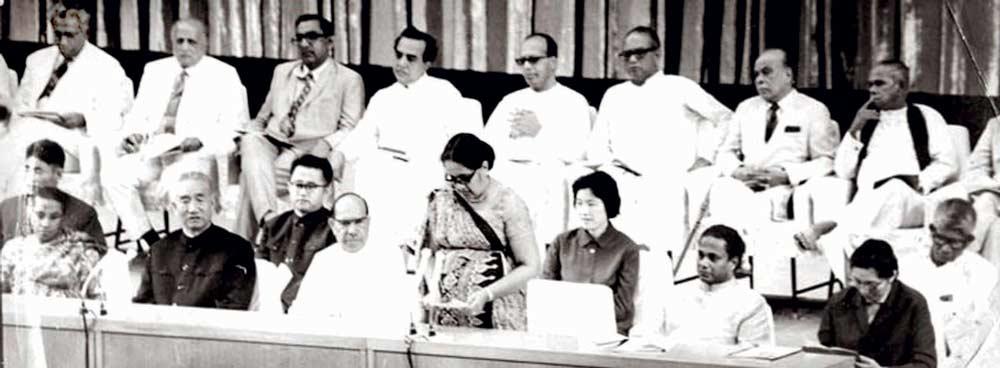
At a time when two major superpowers waged the Cold War, Sri Lanka, under Sirimavo, hosted the Non-Aligned Movement summit in 1976, attended by 86 heads of state. FILE PHOTO
 She demonstrated a remarkable yearning for things close to her heart—a trait abundantly evident throughout her political life. Even as a six-year-old kindergarten student, she insisted that a particular bull be harnessed to the buggy that carried her daily to school from her aunt Mrs Dambavinne’s house, under the care of a faithful maid. She would confound the carter whenever he attempted to use a different bull.
This passion for specific, meaningful things persisted into her years as Prime Minister. Bradman Weerakoon, her official secretary, recalls: “She insisted that fresh fruits—Mangosteens from Horagolla, Rambutan and mangoes from Attanagalle—be airlifted to London to be served to distinguished VVIPs at a dinner she hosted.” He notes that she specified these details in a handwritten personal note to her secretary, indicating precisely where to collect the fruits, their types, and even particular varieties.
|
She left as she had lived: unbowed, uncompromising and faithful to the people until her last breath. Sirimavo Bandaranaike, the world’s first woman head of state, served Sri Lanka for four decades |
An image of this hand-written note -courtesy ‘Rendering unto Caesar’—B. Weerakoon, 2004: pp. 91-92.
When the first marriage proposal from the Senanayakes of Hapitigame Korale, Ihalagama Bothale Walawwa failed, broker Nanayakkara successfully brokered a match with the 41-year-old Oxford-educated son of Maha Mudaliar Solomon D. Bandaranaike of Horagolla Walawwa, West Ridgeway, from the Siyane Korale. The engagement was arranged in June 1940, with the wedding scheduled for October.
During their courtship, on July 8th, the prospective groom paid a visit to Mahawelatenne Walawwa in Balangoda. He spent the day there and departed in the evening. The very next day, she wrote a long love letter to her fiancé—her choice of words gracious, unfaltering, and delightfully “naughty” in expressing the depth of her emotions and passion. SWRD clearly cherished it forever; the letter remains preserved at the Bandaranaike Museum at BMICH.
A short extract from this letter, written 85 years ago...
“My own precious darling…, Why did you leave me and go away yesterday? I am feeling wretched after you left me…my sweetheart, I never felt so helpless…”.
On October 2, 1940, the former Oxford Union secretary was escorted from Horagolla to Mahawelatenne in a grand procession, accompanied by his father and an advisor to the British Governor, an elite from a low-country Sinhalese Anglican family. Oriental music played throughout the ceremony, and the bride carried a spray of white lotuses. Sir D.B. Jayatilleke, leader of the house in the State Council, described the marriage of SWRD—the Minister of Health and a converted Buddhist—to 24-year-old Sirimavo as “a historic occasion worthy of a niche in the records of the country”.
The newlyweds moved into ‘Wentworth’ on Guildford Crescent. There, Sirimavo developed a fondness for tennis, her husband’s game, and was often seen in the evenings walking to the Women’s International Club with her cousin, Mrs. Danton Obeysekara—two young ladies of dignity, poise, and grace.
P.E.P. Deraniyagala, SWRD’s cousin and his best man, skeptically remarked upon her reluctant entry into politics following her husband’s assassination: “What does she know of politics? She’ll end by spoiling her reputation and ruining the family name”. All her critics would soon find themselves gravely mistaken.
Ceylon was known internationally in the pre-independence era as the supplier of Lipton’s tea, and later as Sri Lanka for its Cricket World Cup victory in 1996 and conquest of the world’s most ruthless terrorist organisation. Yet all such achievements will fade with time. What will remain eternal in mankind’s history is how, in July 1960, we stunned the political world by electing the first woman head of state—Sirimavo Ratwatte Dias Bandaranaike.
Reporting the historic event on its front page, the London Evening News wrote in bold letters on July 21, 1960: “There will be a need for a new term, shall we call her Stateswoman?” Six years would pass before another nation elected a woman Prime Minister—India’s Indira Gandhi, followed by Israel’s Golda Meir, Britain’s Margaret Thatcher, and others.
At a time when two superpowers waged the Cold War, competing for influence over third-world nations, Sri Lanka under Sirimavo hosted the Non-Aligned Movement summit in 1976, attended by 86 heads of state.
The Woman Who Put Sri Lanka on the World Map
Sirimavo Bandaranaike’s diplomacy was as much about warmth and personality as it was about policy. Her personal charm and quiet strength in bilateral relations earned her respect across continents. Before entering politics, she had accompanied her husband on diplomatic visits, meeting world leaders and building friendships—particularly with India’s Nehru family—that would later shape Sri Lanka’s foreign relations.
Her first official overseas visit as Prime Minister was to New Delhi in 1960, where Jawaharlal Nehru welcomed her as a friend. In 1962, Nehru visited Ceylon to inaugurate the Bandaranaike Ayurveda Research Centre. Two years later, she signed the historic Sirima–Shastri Pact with Prime Minister Lal Bahadur Shastri, resolving the citizenship status of over 800,000 Indian-origin plantation workers—a problem that had lingered for decades.
Her friendship with Indira Gandhi deepened over the years. Together they resolved the Kachchativu boundary dispute and defined maritime borders, strengthening Sri Lanka’s sovereignty. Yet Mrs. Bandaranaike never let friendship cloud her judgment; she stood firm on national interest, even opposing the 1987 Indo-Lanka Accord.
Her diplomatic reach extended far beyond India. She built strong ties with Pakistan, becoming the first Sri Lankan leader to address its Parliament in 1964, and later hosted Prime Minister Zulfikar Ali Bhutto in Colombo. With China, she deepened the bond her husband had begun in 1957. Premier Chou En-lai’s 1964 visit resulted in the gift of the Bandaranaike Memorial International Conference Hall (BMICH), a proud landmark in Colombo to this day. Her 1972 visit to Beijing secured an interest-free long-term loan and Chinese support for her proposal to make the Indian Ocean a Zone of Peace.
During the Cold War, she walked a delicate path of non-alignment with skill and balance. She corresponded personally with U.S. President John F. Kennedy and later met President Richard Nixon in Washington. Her visits to Moscow and friendship with Yugoslavia’s Marshal Tito demonstrated her ability to engage both sides of the global divide with equal ease.
Mrs. Bandaranaike’s reach was truly global. She met Egypt’s President Nasser, who aided Sri Lanka during an oil shortage; negotiated concessionary oil from Iraq’s Saddam Hussein; voiced support for Nelson Mandela’s anti-apartheid struggle; and built friendships with leaders including Canada’s Pierre Trudeau, Zambia’s Kenneth Kaunda, and Japan’s Takeo Miki.
As the world’s first woman Prime Minister—and Sri Lanka’s Minister of External Affairs and Defence—she proved that diplomacy could be both principled and compassionate. Her vision inspired the founding of the Bandaranaike Centre for International Studies (1974) and the Bandaranaike International Diplomatic Training Institute (1995), institutions that continue her legacy.
Economic Vision
Sirimavo’s economic vision was rooted in a socialist-oriented, mixed economy aimed at achieving national self-reliance. Her government actively intervened in industrial development through the creation and expansion of state-owned enterprises to manage key sectors. Among them were the Ceylon Steel Corporation (with Soviet assistance in 1962), the Ceylon Tyre Corporation (supported by Yugoslavia), the Ceylon Sugar Corporation at Kantalai and Sevanagala, the Ceylon Cement Corporation, and the Ceylon Ceramic Corporation. These ventures symbolised her determination to reduce dependence on imports and strengthen the domestic industrial base.
A central element of her policy was nationalisation. Major foreign and private enterprises—including oil companies, insurance firms, banks, and transport services—were brought under public control. The nationalisation of American oil companies ignoring US threats and establishment of the Ceylon Petroleum Corporation in 1961 marked the expansion of the state’s role in both industry and commerce.
Her economic strategy followed the principle of Import Substitution Industrialisation (ISI), which sought to replace imported goods with locally produced alternatives. The government introduced protectionist measures such as tariffs, licensing systems, and foreign exchange controls. Small and medium industries were encouraged to operate under state supervision, ensuring planned growth and fair distribution of resources. Sirimavo’s Non-Aligned Movement diplomacy also supported her industrial goals. She secured foreign aid, technical expertise, and training opportunities from socialist and friendly non-aligned nations such as the Soviet Union, China, and Yugoslavia.
Beyond large-scale ventures, she promoted rural industrialisation to provide employment and uplift village economies. Traditional sectors—handloom, pottery, and coir—received state assistance, while institutions like the Industrial Development Board (IDB) and the Small Industries Department offered credit and training. Together, these initiatives defined Sirimavo’s legacy as a leader who sought to industrialise Sri Lanka through state-led planning, social equity, and international cooperation.
Sirimavo Bandaranaike’s journey was not just political—it was human, courageous, and profoundly global. She showed that even a small island nation could speak with confidence among giants.
The three unprecedented catastrophes in the years 1962, 1971 and again in 1980, she courageously confronted. High-ranking police and security forces officers planned a Coup d’état in January 1962 to overthrow her government and set up a military junta; it was aborted hours before the scheduled action. Then again, in April 1971, the JVP instigated a youth uprising: two instances of unique experiences occurred during her first and second administrations, which threatened the democratic foundation of Sri Lanka, which she thwarted as head of state, handling them in the most splendid manner. But in the third, in 1980, when she was out of power, her democratic rights were withdrawn on trumped-up charges by JRJ using parliament’s two-thirds majority to introduce Constitutional amendments.
The UNP leadership feared the name Sirimavo so much that they conspired to deprive her of civic rights and prevent her from contesting or campaigning at elections. She was expelled from Parliament. In her masterful farewell speech to parliamentary colleagues, she warned: “Remember, the Sword of Damocles hanging over my head will soon be yours. The people will see to it”.
She stood alone, as her party boycotted the proceedings. Vociferous UNP MPs were raucous and boisterous as Mrs. Bandaranaike prepared to leave. In a remarkable gesture of parliamentary dignity, Opposition leader Appapillai Amirthalingam and TULF president Murugesu Sivasithamparam—who had voted against the civic rights deprivation—flanked her on both sides and gallantly escorted her out. This act of respect was particularly striking given that she had implemented standardisation policies depriving many Tamil-medium students of university entry.
The 45-year-old Prime Minister was scheduled to return from Kataragama on the night of January 27, 1962. A group of military and police conspirators lay in wait along her route, prepared to take her into custody—or, if she resisted, to kill her. It was the night they had chosen for their coup d’état. Her last-minute cancellation of the trip became a twist of fate that saved both her life and the nation’s democracy.
But destiny, it seems, had merely postponed the inevitable. On 10th October 2000, that same indomitable woman—now a frail 83-year-old, defying medical warnings—was simply exercising the sacred democratic right she had championed her entire life. Returning from Attanagalle’s polling booth, having cast what would be her final vote, fate finally caught up with her. This time, there would be no last-minute reprieve, no eleventh-hour rescue.
She left as she had lived: unbowed, uncompromising, and faithful to the people until her last breath.
The writer can be reached at [email protected]
12 Jun 2026 10 minute ago
12 Jun 2026 17 minute ago
12 Jun 2026 21 minute ago
12 Jun 2026 24 minute ago
12 Jun 2026 32 minute ago