07 Aug 2018 - {{hitsCtrl.values.hits}}
 There are times when I lament my abysmal knowledge of Sinhala. It is a language of course, but even as a language it takes much more than memorising grammar rules and vocabulary to master it. Being a dilettante when it comes to these matters, I never really picked it up. Poetry eludes me, so does prose. I tried my hand at writing a few essays there and a few love poems here, but the experience was so overwhelming that I gave up. This was years ago. I haven’t tried again since. In hindsight, this can indicate fear, ignorance, complacency, or a lack of willpower, depending on how you look at it. My excuse is that without getting steeped in the foundation of a language, without understanding the historical processes behind a language, it is difficult to be creative.
Professor K. A. I. Kalyanaratne, former co-honorary secretary of the Hela Havula, in a review of Cumaratunga Munidasa’s Purana Sinhala Akuru Karanaya, contended that it is a language which separates us from the animal world. I strongly agree. Language is what makes civilisation possible, and civilisation is what facilitates identity on the basis of shared rituals and practices. Perhaps no other intellectual and artiste from the 20th century understood this in relation to the Sinhala language more than Munidasa himself, whose death anniversary fell on July 25. No, this is not a sketch of the man, much less an exploration into what he did, rather some brief reflections on his work.
Garrett Field, in his seminal but overlooked work Modernising Composition, contends that the modern history of linguistic politics in Sri Lanka begins with Cumaratunga.
Put briefly, the man tried to do for the language what the revivalists of the previous century had done for Buddhism. It was his belief that purity in language, the ‘maw basa’, shorn of foreign accretions, was integral to the ideal of nationhood. There would not, in other words, be a ‘desa’ and ‘rasa’ without a ‘basa’. With this objective, he thus sought to redefine Sinhala, not just in relation to academic syllabuses (at one point he was appointed as an inspector of Anglo-Vernacular schools for the Department of Education), but also in opposition to the accepted texts which had been used to teach the subject. Based on these beliefs, he confidently rejected both the Sasadāvata and the Muvadevdāvata, which contained Sanskrit loanwords he felt to be inimical to his project. He was not, in other words, afraid of rebuking what needed to be rebuked.
Cumaratunga Munidasa’s poetry rises from its pages and implores us to musicalise it
There were three faces to the man: linguist, poet, and activist. Contemporary society and scholarship tend to analyse each facet in isolation, forgetting that it is the fusion of them, and not the study of one over the other, which can help us understand what the man did and whether the project he spearheaded worked to its envisioned end. That is why his criticism of poets who imbibed Tagore cannot be seen as only an aesthetic judgment, but rather as an integral part of his belief in achieving purity in the markers of our identity. Not even the Mahavamsa was immune from his pen since it promoted the idea that the Sinhalese were descended from North India when historical records showed that there was a thriving “help” civilisation prior to the arrival of Vijaya.
I am certainly not up to the task of charting and tracing what Cumaratunga did in relation to Sinhala poetry, prose, and polemics, but I cannot help but observe that throughout his life, the man combined didacticism and austerity of expression to convey his beliefs to the lay reader, and to convince that reader. This proved to be a strength in later years. With Lakminipahana, Subasa, and Helio, the three journals which helped the Hela Havula disseminate its worldview throughout the country, he was able to turn his endeavours from the fringe project it could well have become to an active search for roots. And one demographic that he targeted, more than any other, was the child. No one who has read Kumara Gee, or sung such immortal classics as “Ha Ha Hari Hawa”, can fail to be moved by its nuances, a point made by former Speaker of the Parliament W. J. M. Lokubandara at the recently held Cumaratunga Munidasa Sisuvarama, where he observed that the man’s poetry rises from its pages and implores us to musicalise it. There was nothing immobile about it, in other words.
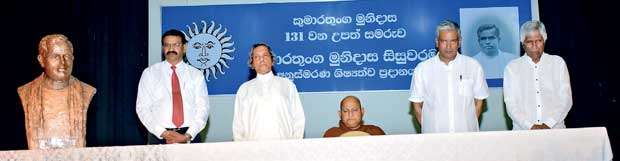
The Cumuratunga Munidasa Sisuvarama is one noteworthy way through which his contribution to children’s literature is being sustained, and promoted, among the children of today. Begun in 2012 and organised by the Cumaratunga Munidasa Foundation, it rewards academic achievement in Sinhala by granting a scholarship to the student who obtains the highest mark for the subject at the Ordinary Level exams. And so it was. Professor Wimal Dissanayake, who wrote an extensive piece years ago on the route linguistics took in Sri Lanka through the Munidasa, spoke of the way the man brought tradition to modernity. This year, by contrast, the organisers focused on the poet in the man, seeing it fit to invite the leading academic on the subject in Sri Lanka, Professor Sunil Ariyaratne. Also, by contrast, this year saw just one winner, Senuki Vilara Gunaratne from Museaus College, with the event being unveiled at the much larger, more comfortable Western Province Aesthetic Resort, on the death anniversary of the Munidasa, July 25.
Garrett Field, in his seminal but overlooked work Modernising Composition, contends that the modern history of linguistic politics in Sri Lanka begins with Cumaratunga
Professor Ariyaratne spoke. He referred to some poems that, in his opinion, had not been researched into or analysed well before. He contended that these poems could help us gain insights into the man’s innermost beliefs. “Just as the moon brightens the night sky as a thousand stars cannot, so can one good child brighten up his parents’ life in a way that many bad children cannot,” he quoted, observing that it was the man’s didacticism, combined with the many metaphors he borrowed from everyday life, which made his poetry stand out. To this end, a few observations made by that other renowned critic of the Sinhala poem, Gunadasa Amarasekara, might be pertinent here.
In an article titled “Cumaratunga Munidasa the poet”, later published in an anthology dedicated to the man (the first in a series titled “Visidunu Vimasuma”), Amarasekara roundly dismisses the two strands of poetry which dominated the first and second halves of the 20th century: respectively, the Colombo school and the nisadas (free verse) school. “My contention is that Cumaratunga’s Piya Samara is greater than the work of either of these two groups, because of its originality and its efforts at going beyond the confines of the Kotte era,” Amarasekara argues, observing that while the Colombo school, represented in its early years by Ananda Rajakaruna, sought to combine the form and meter of the Kotte Period with contemporary experience, it failed because, in his opinion, it deteriorated to a series of exercises in aestheticism, “more preoccupied with its own workings” as he suggests or rather implies.
This can, depending on how you view Amarasekara’s critique, be taken to mean that while the Colombo poets (who imbibed not just the likes of Thotagamuwe Rahula Thera, but also the Lake Poets from England) found a reference point in the 15th and 16th centuries, they were unable to find a canvas for their inspiration in their society.
But while the likes of Rajakaruna failed to move from the 15th century, they did not make the error of erasing the fine distinction between prose and poetry, something Amarasekara argues the nisadas school committed. Amarasekara’s distrust of free verse was shared even by contemporary English language poets, most famously Robert Frost, who once contended that writing it was like “playing tennis with the net down.” “Because of the liberty taken by our free verse poets,” the critic argues in his piece, “Sinhalese writers began coming up with metaphors like ‘adaraye simenthi’ (‘the cement of love’) and ‘jeevithaye bhumi thel’ (‘the fuel of life’)”, implying of course that such metaphors made little to no sense and were a convenient cover for the writer’s laziness.
Photos by Manusha Lakshan and Sithira Edirimanna
17 Jun 2026 2 hours ago
17 Jun 2026 2 hours ago
17 Jun 2026 3 hours ago
17 Jun 2026 3 hours ago
17 Jun 2026 4 hours ago