26 Jul 2018 - {{hitsCtrl.values.hits}}
Ranjith Rubasinghe
 In his introduction to his collection of essays “Our Films, Their Films”, Satyajit Ray argues that the cinema is not a cerebral craft and, far from being so, it is reliant on movement and labour. The gist of his contention is that words are hardly enough by way of salvaging the medium, and regardless of what critics and philosophers can do, it can only be salvaged by people who are willing to risk everything for nothing. In that sense, probably the worst thing to happen to the medium was the misconception that art could be divided from craft, and that movies could be made in the minds of their directors.
What this misconception conveniently leaves out, Chandran Rutnam told me years ago, was the fact that when shooting a film, everyone, from the editor to the tea boy, is important. “The director who doesn’t account for this fact,” Rutnam put it to me rather frankly, “is a fool, and is hardly deserving of the title of ‘director’.”
More than literature, more than music, more than even the theatre, the cinema is a heavily collaborationist art. It is as dependent on creativity and imagination as it is on an army of technicians and labourers. After all, let’s not forget that the world’s first filmmakers didn’t consider themselves as artistes, but as businessmen who were there to enthral audiences using whatever means possible. They worked, they sweated, and in the end, when they achieved popular success, they triumphed. None of that would have been possible if, like the Cahiers du Cinema critics and auteurs, they considered the filmmaking process as an act of faith by individuals. “It needs a Bach to write a Sarabande that needs a Casals to do it justice,” Ray wrote in his introduction. That statement, multiplied 10 times over, proves valid for the cinema. From Griffith to Hitchcock, from Spielberg to Nolan, the cinema is thus both a craft and an art.
Sri Lanka, in particular, is no exception to this rule. Particularly after 1956, right after Lester James Peries revolutionised the way we made movies, there came about a rift between creativity and craftwork, corresponding to a larger rift between art and entertainment, in the industry. As has been pointed out, one of the most lamentable results of free education was the abandonment of a cohesive project to come up with technical terms in Sinhala (and Tamil, though I’m not too sure). I believe it was D. B. Nihalsinghe who contended that free education did more damage than good when it came to the cinema, since it virtually made unnecessary any effort made at translating such terms. Particularly when it came to directors who did not view the medium as a means of self-enrichment, seeking a proper contingent of technicians thus became a challenge, because movies were, for quite some time, seen as something anyone could do. These directors were visionaries in the truest sense of that term, and in the end, by taking in those technicians as their students, they did what free education could not: bring about an alternative perspective to the movies within their crew members.
These crew members are probably the last reminder we have of how subtly intricate the filmmaking process was in the early days (before the late nineties), and from them, I can point out at one name in particular. Ranjith Rubasinghe. This piece is for him.
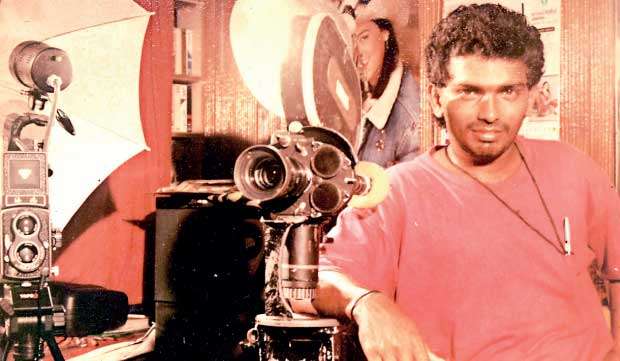
Ranjith Rubasinghe was born near Akuressa, in Matara. He was educated at three schools, ending up in Rahula College, and in all three of them, he indulged in various sports and other activities, in particular drama and music. But while his teachers nurtured his love for the arts, it was his parents who instilled in him that love from an early age. His father, a peon, was a rabid follower of the theatre, and exerted a rather considerable influence over him. “He could sing, he could act, he could craft,” Ranjith remembers for me, adding that he and his friends would invariably help him out in, for instance, designing the sets of the choreography for his plays. “Since lighting was a problem, we used Petromax lamps and coloured paper to accentuate whatever mood a scene evoked. I still remember the cues I was given to turn the set green, red, or even yellow, depending on the situation the characters were in.” In other words, as these early encounters vividly proved to him then and there, young Ranjith viewed the arts as a field of human activity dependent on both creative power and physical labour. A highlight was the thorana they would design and unveil at the Maramba Wewa near their home, a thorana that is still unveiled there, almost as a ritual, every year.
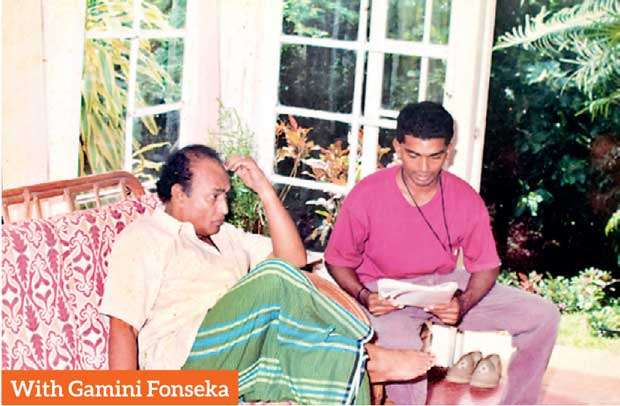
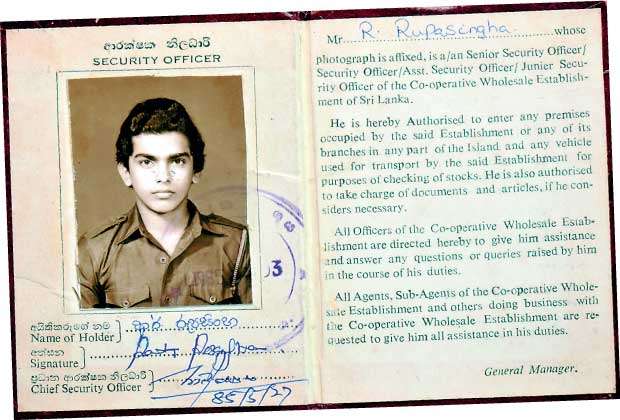
Eventually, having left Matara, he found himself working at Sathosa as a security officer, his first job and one he didn’t really take to. “I was restless, fidgety, blunt, always looking for ways of soothing my love for the arts.” This was a problem, given that it was, after all, a nine-to-five job and he needed to conform to a routine. “I quit a short while later, vowing to pursue the arts no matter,” he tells me, and as the months rolled by, that is what eventually happened. The man could not have picked a better time to make this decision, since the early eighties, owing to the introduction of television, saw production houses popping up here and there. In the midst of this chaos, Ruba began working for Selacine, Telecine, Telestar, and Rupavahini, in that order. At Telecine he was under D. B. Nihalsinghe, at Telestar he was under Bandula Weerakkody, and at Rupavahini, he was under Athula Ransirilal. I ask him as to how he managed to secure his life financially during this time, and with a casual shrug he tells me “We didn’t care how we led our lives outside work. One night we would be at a director’s residence, the next night we would be at Sudarshi. It didn’t matter where we slept or what we ate or drank. What mattered was how we did our job. That is the price for going freelance, but that is a price I was only too willing to pay at the time.”
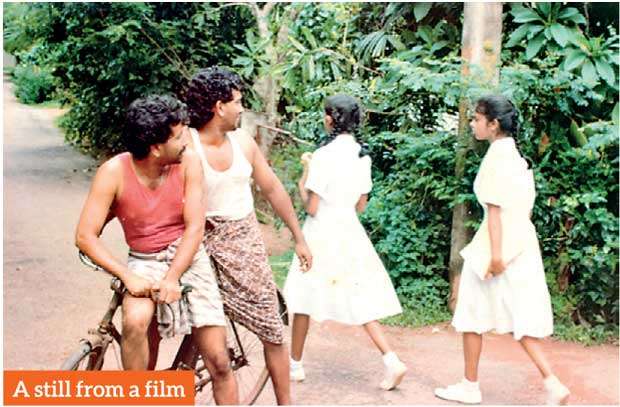
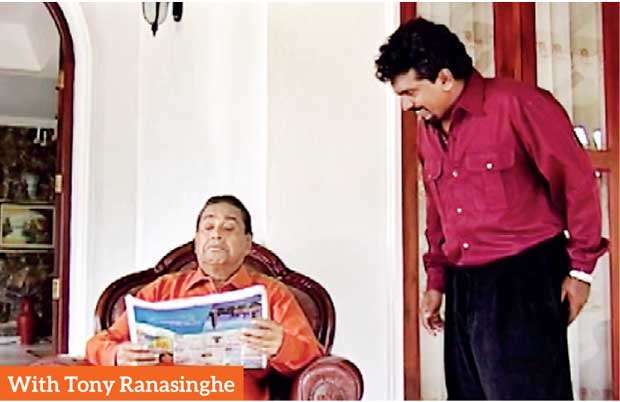
From these stints in television, he moved to the cinema, and soon enough, he was working under various established directors: Lester James and Sumitra Peries, Vasantha Obeyesekere, and Dharmasena Pathiraja, among others. It was at then and there that he decided to obtain a professional qualification, obtaining diplomas and qualifications in journalism from the University of Colombo, the Open University, and the Press Council. While not strictly a journalist, Ranjith was, I think, perfectly fitted for these qualifications, given his sharp, aquiline penchant for research. This proved to be important in his next, and arguably most important, career shift, as he moved from working under others to working for himself. He took off as a director in 2003, with the television serial Ruwan Sakmana, where he was helped by the late H. D. Premaratne (he was working at Swarnavahini at the time, and it was telecast there). Four years later, his second serial, Mosam Ralla, was telecast on Rupavahini, which he himself scripted and which starred, among others, Tony Ranasinghe and Daya Tennakoon. Since I have not seen either, I asked Sumitra Peries for her opinion, and she at once observed that they were “pretty good, not because they are technically proficient, but more importantly because they reveal his penchant for storytelling.”
I ask him as to what the most important lesson he’s learnt so far is, and he replies, “First and foremost, that filmmaking is not a nine-to-five job. You can have 20-hour shoots with only short breaks. If you are planning to enter this industry, you have to learn to work on time, overtime, and with a plan.” According to Ranjith, these values are deteriorating in the industry, a problem he attributes to the race for popularity actors and directors today get entranced by. “They are interested in what they can buy with the money they earn,” he opines, “Not in sustaining the industry that sustained them.”
Accentuating this, he argues, is the point that unlike his time, when Ruwan Sakmana and Mosam Rella were being telecast, now what is in vogue are mega serials which operate on the profit motive and the lowest common denominator. These are problems the man himself has encountered with his latest production, Pitastharaya, problems which, given spatial constraints, need to be explicated in full elsewhere. Ruba, vociferous and frank no matter where he is, is modest to a fault. I insist on calling him “Sir”, no matter how much he asks me not to. The truth is that I rarely call anyone sir or madam, regardless of age or gender, and if I do, it is for someone whose work is befitting of such titles regardless of how inadequate they are in summing up the full worth of such persons. In that sense, for the foreseeable future at least, Ranjith Rubasinghe, Ruben and Ruba to his colleagues and compatriots, is a sir in my book.
19 Jun 2026 13 minute ago
19 Jun 2026 28 minute ago
19 Jun 2026 2 hours ago
19 Jun 2026 2 hours ago
19 Jun 2026 2 hours ago