01 Jan 2026 - {{hitsCtrl.values.hits}}
By Prageeth Sampath Karunathilaka and Sudharika Gurusinghe
The use of organic and liquid fertilizers in agriculture drew increased attention during Gotabaya Rajapaksa’s regime. Due to the sudden ban on chemical fertilizer and other agrochemicals, the focus shifted heavily toward organic fertilizer. However, the use of substandard organic fertilizer in cultivation led to the destruction of farmland cultivation done using organic fertilizer. As a result, the country experienced a serious food shortage during the above mentioned regime. Even though people had the finances, they struggled to buy basic vegetables. Farmers also witnessed their crops failing as they attempted to be in the cultivate business using organic fertilizer. The situation later improved once appropriate corrective measures were taken. During the food shortage, the importation of chemical fertilizer remained prohibited, and as a solution, organic fertilizer was produced across the country. Over time, concerns emerged regarding the quality of certain fertilizer products. Although some of these issues eventually subsided, problems have arisen again regarding the quality of organic fertilizers. As of now, two weeks have passed since paddy cultivation for the Yala season began in many parts of Sri Lanka.
In several areas, farmers have already reached the stage where fertilizer and agrochemicals must be applied to the paddy, with MOP (Muriate of Potash) fertilizers used at this stage. Due to this situation, farmers who have begun their cultivation activities have made requests from various fertilizer and agrochemicals. This newspaper has received reports from many areas stating that the organic fertilizer delivered to them were of poor quality. During inquiries made by this writer, farmers revealed that the fertilizer brought to them by courier services via online orders appeared substandard. They added that fertilizer used in previous seasons had been of high quality, but the products they received this time seemed noticeably inferior. “This 20-kilo fertilizer bag has an unbearable smell. The bag looks different from what we normally receive. It has no manufacturing or expiry date. Although the label says ‘organic fertilizer,’ the word ‘organic’ has been erased. Only the name of the company remains, and both the phone number and address have been removed. There is the number FC-705843884 written on the bag. They also sent some organic granular fertilizer and liquid fertilizer. We are suspicious about their quality as well. The Fertilizer Secretariat has not issued a licence to sell this type of liquid fertilizer.
A person named Shammi told us that the fertilizer was good. I paid Rs. 21,360 for it. We ordered it online, and it was delivered through a courier service. There are problems with the fertilizer and we cannot use it for cultivation, as it can damage the crops,” said Chaminda Kumara, a resident of No. 19, Track 06, Jayabima, Galgamuwa. W. P. S. Gunaratna, a farmer from Warawewa, Galgamuwa, also shared his experience: “Mr. Shammi brought us some liquid fertilizer. I bought it because I trusted what Chaminda Malli said. I purchased 12 litres and paid for 6 litres. He gave me another 12 litres and asked me to pay later and use it for cultivation. We were not given a bill for this transaction. It was this same person, Shammi, who delivered all the liquid fertilizer.” Similarly, Amita Priyardarshani, a resident of Netolpitiya, Tangalle, had also purchased this unapproved liquid fertilizer. She made the purchase after seeing an advertisement on Facebook and calling the phone number provided, which eventually connected her to a person named Shammi. “He had given us good fertilizer before. We ordered this one as well based on that trust. Mr. Shammi told us that this fertilizer was far better than others and that it would increase our yield. But this time, he deceived us and sold a fertilizer that does not have government approval.
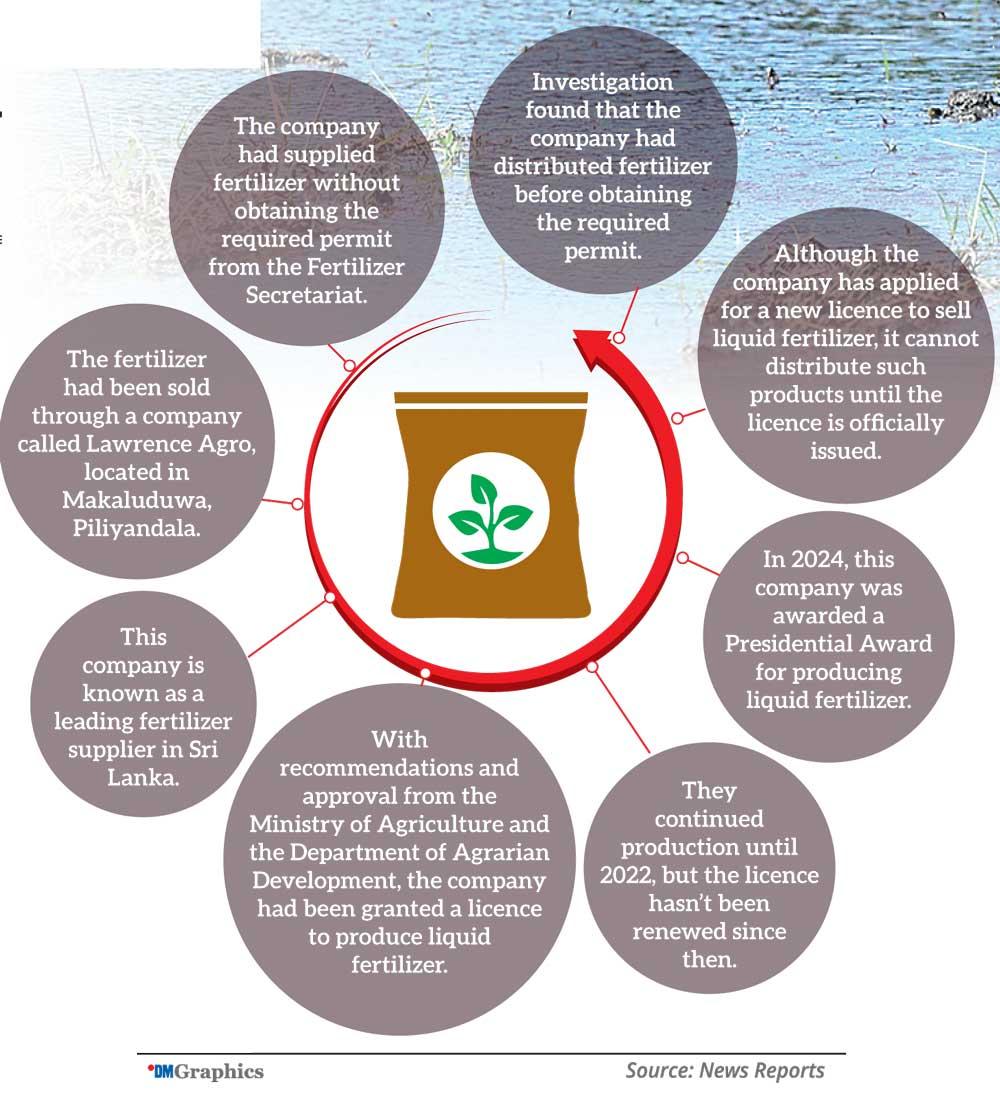
I paid eight thousand rupees for it,” she said. When the representatives of this newspaper visited Galgamuwa area, a group of farmers gathered at a selected location. Their discussions made it clear that they were helpless without proper fertilizer for their cultivation activities. This scribe then investigated which company had supplied fertilizer without obtaining the required permit from the Fertilizer Secretariat. It was revealed that the fertilizer had been sold through a company called Lawrence Agro, located in Makaluduwa, Piliyandala. This company is known as a leading fertilizer supplier in Sri Lanka. With recommendations and approval from the Ministry of Agriculture and the Department of Agrarian Development, the company had been granted a licence to produce liquid fertilizer. They continued production until 2022, but the licence hasn’t been renewed since then. In 2024, this company was awarded a Presidential Award for producing liquid fertilizer. Although the company has applied for a new licence to sell liquid fertilizer, it cannot distribute such products until the licence is officially issued. Fertilizer should only be sold under a relevant batch number after the accompanying laboratory report is received. However, investigation done by this newspaper found that the company had distributed fertilizer before obtaining the required permit.
Middleman playing monkey business
A fertilizer manufacturing company may, in agreement with farmers, provide fertilizer for cultivation for testing purposes. Such an arrangement forms a bond between the farmer and the company. However, this fertilizer cannot be sold for money under any circumstance. Despite this, this newspaper possess a receipt showing that Laurance Agro Company sold liquid fertilizer and organic fertilizer to Chaminda Kumara of Galgamuwa for Rs. 21,360. We also have another receipt indicating that two litres of the company’s liquid fertilizer were sold to S. G. A. Dharmakeerthi of Netolpitiya for Rs. 4,420. The company had cut out the word “organic” from the 20 kg bags of organic fertilizer and removed all manufacturing and expiry dates. The name Hyosung appears on the fertilizer bag. When this newspaper searched for information about this issue, it was revealed that this company was the first organic fertilizer manufacturer in Sri Lanka; the company had built a strong reputation and earned the trust of farmers at one time.
According to the information this newspaper obtained, a person named Shammi Kirinda had allegedly purchased fertilizer bags from this reputed company, removed their phone numbers, addresses, and other identifying data, and then re-sold that fertilizers along with the liquid fertilizer produced by Laurance Agro Company. Farmers who purchased this fertilizer pointed out that no one is willing to take responsibility for the disastrous results that may occur from using fertilizers without government approval or organic fertilizers with their data erased. Therefore, they urged the responsible authorities to ensure that fertilizer is released to the market only after proper standards and official approval are granted. Selling fertilizer without government approval or selling products with erased data are serious matters. Farmers cannot be deceived in this manner. There is a strong likelihood that the use of such fertilizer could lead to severe fungal infections or insect damage and the complete destruction of crops. If that happens, the consequences will not be limited to just one farmer’s two-acre paddy field; the entire cultivation area could suffer the same fate.
If these issues spread across the country, the losses would be severe. Former Director of Agriculture K. B. Gunaratne stated that such a situation could even lead to another food shortage similar to the one experienced in the past. When asked about this matter, Director of the National Fertilizer Secretariat, Chandana Lokuhewage had this to say: “You cannot sell fertilizer online or in any other way without a sales licence. If anyone is selling fertilizer illegally, inform us and we will take action. If fertilizer has been sold online using courier services, inform us with bills related to those transactions. Anyone can sell any type of fertilizer, but individuals cannot sell fertilizer in bags where the information has been erased. If such fertilizer harms crops, the responsible company must be held accountable.” This newspaper has received information that unapproved fertilizer—often with the data on the bags erased—is being distributed rapidly across the country. Farmers who have purchased these products are now facing challenges and fear that their crops may be damaged.
Moreover, while this newspaper was gathering information for this article, a company in the fertilizer business attempted to pressure its editorial staffer to stop ‘putting pen to paper’. This newspaper therefore urge the authorities to ensure that the country doesn’t face crop destruction or a potential food shortage due to the use of unapproved fertilizer.
GOVERNMENT MINISTERS UNAVAILABLE FOR COMMENT
We attempted to inquire about all these matters from the Minister of Agriculture, Livestock, Lands and Irrigation, K.D. Lal Kantha, Deputy Minister Namal Karunaratne, as well as the Secretary of the Ministry. Attempts to contact the Deputy Minister and Secretary through the Minister’s mobile phone and the Ministry’s telephone numbers on 14 occasions were unsuccessful.A ministry official confirmed with us that the minister, the deputy minister, and the secretary were at an emergency meeting.
“PEOPLE FAMILIAR WITH OUR PRODUCTS REQUEST FERTILIZER DIRECTLY FROM US” - LAURANCE AGRO COMPANY DIRECTOR
This newspaper also spoke to Nishan De Silva, Director of Laurance Agro Company, regarding how they sold liquid fertilizer and organic fertilizer without the approval of the National Fertilizer Secretariat. He stated the following: “We have the authority to manufacture and sell fertilizer. The fertilizer sales licence hasn’t been renewed since 2022. A request has been submitted to obtain approval for sales, but we haven’t received it yet. The required fertilizer samples have already been provided for evaluation. Our fertilizer is not sold in my shop or anywhere in the open market. People familiar with our products request fertilizer directly from us. We provide it to them. They come to my place to collect the fertilizer. Sometimes we deliver it online. If someone I know asks for fertilizer, I give it to them. There is nothing wrong with that. I do not sell fertilizer openly in my shop or elsewhere. Once I receive the licence, I will begin selling it formally. Until then, I provide fertilizer only to those who request it. The method by which I give it doesn’t matter to me. What is the issue? Even if you ask for fertilizer, I will provide it. I bought 20 bags and sold them. What is wrong with that? Do you have a personal issue with me,” said De Silva before hanging up the phone.
“WE HAVE NEVER DECEIVED THE FARMERS OF THIS COUNTRY”- HYOSUNG FERTILIZER COMPANY DIRECTOR
This newspaper then made inquiries from the Director of Hyosung Fertilizer Company, Ms. Nimalee Perera, whether she was aware that fertilizer was being sold under her company’s name after erasing the original data on the bags. In response, she stated the following: “Laurance Agro Company purchased 20 bags of 20-kilogram organic fertilizer and 50 bags of 2-kilogrammes of organic granular fertilizer from our company for Rs. 30,000. However, I never instructed them, nor anyone else, to erase the data on the fertilizer bags and sell them. We are a recognised fertilizer manufacturing company in Sri Lanka, and have never deceived the farmers of this country. Our company has always stood with the farming community. If anyone is erasing our company’s information and selling fertilizer to farmers, legal action should be taken against them. Their wrongdoing shouldn’t be directed at or blamed on our company. Our fertilizer is distributed only through agrarian service centres. If fertilizer with erased data is being sold elsewhere, I request farmers to immediately lodge complaints with the relevant authorities in their area.”
“THOSE FERTILIZER UNITES WERE PROVIDED STRICTLY FOR TESTING PURPOSES” - SHAMMI KIRINDE
This newspaper also spoke to Shammi Kirinde who is said to have sold fertilizer under the name Laurance Argo according to farmers. This is his response: “We have sold fertilizer only through our company (Shammi Kirinde claims to be an employee of Laurance Agro Company). We have given out only one or two units. Those fertilizer unites were provided strictly for testing purposes. We did not provide them for money. Even if money had been taken, it wouldn’t necessarily be a serious issue. We provided fertilizer based on the requirements of the fertilizer company. This is a government-approved fertilizer. The delay is only in obtaining the sales licence, and that part is true. If any damage occurs to cultivation because of the fertilizer we have supplied, we as a company will take full responsibility for it.
“FERTILIZER MAY BE PROVIDED FOR EXPERIMENTAL PURPOSES” - ASSISTANT DIRECTOR NATIONAL FERTILIZER SECRETARIAT
This newspaper made inquiries from Assistant Director of the National Fertilizer Secretariat, Digoda Gamage, and these are his comments: “Fertilizer cannot be sold without a valid fertilizer sales licence, even if a company has a licence to manufacture fertilizer. The sales licence must be renewed annually. This rule doesn’t apply to those engaged in small-scale, self-employed activities, but large-scale companies must strictly follow these regulations. Fertilizer cannot be sold online either, although many people do so because there are loopholes in the law. Fertilizer may be provided for experimental purposes, but it cannot be sold for money. We have received complaints that Laurance Agro Company is selling fertilizer, and we have already informed them not to sell it. Complaints were reported from the Hambantota area that fertilizer is being sold online. We also received phone calls informing us that fertilizer bags didn’t have labels. We instructed an Assistant Director in that area to investigate and submit a complaint. Fertilizer cannot be sold until that company obtains the proper licence,” said Gamage.
04 Jun 2026 5 minute ago
04 Jun 2026 8 minute ago
04 Jun 2026 34 minute ago
04 Jun 2026 37 minute ago
04 Jun 2026 42 minute ago