03 Sep 2025 - {{hitsCtrl.values.hits}}
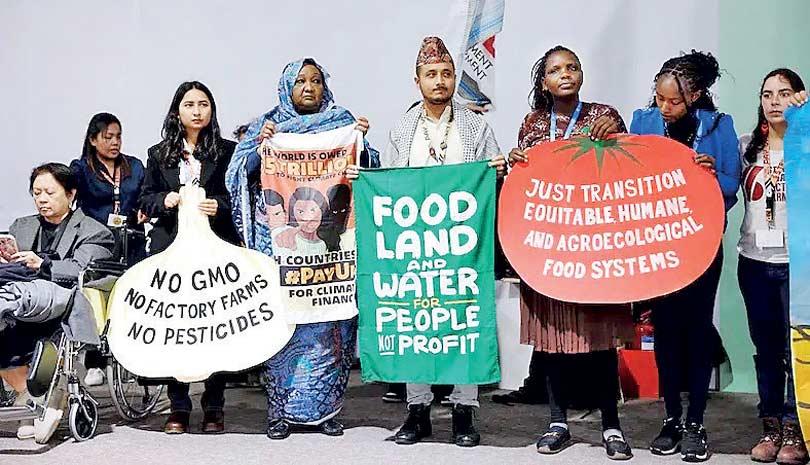
The Nyéléni Process is rooted in the broader struggle for food sovereignty
 At this Forum participants will unite to raise their voices for food sovereignty and social justice
The 3rd edition of the forum will be held in Kandy from September 5-14
The Sri Lankan edition is expected to bring together 600 delegates from over 120 countries
Inspired by a legendary peasant woman named Nyéléni from Mali, Africa, the Nyéléni Global Forum is a space that was initiated in 2007 to unite activists from 80 different countries who are advocating for change on behalf of those affected by the current system. The world is in crisis due to the impact of climate change, hunger, land grabbing, inequality, war and the influence of multinational corporations. At this Forum, individuals from farmers and smallholders to indigenous people, fishers, animal rights activists, activists in fields such as women’s rights, climate justice and public health will unite to raise their voices for food sovereignty and social justice. In its third edition, Sri Lanka is the proud host of this living movement which is scheduled to take place at the National Institute of Cooperative Development (NICD) in Kandy from September 5-14.
The Nyéléni Process
The Nyéléni Process is rooted in the broader struggle for food sovereignty. The concept of food sovereignty was formally introduced in 1996 by La Via Campesina during the World Food Summit held in Rome. While the official Summit promoted a market-led approach to food security, social movements responded with a powerful alternative vision that centers peasants, indigenous people, small-scale food producers, fisherfolk and rural workers in shaping their food systems and decision-making spaces. The Sri Lankan edition is expected to bring together 600 delegates from over 120 countries. One of its main objectives is to amplify Sri Lanka’s leadership as a progressive voice in the global movement for justice and sustainability.
Shift in agricultural methods and threats to humanity
The Green Revolution that came about in the 1960s encouraged multinational companies to introduce pesticides, weedicides and hybrid plants while slowly taking over the role of farmers in the agriculture sector. “They initiated monoculture plantations, cleared forests by felling trees and a health crisis was in the offing due to the introduction of weedicides and pesticides,” explained Hemantha Withanage, Executive Director at Centre for Environmental Justice (CEJ). “After 2000, the introduction of gene technology brought about a monopoly among corporations. As a result, people had to depend on fertilizers and other chemicals in order to reap maximum harvest. This way, the agriculture that initially depended on the environment was later dependent on corporations, technology and chemicals. There are multiple environmental issues that came about as a result of this shift in agricultural methods. A forest carries out various ecosystem services but people were deprived of oxygen and other services. In Sri Lanka there are various issues from water pollution, soil exhaustion, human-wildlife conflict, chronic kidney disease of unknown origin (CKDu) in the North Central Province, spike in cancer-related illnesses and similarly modern agricultural methods are posing a huge threat on humanity. This is when people started talking about agroecology – where we protect the environment from tiniest organisms such as bacteria. The Nyéléni Global Forum is a good opportunity for us to discuss about food security, food sovereignty, providing opportunities for farmers to talk about growing food crops in their agricultural plots, resist attempts of land grabbing done by multinational companies,” he added.
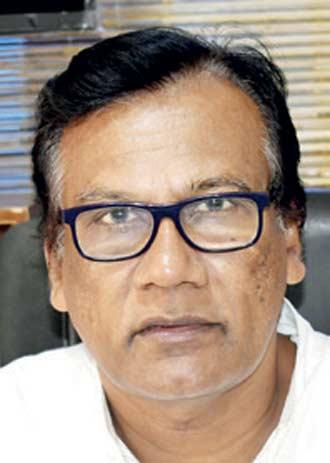
 In Sri Lanka there are various issues from water pollution, soil exhaustion, human-wildlife conflict, chronic kidney disease of unknown origin (CKDu) in the North Central Province, spike in cancer-related illnesses and similarly modern agricultural methods are posing a huge threat on humanity”-
Hemantha Withanage, Executive Director at Centre for Environmental Justice
Focus on feminist economy
From a laborer’s point of view, a majority of Sri Lanka’s labor force have become victims of cheap labour despite their role in catering to global supply chains. But what has often been neglected is the role of a female labourer and the fact that they need to be recognised and paid for their labour. In Free Trade Zones for instance there are over 350,000 workers while over 85% of them are females. “Within the global supply chain they work for transnational and multinational corporations,” said Gayani Gomes, human rights activist and trainer on labor and gender rights. “But none of these corporations could be held responsible or accountable. They instruct the local employer to take the responsibilities of the female employees. So while these companies make profits, those profits never trickle down to the end worker. It was after a long struggle that we increased the national minimum wage from Rs. 21,000 to 27,000 last year. Within a wage of around Rs. 40,000 they have to manage their household expenses, spend for children, pay utility bills and also put food on the table. Countries such as Bangladesh, Cambodia and Vietnam were more impoverished than us but they managed to increase their minimum wage and today it is double than that of ours. At this Forum we will also talk about laborers who contribute to the global supply chain. In 2015 there were discussions about a feminist economy. But we still haven’t been able to achieve it. Because those with patriarchal mindsets feel that we are talking against them. But feminism is not about going against patriarchy. Feminist economy is a central point in food sovereignty. In its key principles we talk about equal resources and equal power sharing,” she explained further
Addressing challenges faced by peasant farmers
Even though farmers used traditional knowledge to engage in agriculture, today they face a gamut of issues from soaring production costs to finding their niche in the marketplace in addition to facing risks of losing their lands due to resource hungry corporations. “Instead of protecting the smallholder farmer there’s a tendency to promote commercial agriculture or export-oriented agriculture, said Chinthaka Rajapakse, Convener of the Movement for Land and Agricultural Reform (MONLAR). “The rural debt crisis is another issue faced by farmers. We need to address the struggles faced by Malaiyaha and adiwasi communities. Industrial agriculture has an impact on aforementioned crises and farmers are the ultimate victims. Farmers are becoming victims of renewable energy projects such as floating solar farms established on lakes. We see that smallholder farmers are being deprived of their economy, marketplace, food and basically their rights and resources. We need a new discourse to share experiences and a fresh approach to face these challenges. We should look at creating a suitable marketplace, protect our natural resources, our seeds, new methods of championing climate change, initiate a community-led economic process, create people-centric loan schemes and act to make a change. So we hope to discuss alternatives within these sectors, cooperative models, community-led banking systems, and make a united voice to resist external forces at the upcoming Nyéléni Global Forum,” he added.
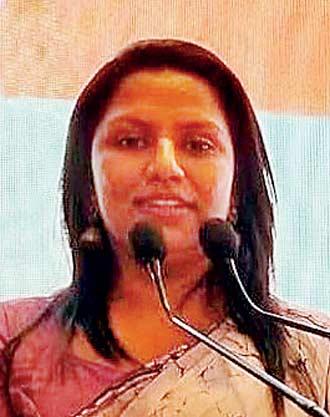 Countries such as Bangladesh, Cambodia and Vietnam were more impoverished than us but they managed to increase their minimum wage and today it is double than that of ours. At this Forum we will also talk about laborers who contribute to the global supply chain”
-Gayani Gomes, Human Rights Activist and Trainer on Labour and Gender Rights
An opportunity to derive practical solutions
With the destruction of ecosystems, smallholder food producers are facing a crisis in domestic food production. “The profit oriented production process takes place without considering the ownership of land of farmers, coastal areas of fishers and so on,” said Herman Kumara, National Convener of National Fisheries Solidarity Movement (NAFSO). “It’s difficult for fisheries and farmer organisations to resist this process single-handedly. So we have to make systematic interventions to resolve crises faced by food producers. So we need to talk about laborers’ rights, the traditional knowledge passed down generations of farmer communities, protecting people’s right to land, coast, river and lagoon, issue of female labor which is often neglected and new challenges faced by fishers. For over 30 years, NAFSO has intervened to bring about a people-centric activism within the fisheries sector. They have been at the forefront in formulating policies, rules and regulations that benefit fisherfolk in Sri Lanka. So NAFSO is delighted to join hands with the Nyéléni Global Forum to discuss these issues and derive solutions in a more practical sense,” he said.
08 Jun 2026 34 minute ago
08 Jun 2026 42 minute ago
08 Jun 2026 1 hours ago
08 Jun 2026 1 hours ago
08 Jun 2026 2 hours ago