26 Feb 2025 - {{hitsCtrl.values.hits}}
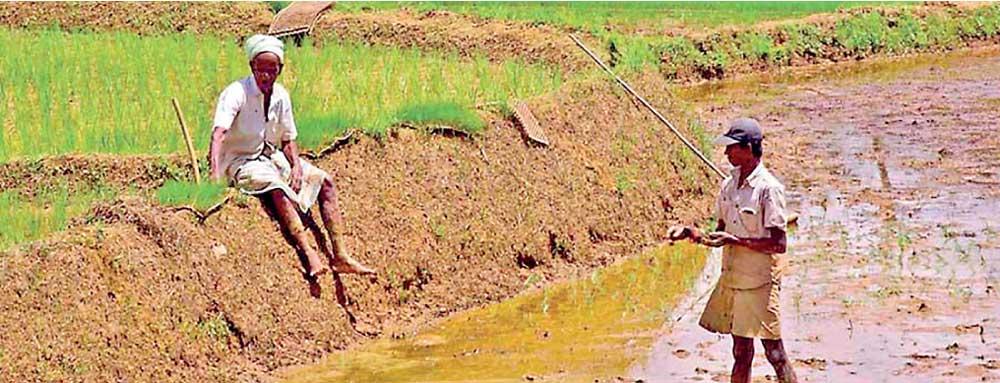
50% of Sri Lanka’s paddy cultivations are in the wet zone and the wet zone doesn’t have irrigation systems. They entirely depend on rainwater
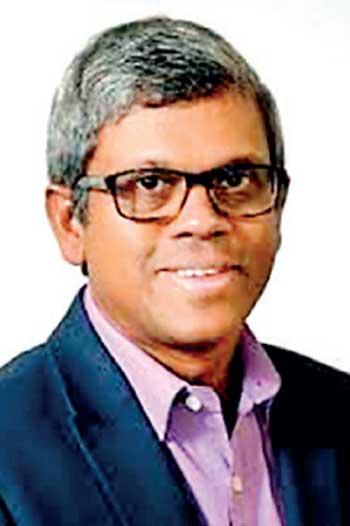 |
| Prof. Bingunath Ingirige |
Global food insecurity is on the rise due to aggravating climate change phenomena. In Sri Lanka, agriculture is one among 15 other sectors identified as being vulnerable to climate change. But according to experts, climate change is regional and has a long-term impact on vulnerable nations when compared to climate variability which is more local.
Climate change Vs.
climate variability
Sri Lanka is experiencing climatic events with regards to climate change similarly to that of other countries. According to Bingunath Ingirige, Professor of Urban Resilience and Adaptation at the University of Salford, climate variability is somewhat different to climate change. While climate change is regional, the countries that suffer from climate change may not be the same as countries that emit high amounts of Carbon dioxide. “Heat is one of the consequences of climate change. A major flood event occurred in Pakistan in April 2022. The heat wave increased the temperature up to 55 ̊ C causing some glaciers in the Himalayas connecting Pakistan to melt. Excess heat cause moisture to rise and a week later there were heavy rains. The rains coupled with melting glaciers caused a devastating impact, breaking several banks of rivers and lakes. As a result people died and agriculture was destroyed,” he explained.
But on the other hand, climate variability happens within a season or is a phenomenon that happens inter-seasonally. Prof. Ingirige explained that when it comes to climate variability over a five year time period, the annual averages (e.g. rainfall) derived by climatologists may not have changed. “Perhaps there may be slight variations. But within a season things change quite drastically, without impacting the annual averages. The agriculture community would be impacted by this phenomenon,” he added.
Communication gap
Farmers experience unseasonal rains which usually impact their paddy harvests. Paddy farmers across the country are now seeking compensation from the government as their harvests were destroyed following heavy rains.
“People who are working closely with farmers are called Agriculture Extension Officers (AEOs). Their proximity in their working relationships with the farmers and farmer associations put them into a unique position to facilitate climate communication and behavioural change among farmers in adapting against the variability. Perhaps they are not given the proper level of authority at the moment or they are not given the level of incentive and training to enact much needed behavioural change as a response to climate variability. Due to that reason there’s a big gap in communication mainly when it comes to paddy cultivation. At the time of planting paddy you need what is known as flood irrigation. During the harvesting season the paddy fields should be completely dry. But what happens within that season is sometimes completely the opposite. 50% of Sri Lanka’s paddy cultivations are in the wet zone and the wet zone doesn’t have irrigation systems. They entirely depend on rainwater. Farmers in the dry zone depend on lakes, cascade systems etc., but they are less dependent on rain. The irrigation systems can vary the water levels,” he added.
But if the weather could be predicted at short time scales or two months prior to the actual event, then farmers would be made aware of the timing. Prof. Ingirige suggests that this message needs to be communicated to the farmer, so that they can recover 80% of the harvest by harvesting either a week or two prior to the predicted heavy rains. But farmers on the other hand need support sometimes to ramp up labour at unusual times in case if planting and harvesting times are regulated. The AEOs in this instance are uniquely placed to advise both farmers and the Government departments to ramp up such resources to sustain productivity levels and for the farmers to cope with climate variability.
Efforts to bridge communication gap
In order to bridge the communication gap, all focus group discussions at the community level were conducted in the vernacular. Students from Moratuwa University had assisted in this endeavour. “We follow the hub and spoke structure. We don’t think things up in UK and implement those decisions here. Our research is purely collaborative. What we do is academic to academic collaboration and the academics in those places collaborate with the industry and communities. So it is through them that we get the channel right. We define the problems with them. As a methodology we use systems science approach and very specifically we use causal loop diagrams to both understand the problem and then to collaboratively design and execute strategies. So the beginning of the cause-effect relationship is defined by the people. For this we get a mix of the stakeholders such as farmers, grama sevaka, AEOs and others involved. We are trying to develop more of these projects at the grassroots while trying to understand the problem as well as provide solutions with them at the same time. From our side we want to see the impact being realized. If we suggest a better communication method then we see from a community aspect whether their lives have improved as a result,” Prof. Ingirige added.
Improving livelihoods
of farmers
Academics such as Prof. Ingirige are continuing their efforts that eventually result in sustaining of livelihoods of farmers as they believe that the existing generation of farmers should remain in agriculture in order to nurture the next generation. “Sri Lanka is an agriculture-based country and we need to sustain those livelihoods,” he added. The younger generation look for easy ways out and it is understandable because agriculture is a ‘dirty job’. Because of that constraint there has to be some kind of a programme to sustain the farmer. But due to climate variability, discrepancies in distributing fertiliser and poor compensation schemes for farmers, efforts to sustain paddy farmers in agriculture are often short-lived,” Prof. Ingirige further said.
Risk sensitive urban development
Rapid urban development in developing countries directly affects risks of other disasters. Through projects such as TRANSCEND, Prof. Ingirige looks at reducing these risks amidst development and leads one of the work packages in the project on climate resilience. TRANSCEND is a University of Salford, UK led project which focuses on risk sensitive urban development. “When we do development we must also look at how risks in other areas are raised. Particularly when it comes to the subject of paddy cultivation what are the nature-based solutions available? Paddy as a crop is extremely ‘water thirsty’. But there are smart ways of reducing water consumption given the variability of rainfall and still sustaining growth potential. For example, an Alternative Wetting and Drying (AWD) process can drastically reduce the large water content required for paddy cultivation by various low cost mechanisms. We conduct research in north-west Bangladesh where we observed a measure of Government support given to potato cultivators and how that created a big impact in their market. The moment they get their harvest of potatoes the price levels drop because there is an abundance of potatoes. What the government did was building storage facilities for farmers. It’s like a vault in a bank. When they have the harvest they go and store in those facilities. Therefore, the farmers themselves are able to control the price and therefore they are able cut off the middlemen. I don’t think that’s an expensive move by the government. The benefit is quite widespread, and thinking along the same lines, there could be similar measures to cope with climate variability,” he explained.
Pilot projects
in Sri Lanka
Several pilot projects have been implemented in Sri Lanka to raise awareness among people and directly affected communities such as paddy farmers. The Technology enhanced Stakeholder Collaboration for Supporting Risk-sensitive sustainable urban development (TRANSCEND) project commenced in 2019 and drew to a close in 2023 but several follow-up projects on flood impact, landslide risk management and data sharing platforms have taken off. “For example, Before COVID we ran a pilot project along with the Lions Club District 306 C1 as part of our MOBILISE research project where we set up rainfall gauges along the Kelaniya River and it was a major benefit to people. When the water level of the river touches the gauge it automatically sends a signal to the weather monitoring department which triggers evacuation messages to the relevant authorities, who are then able to get a better situational awareness in comparison with other weather-related information that they hold. Further, the authorities are able to communicate directly with people to give them a timely early warning to evacuate,” Prof. Ingirige said.
Prof. Ingirige and other colleagues at University of Salford, UK have also studied on long-term sustainability of housing in flood-damaged areas and areas prone to landslide risks. “One of the important things that we are trying to write in our documents is about communication. We have the tsunami warning systems, normal flood warnings, landslide warnings issued by the National Building Research Organisation. A mobile app too has been developed for early warnings. But what we need is real-time data when it comes to farmers. If there’s an imminent threat of a monsoon coming early, that particular risk should be communicated weeks and if possible months in advance so that the farmers can potentially change their behaviour given the early warning. In farming what is interesting is that you have this leader-follower behaviour – if one farmer does it and if he is highly regarded then others readily follow. So, the farmers may change their behaviours by looking at what is happening around them,” he explained further.
Sustaining agricultural livelihoods
When asked about how Sri Lanka as a coastal nation should be prepared for climate change challenges, Prof. Ingirige said that from a coastal aspect, the 2004 tsunami and the ongoing threat of sea level rise and salinity intrusion into the agriculture nearby are some of the challenges identified. “That is a problem but not as that of Bangladesh. We don’t get much agriculture in the coastal belt but it’s mostly inland and that may be the reason. Sea erosion too is a major problem,” he said.
He further said that his main motivation is to sustain agricultural livelihoods through this research. “I’m personally interested in that because people in agriculture should remain in the field, particularly the current generation and we need to remove any obstructions that are there in their pathway. It would be a challenge to encourage the next generation remain to remain in the industry if the current challenge is not solved. We can’t think of a country like Sri Lanka without being agriculture oriented,” he said.
Prof. Ingirige said that the technology is improving as well. “There is the use of agriculture, use of drones, research and development and IOT devices used in monitoring. Overall ‘smart agriculture’ is a good way forward. Inter-cropping too needs to be developed and it is the AEOs who are in that position to inform about changes in planting / harvesting etc. So there are certain crops they can plant to get a harvest in time for the next season. This happens in Bangladesh where one team plans for this season while another team plans for inter-seasonal harvesting,” he said in conclusion.
14 Jun 2026 11 minute ago
14 Jun 2026 58 minute ago
14 Jun 2026 1 hours ago
14 Jun 2026 2 hours ago