10 May 2025 - {{hitsCtrl.values.hits}}
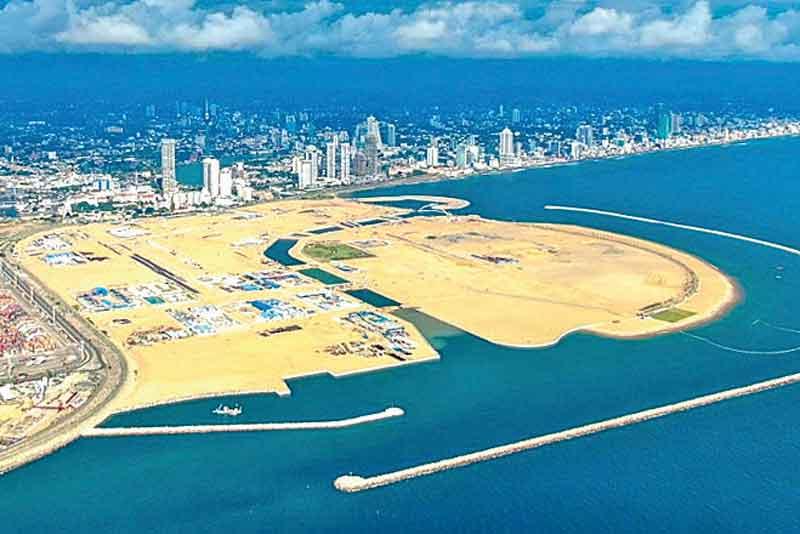
Port City Colombo
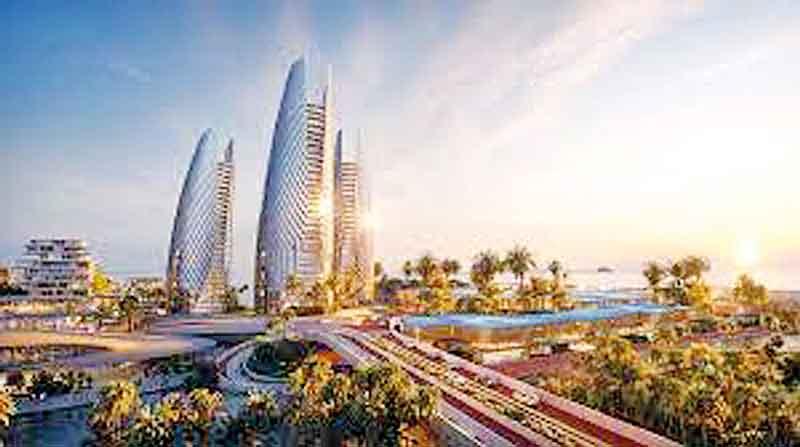
An artist’s impression of the Maldives International Financial Centre
 The Maldives is not only a destination or a small island state, but a driver of global change.
Unless the business environment is developed and economic reforms implemented without any further delay, the country should not envy the Maldives in this regard since economic growth in the neighborhood will spill over for the benefit of all.
Middle Eastern investors are turning to the Maldives, which offer clearer investment pathways and fast-tracked approvals.
Sri Lanka’s continued inaction will represent a missed opportunity and a transfer of economic potential to emerging competitors.
Unless the business environment is developed and economic reforms implemented without delay, Sri Lanka should not envy the Maldives.
The Maldives is launching the Maldives International Financial Centre to become a future-ready economy by 2040. Backed by Middle Eastern investors, the move signals bold ambition. As the island nation accelerates, Sri Lanka faces pressure to act swiftly or risk losing ground, despite its resources and the underutilised potential of Port City Colombo.
Maldivian President Dr Mohamed Muizzu on Sunday night stated that the Maldives International Financial Centre (MIFC) would be the Maldives’ legacy of bold decisions, courageous partnerships, and national purpose.
President Dr. Muizzu made the remarks while speaking at the landmark joint venture agreement and Memorandum of Understanding (MoU) signing ceremony for the establishment of the MIFC, according to a statement from the Maldivian government.
The President stated that the MIFC is the Maldives’ launch pad to becoming a developed nation by 2040.
He added that the Maldives is embarking on this extraordinary journey with clarity, conviction, and optimism. The President further stated that the Maldives is not only a destination or a small island state, but a driver of global change and a smart island nation at the epicentre of the Indian Ocean’s economic and digital evolution.
According to him, the Maldives would not imitate models of the past, but rather set a new benchmark for a financial ecosystem that is borderless, digital-first, inclusive, sustainable, and future-ready.
He noted that the MIFC, with its projected multibillion-dollar revenues and significant long-term contributions to the Maldives’ national GDP, would be a catalyst for unlocking opportunities across industries.
The President envisioned the MIFC uplifting the community and creating pathways for generations of Maldivians to come.
The approach by the Maldives, a small archipelago nation in close proximity, became news in Sri Lanka, which is also Port City Colombo - an international service-oriented Special Economic Zone located on a 269-hectare landmass reclaimed from the sea next to the Colombo port.
The fear is that whether Sri Lanka and the Maldives will be competitive, not complimentary.
The countries that were lagging behind Sri Lanka by the time of independence have now outperformed Sri Lanka. Lack of policy consistency, timely and far-reaching economic reforms left the country stagnant in its development path. Civil strife also contributed to the current predicament of the country. Still, opportunity remains with Sri Lanka. Unless it acts fast, it will again be a missed opportunity.
The Maldives, a small island nation having significant resource limitations, recently captured media attention.
Middle Eastern investors, including from the UAE and Saudi Arabia, are turning to the Maldives, which offer clearer investment pathways, fast-tracked approvals, and active government-level facilitation.
Sri Lanka, despite possessing more resources, social infrastructure, and Port City Colombo as its flagship FDI (Foreign Direct Investment) project, has barely managed to capture global media attention for its proposition as an FDI destination.
Colombo Port City is a key vehicle for FDI’s that has been underutilised. With 100 percent foreign ownership allowed for businesses to operate in Port City Colombo, a robust regulatory framework, and world-class infrastructure, it showcases the instrumental facets to attract foreign capital, especially from the Gulf Region.
Bureaucratic stagnation, slow progress in passing regulations, and lack of government-led promotion have often led to prospective investors looking at regions other than Sri Lanka.
Promoting a strong and progressive ease-of-doing business environment plays an integral role in attracting high-level investments.
As understood PCC’s Special Economic Zone (SEZ) regulatory framework provides for that, and hence delays in approvals and activating vertical developments at Port City Colombo have raised concerns whether Sri Lanka is truly open for business and FDI’s.
As the Gulf sovereign funds are actively diversifying and looking for South-South investment opportunities, Sri Lanka’s continued inaction will represent a missed opportunity and a transfer of economic potential to emerging competitors, including the Maldives and East African SEZ’s.
It is crucial for the current government to keep fast-tracking cross-border investor facilitation. Otherwise, as Port City Colombo aims to become an engine of Sri Lanka’s future economy, the government risks eroding overall investor confidence in its largest PPP and most ambitious FDI initiative.
Middle Eastern investors expect high-level engagement and regulatory consistency similar to the frameworks present in their home regions.
The absence of proactive cross-border investment facilitation is a blind spot in Sri Lanka’s current FDI strategy.
Sri Lanka must act now—streamline approvals, showcase progress, ensure policy consistency and re-energize international investor confidence—before PCC becomes a case study in lost potential rather than a regional success story.
To avoid this, the government and stakeholders must urgently showcase the momentum already building within Port City Colombo.
A number of flagship projects are already underway, offering strong signals to investors about the SEZ’s viability and value proposition.
Time is running out for Sri Lanka to get its act together. Today, Sri Lanka repents over countries in the region making giant leaps. Unless the business environment is developed and economic reforms implemented without any further delay, the country should not envy the Maldives in this regard since economic growth in the neighborhood will spill over for the benefit of all.
The two countries should be complementary to each other.
11 Jun 2026 52 minute ago
11 Jun 2026 57 minute ago
11 Jun 2026 2 hours ago
11 Jun 2026 2 hours ago
11 Jun 2026 2 hours ago