28 Nov 2025 - {{hitsCtrl.values.hits}}
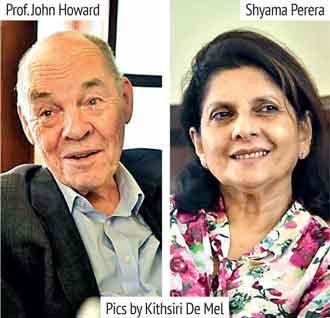 Parents should allow children to get a balance of creative areas such as literature, drama and music, says John Howard, Professor of Music at the University of West London and Ambassador for London College of Music Examinations (LCME).
One of the highlights in his illustrious career is his contribution to Chinese music. Prof. Howard is the winter examiner for the International Institute of Music, Speech and Drama (IIMSD) and is currently on a visit to Sri Lanka to attend the institute’s LCME prize giving as the chief guest.
Prof. Howard has composed music for the Chinese orchestra since 1983 and also for the Hong Kong Chinese orchestra, which is a very prestigious and professional orchestra. His music has been performed in Australia, the UK, Hong Kong, the Netherlands, Taiwan, Zimbabwe, Israel and Singapore. Speaking about his interests in Chinese music during an interview with the Daily Mirror, Prof. Howard said that it’s important not to be Western-centred, which is why he developed an interest in Chinese music. “Composition has been central to my life, and I’m interested in various traditional music in places that I go to. I like to listen to it and learn about it,” he said.
Speaking about Sri Lankan professional music, Prof. Howard said that it’s quite interesting. “I know quite a lot of Indian music, and we’ve had a couple of attempts to create Indian music, but it still didn’t work in the UK, partly because we couldn’t find the right partners. But I’ve maintained a strong interest in it. But Sri Lanka has its own flavour of music. Sri Lanka is also an interesting party because of its geographical location. I love history, not just music and I like to know what Ceylon was like. In India, the music is divided into north and south, and you’ve also got the influence from the East. The Javanese and Indonesian influences have wonderful traditions and theatre as well. In this part of the world, I love theatrical traditions as well,” he said.
Speaking about his life as an examiner, Prof. Howard said that as examiners, they travel a lot and it’s great to meet musicians, develop friendships. He served as the Director of the LCME board till 2000 and became an emeritus professor post-retirement.
Speaking about his first visit in 1997, he recalled the small exam Centre back in the day. “Mrs Malini Ratnayaka was just starting small, and we did the first two days of exams. A big tribute also goes to Madam Perera and their school because she increased our exams here enormously, and we took it from there,” he added.
Prof. Howard also spoke about standards developed by the UK exam structure. “Parents particularly want their children to have qualifications. In a way, graded exams fit into that structure. The way the UK has done it is that we have made a UK national framework and every one of the qualifications has a value. So it’s about 11 years old. Before that, it was a free market, but it didn’t give users stability. Now we have stability and a recognition of standards. The major exam boards in the UK are mapped onto that national framework. If you do Grade 8 with us, it has the same values and added to that, we give university entrance points to the upper grades. This is a bonus in a way more directly for British students because it’s a system for them to apply to,” he explained.
LCME is the second-oldest graded exam board with a lot of international experience and is a faculty of the University of West London. However, Prof. Howard said that the standards are the same everywhere as in the UK. “Otherwise, it’s not fair. We have a way of organising ourselves using local representatives. These people are very important to us. Their job is to liaise with all the teachers. Sometimes the representative is also a teacher, and they organise the growing interest in the exam and also work with parents. Our job is to send an examiner when we are ready and deliver examinations. That’s what I’m doing on this visit. We have to train examiners as well, and we are serious about that. We don’t have a fixed profile for examiners, and we consider them as individuals and look at their qualifications and experience, and we interview them. We gave them some training and put them on probation. In Sri Lanka, the results tend to be very good. The average here is better than most places,” he said.
According to Shyama Perera, Managing Director at IIMSD and country representative of the London College of Music, exams are conducted three times a year during spring, summer and winter. “Most number of students sit in winter because psychologically they think they can finish the exam in December and start a new exam in January,” she added.
Perera further said that there’s no other exam board that gives qualifications to university and that’s the difference with LCME.
Prof. Howard further said that UWL includes degrees in drama, musical theatre, music technology, composition and so on. “It’s not large numbers that come in at those levels. It’s like a pyramid structure. At the earliest levels, you get a lot, but gradually it will reduce. There are students who have reached a serious commitment level and want to study further than grade 8. If they qualify, they can study music at university. We are keen on international students, but it’s also tough with the UK visa system,” he added.
In terms of challenges, Prof. Howard said that AI has become part of the challenge. “In terms of theory exams, we are aware of the fact that teachers help students with written material. “But in Sri Lanka, you are well organised. My statement to my team is that if you are going to have written work, assume that the teachers have helped students. It’s not a reliable indicator. What AI has done is added another dimension to it,” he said.
His message to parents is that it’s good to have a balance with your child. “Don’t necessarily allow them to do mathematics. Get a balance of creative areas such as literature, drama and music. They offer an enormous amount for the personality and the brain. Parents often don’t know enough about the value of the mind. The other thing they should do is take an interest in what children are doing. Not just the exam. They don’t have to be musical, but be interested in what children are learning. Try to help them enjoy. It’s not about serious discipline, but it has to be enjoyable,” he said in conclusion.
04 Jun 2026 1 hours ago
04 Jun 2026 3 hours ago
04 Jun 2026 4 hours ago
04 Jun 2026 4 hours ago
04 Jun 2026 4 hours ago