19 Dec 2025 - {{hitsCtrl.values.hits}}
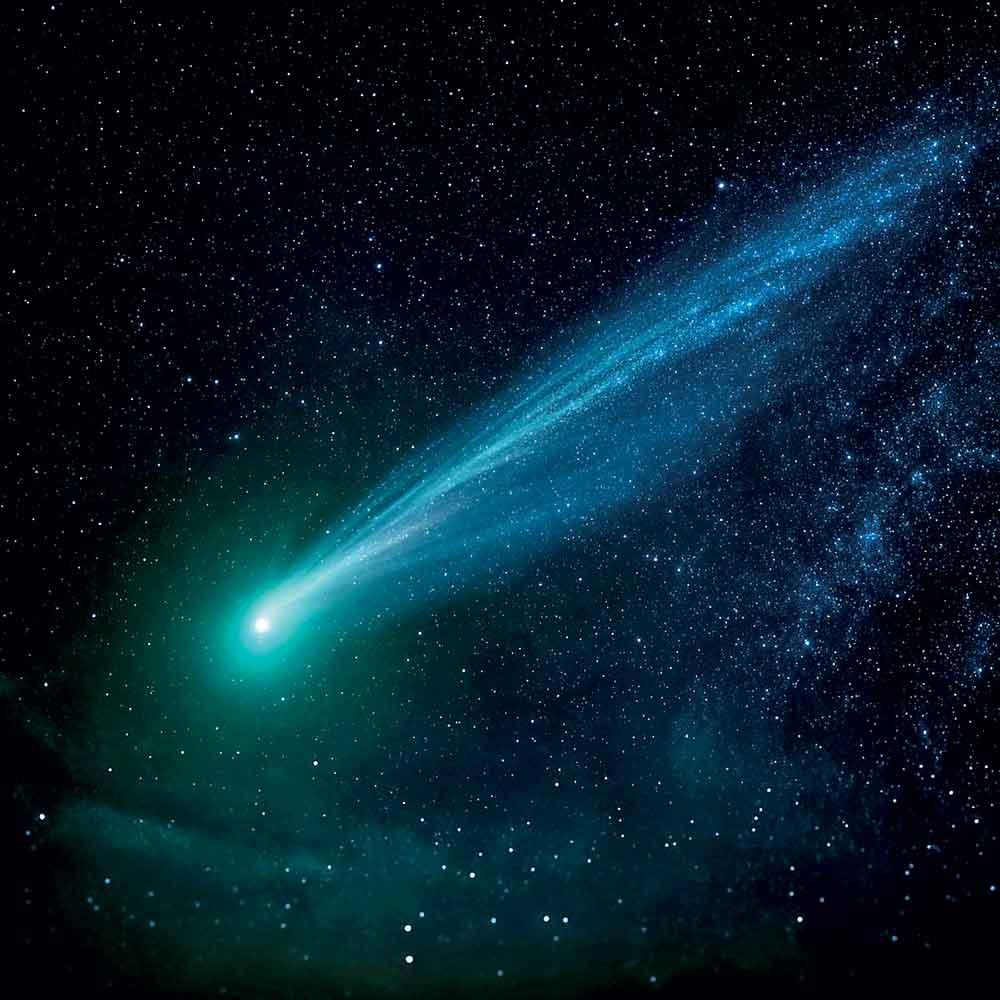
An artistic visualization of Comet 3I/ATLAS traveling through the stars
Note: Rise and set times are defined as the time at which Comet 31/ATLAS reaches the horizon, accounting for atmospheric refraction. Since the atmospheric conditions cannot be modeled with perfect precision, these times should be considered accurate to within a few minutes
By Sugath Kulathunga Arachchi
Every December, as winter winds stir, the world remembers the birth of Jesus in Bethlehem. The Gospel of Matthew tells of the Magi—royal scholars from the East—who followed a mysterious star to find the infant King. That celestial sign, known today as the ‘Star of Bethlehem’, remains one of history’s great enigmas.
This Christmas season, a rare cosmic visitor has rekindled the debate. NASA has confirmed that an interstellar Comet, 3I/ATLAS, will pass close to earth on December 19, at a distance of about 167 million miles. Discovered in July 2025, it is only the third interstellar object ever detected entering the solar system. Its unusual composition—methane, carbon dioxide, solid water, and rare traces of cyanide and nickel vapor—suggests it originated in a star system exposed to intense ultraviolet radiation.
This discovery lends weight to the theory of panspermia, championed by Sri Lanka’s eminent scientist Professor Chandra Wickramasinghe, which proposes that comets carry the seeds of life across the universe.
What, then, was the original Christmas Star? Scholars have long debated its identity:
A comet: Ancient Chinese records describe a bright comet visible in the southern skies around the time of Jesus’ birth. Its tail, pointing southward, could have guided the Magi toward Bethlehem.
Planetary alignments
Two rare conjunctions stand out:
Modern astronomy allows scientists to reconstruct the skies of the past, mapping celestial positions to identify what might have been visible over Bethlehem. The Magi, skilled observers, reported seeing the star first in their homeland, then again in Jerusalem, where it appeared to hover southward toward Bethlehem.
Professor Chandana Jayaratne, Director of the Arthur C. Clarke Institute for Modern Technologies notes that while many believe the biblical star was a comet, stronger arguments suggest it may have been a supernova or planetary alignment.
Whether comet, supernova, or conjunction, the Star of Bethlehem remains a symbol of mystery and hope. Today, as 3I/ATLAS streaks across our skies, it reminds us of that ancient sign—a celestial messenger echoing across millennia.
Comet 31/ATLAS Rise and set times from Sri Lanka starting December 19
Rise- 23.07 pm
Transit-05.07 Am
Set- 11.16 am
07 Jun 2026 15 minute ago
07 Jun 2026 18 minute ago
07 Jun 2026 34 minute ago
07 Jun 2026 1 hours ago
07 Jun 2026 1 hours ago