28 Feb 2025 - {{hitsCtrl.values.hits}}
|
Has the honeymoon period come to an end, or has the NPP’s governance shown enough potential to convince Sri Lankans that their country is on the right track? As Sri Lanka continues to grapple with economic turmoil and social unrest, President AKD’s leadership is facing intense scrutiny
|
 It has been exactly 160 days since the National People’s Power (NPP) rose to govern the nation and it seems that the public mood is already divided, even among their supporters. The rise of the NPP brought a sense of renewed hope to many voters seeking a lasting solution to the nation’s economic turmoil and political instability. President Anura Kumara Dissanayake (AKD), known for his outspoken stance on corruption, economic equity and social justice, now faces the challenge of transforming his promises into tangible outcomes before his supporters lose faith. Perhaps, they have already begun to feel disillusioned by the harsh realities of the current situation, with inflation and the debt crisis affecting their lives.
Currently, what do people think of President AKD’s leadership? Has the honeymoon period come to an end, or has the NPP’s governance shown enough potential to convince Sri Lankans that their country is on the right track? Let’s dive into a few voter sentiments, from both professionals and the general public, in the aftermath of the elections.
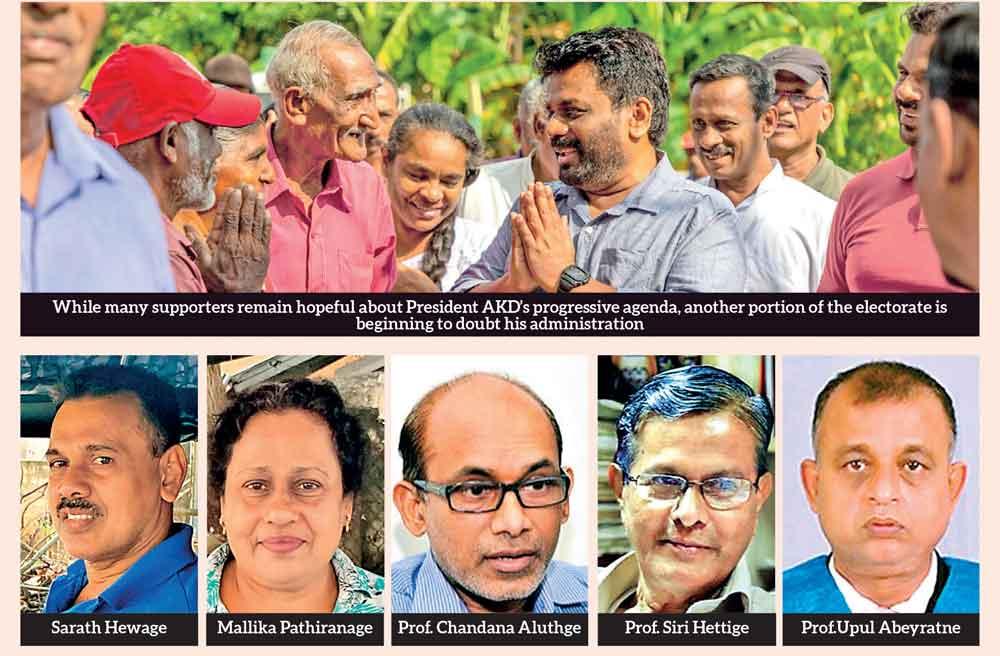
When asked about their overall impression of the leadership under the current government, Sarath Hewage (55), a taxi driver in Ratmalana, said “It’s too soon to give a judgment based on the new government’s decision-making and actions. For now, I see both positives and negatives, there are certain things which must be addressed. However, I suppose their leadership so far is not too bad.”
Government’s economic management
Chandana Aluthge, Professor of Economics at the University of Colombo spoke about the government’s handling of inflation, unemployment, and the cost of living. He said “Currently, Sri Lanka’s inflation has decreased, in fact, it is negative. Most people think that negative inflation is good since prices are falling but if prices fall continuously, it will affect the producers. People may also wonder how inflation could be negative when the prices of essentials like rice and coconut have increased. However, inflation is the overall increase in the price level, fluctuations in prices of a few goods will not impact the price index. One contribution to inflation would be increasing vehicle prices since there is a possibility of the cost of transport services rising. If we consider the current budget, there is a government budget deficit to be financed so we will have to wait and observe how the government plans to manage this deficit which will have an impact on inflation. In terms of unemployment, the government sector is overpopulated and if the government takes measures to reduce this, finding alternative jobs for these people will be important. There is also uncertainty in private investments, especially foreign investments coming into the country. The Adani Group withdrawing from the wind power project could give negative signals to other prospective investors.
The Tourism sector, on the other hand is booming now, so there is a possibility this sector absorbs some of the vacant labour. Furthermore, many people seek to migrate for better job opportunities elsewhere since employment generation is quite low here. Whether the Government has any employment generation plans and strategies to maintain inflation at 5% which is the target level, is not very clear. Promises were made by the Government, so inevitably, people’s expectations are high. Economic recovery should be prioritized, the focus of the budget on medium to short term recovery is very low, the budget is only planned for the next five to six years which is too long for a bankrupt nation.”
Lack of transparency and unnecessary intervention
Upul Abeyrathne, Professor of Political Science at the University of Peradeniya shared his thoughts on the level of transparency and accountability in the current government. “I don’t see any transparency as such. They’ve misled the voters and misused public privileges. There have been numerous allegations about construction projects and significant political interference, even preventing certain public discussions at universities. In terms of accountability, simply acknowledging a mistake isn’t enough; they must take full responsibility. The unnecessary interference in academic affairs is also unacceptable. Overall, I don’t see any difference between the new government and the previous ones.” Prof. Abeyrathne remarked.
Collective responsibility over constant criticism
When asked about recent improvements to public services such as transportation, education and healthcare, Siri Hettige, Senior Professor of Sociology at the University of Colombo expressed his thoughts. “It is crucial to note that the rural-urban gap widened over four decades and the problems faced by ordinary citizens worsened with the economic crisis in 2022. This gradually led to a desire for a regime change in 2024. It was a culmination of all these changes that took place in the country which brought a new government into power with hopes of making a difference. Yes, they can make a difference but not overnight. All the changes that occurred throughout 40 years cannot be reversed in a few months. People who have been under immense social and economic pressure respond very differently from the privileged who did not exactly want a change. Sixty percent of the lower income earners voted in the NPP government since they suffered during the previous corrupt regimes. However, you cannot improve conditions in a short time period. It is a gradual process since trends that have existed for four decades cannot be reversed within four months. We haven’t improved the public transport or the healthcare system and it’s difficult to improve sectors that have been deteriorating for years. The current government is being held responsible for the damages caused throughout the decades. We need to have the widest possible consultation from the best minds to address issues in the country which is not being done at the moment. Collective responsibility is crucial, everyone must contribute to strengthen the institutions rather than constantly criticize the individuals involved,” Prof. Hettige shared.
Impact of Government decisions and hopes for the future
Mohammad Atheef (25), an aspiring entrepreneur from Kandy spoke of recent government decisions that affected his life both positively and negatively. “The increase in taxes and the cost of living is a heavy burden since everything has become more expensive—food, fuel, electricity and other basic needs. It’s difficult to save up, and starting a business feels risky because costs keep changing. Many people, including my friends, are struggling to manage their expenses. It also feels like no matter how much we earn, we keep spending on mere essentials. While I understand the government is trying to fix the economy, I wish there were better ways to reduce the burden on ordinary people. However, the relaxed import restrictions on textiles and raw materials is definitely a positive factor. I was planning to start a hoodie business, but finding high-quality fabrics like Pima cotton with 500 GSM thickness was a challenge. Many local suppliers didn’t have the stock, so I was forced to look for alternatives, often at higher prices. Yet, there is hope now and if the Government follows a more balanced approach, it would really help businesses grow,” Atheef shared.
When asked about their hopes for the future of Sri Lanka under the current government, Damith Cooray (49) said “I believe President AKD is doing a good job by trying to eradicate all forms of corruption, robbery and wastage that has taken place for years. We hope this continues in the future, eventually paving the way for a debt-free and prosperous nation.”
Mallika Pathiranage (62) a street vendor in Wellawatte shared “Over the years, we’ve been heavily relying on imports, but the best solution to all these issues lies in utilising the resources available within the nation. Unfortunately, we have all been shaped by the previous ruling systems. Thus, an overall system change is necessary, firstly by removing all the corrupt officials in the country and reducing income disparity so that future generations of Sri Lanka may lead better lives.”
As Sri Lanka continues to grapple with economic turmoil and social unrest, President AKD’s leadership is facing intense scrutiny. While many supporters remain hopeful that his progressive agenda can bring about lasting change, another portion of the electorate is beginning to doubt whether the Government can truly fulfill its goals. The coming months will be critical in shaping public opinion, as NPP’s administration must confront the challenge of executing policy in a nation still recovering from years of crises.
03 Jun 2026 9 hours ago
03 Jun 2026 9 hours ago
03 Jun 2026 9 hours ago
03 Jun 2026 9 hours ago
03 Jun 2026 03 Jun 2026