19 Mar 2026 - {{hitsCtrl.values.hits}}
 Forget the usual headlines about interest rates and stock market jitters. A much deeper game is playing out on the world stage, one that connects the battlefields of the 20th century to the petrol pumps of Caracas and the ports of Colombo. The global economic order is undergoing its most significant transformation since the Bretton Woods system was established in 1944.
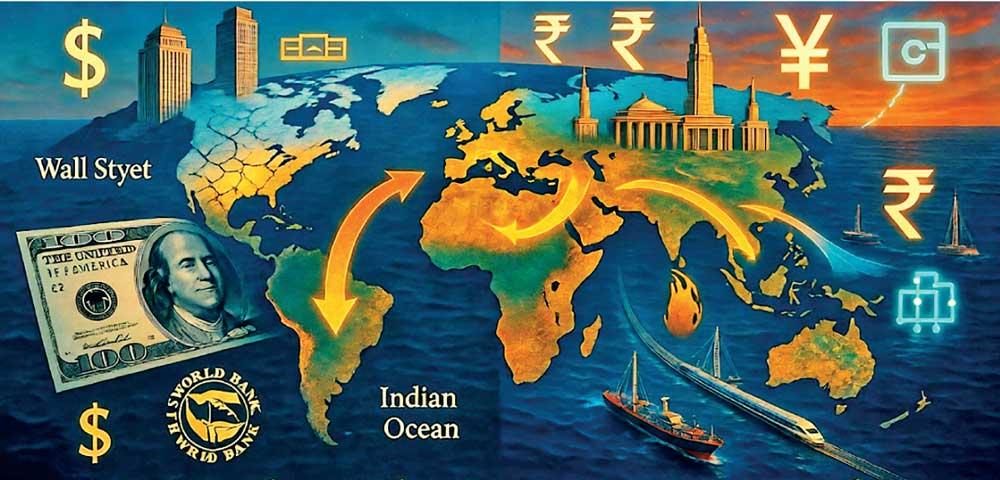
At the heart of this shift is the rise of “Asianization”- a multipolar realignment led by China, India, and the expanded BRICS+ formation. This new bloc is systematically building a parallel financial architecture, challenging the decades-long dominance of the US dollar, and redrawing the map of global trade. To understand this seismic shift, one must first understand the old pattern: the role of war in shaping the long business cycle.
The Price of War: How Conflict Drives the Economic Cycle
For decades, mainstream economists treated war as an “exogenous shock”- i.e. an external disruption, to the otherwise orderly rhythm of business. However, a critical reading of economic history suggests a more uncomfortable truth: modern war may be the dominant cause of long waves in economic activity as highlighted by Nicolia Kondratieff in his research work on long business cycles. War does not just pause commerce; it fundamentally rewrites the rules for global market share. New empirical research, spanning 150 years of data across 60 countries, provides stark quantification. When war occurs in a country’s territory, the immediate effect is catastrophic: output typically declines by 30%, while global inflation surges by 15 percentage points[1].
These are the direct costs; the destruction of factories and the severing of supply lines needed for manufacturing.
Yet, in an integrated global economy, the fallout is never contained. The same research shows that neighboring countries, regardless of their participation, Moodys Analytics noted that every sustained $10 per barrel increase in oil prices will increase the cost of a gallon of regular unleaded by 25 cents and reduce real GDP by 10%.
This happens because war destroys capital and productivity in the conflict zones, disrupting trade with nearby economies pulled into the conflict and triggering a supply-side contraction abroad. Crucially, wars create winners and losers. For very distant countries, output spillovers can turn positive. Capital and production flee contested zones to perceived safe havens. The United States’ economic trajectory during both World Wars exemplifies this: geographic distance combined with late entry allowed it to supply the warring parties, underwriting its ascent to global hegemony.
This pattern is not merely historical. The wars of the 21st century, from Iraq to Ukraine, are not exceptions to the business cycle but rather its primary drivers. They are liquidating the old US-dominated order and clearing the ground for a new configuration. As early as 1940, economists E. M. Bernstein, A. L. Macfie and Geoffrey Blainey have all noted that the level of business in the first decade after a great war depends upon foreign exchange policy, a prescient observation for the currency wars unfolding today.
Kondratieff and Goldstein discovered that the most dramatic and deadly wars occurred during periods of economic upswing. These findings may provide some clues to the relationship between war on Iran and the long business cycle. Kondratieff and Goldstein observed that the most intense and lethal wars tend to erupt during phases of economic expansion (Similar to what we have witnessed with Chinas superior AI capabilities[2], Digital Currencies, Green Technology, Robotics).
These empirical insights hint at a potential link between warfare and business cycles. While the precise timing of war outbreaks relative to the cycle remains ambiguous, the conflict’s magnitude likely depends on the cycle phase affecting the involved nations. This makes intuitive sense, as economies in upswing provide stronger fiscal resources, enabling countries to sustain larger-scale military engagements.
The Rise of BRICS+: A Demographic and Economic Tectonic Shift
The most significant structural shift in the contemporary long business cycle is the emergence of a coordinated Asian-led bloc. Iran is a full BRICS member. It joined on January 1, 2024, alongside Egypt, Ethiopia, and the UAE, expanding the group from five to nine core members.
The expanded BRICS formation, following the January 2025 admission of Indonesia as a full member and the inclusion of eight partner countries including Malaysia, Thailand, and Nigeria, now represents a transformative share of global activity. According to International Monetary Fund (IMF) data and S&P Global, BRICS+ countries predominantly dominated by Asia account for approximately 49% of the world’s population, Asia dominates semiconductors as the region produces 76% of global STEM graduates, Asia accounts for 60-65% of all global reserves, equating to $7.2-7.8 trillion and an estimated 40% of global GDP In critical sectors, this concentration is even more pronounced. Russia and Brazil rank among the world’s largest crude oil exporters, while China and South Africa dominate gold and platinum production, China possesses approximately 44 million metric tons of rare earth oxide (REO) reserves, representing about 37% of global totals. China also controls 60-70% of global mining and 85-90% of refining/processing capacity as of 2025.
This is not merely a statistical curiosity; it is the material foundation for a new economic architecture. The bloc’s combined resources allow it to contemplate a genuine alternative to the Western-controlled financial system. The Asianization of global trade is characterized by a circular, self-reinforcing flow: discounted energy from Russia, Iran, and Venezuela fuels Asian industrialization, which produces a plethora of industrial and consumer goods far more competitive than Western markets, generating surpluses reinvested in further infrastructure and energy exploration.
The Mechanics of De-dollarization: The Iran-Venezuela Axis
To understand the macro-level realignment currently underway, one must look beyond the G7 summits to Caracas and Tehran. The Islamic Republic of Iran, one of the world’s oldest continuous civilizations, has emerged as a central node in the construction of a post-dollar financial architecture. Its alliance with Venezuela, which holds the world’s largest proven oil reserves, represents a laboratory for financial warfare against the dollar.
During a visit to Caracas in June 2025, Iranian Parliament Speaker Mohammad Baqer Qalibaf articulated the strategy explicitly[3]. He told Iranian and Venezuelan traders that they are “on the frontlines of the economic war waged by our common adversaries”. His message was clear: private sector actors are now the agents of this monetary system transformation.
The critical innovation is the systematic development of payment mechanisms that circumvent the dollar. Qalibaf proposed using the BRICS payment system (BRICS Pay) and settling transactions in national currencies to “neutralize the impact of foreign pressure on our economies”. He also promised to accelerate the establishment of a joint Iran-Venezuela bank and provide government guarantees for transactions, including barter arrangements.
This is not just rhetorical; it is operational. Recent analysis from the Global Trade Research Initiative (GTRI) confirms the scale of this shift. Ajay Srivastava, GTRI founder, notes that US sanctions and SWIFT bans on Russia, Iran, and Venezuela have backfired spectacularly. “They can block access to the SWIFT payment system, freeze dollar transactions, and even cut digital services critical to refineries, ports, and banks. The risks are real.” he explains. “Over 90% of Russia-China trade is now settled in rubles or yuan; India pays for Russian oil in Indian rupees and UAE in dirhams; even Saudi Arabia is open to non-dollar oil trade, cracking the 1970s petrodollar pact”. The implication is profound. When oil exporters accumulate claims on Asian economies currencies and Digital currencies rather than dollar-denominated assets, the recycling of petrodollars into US Treasury securities diminishes. Srivastava adds that local currency trade can cut transaction costs by up to 4% by avoiding double-dollar conversions, a powerful incentive for its continued growth.
Sri Lanka at the Crossroads: A Geopolitical Choice
Sri Lanka’s position in this emerging order illuminates the choices facing smaller states. Following a historic economic crisis and sovereign default in 2022, the island nation finds itself at a strategic crossroads between its historical Western institutional arrangements (which US President Donald Trump has dismantled now) namely IMF, World Bank, WTO, UN alignment and the gravitational pull of its Asian neighborhood.
At the BRICS Summit in Kazan, Russia, in October 2024, Sri Lanka’s Foreign Secretary Aruni Wijewardane delivered a significant statement[4]. She reiterated Sri Lanka’s wish to “seek closer association” with BRICS and the New Development Bank.
She framed the bid as an extension of Sri Lanka’s historical non-aligned foreign policy, first championed by Prime Minister Sirimavo Bandaranaike, who made Sri Lanka a founding member of the Non-Aligned Movement in 1961. Mrs. Wijewardane articulated a clear vision of why the old order needs to change. “Ongoing transformations in the community of sovereign states must be reflected within the structures of multilateralism,” she stated. She pointed out that institutions established in the last century were created in a world without pandemics, climate change, or cyber threats, where the “collective voice of the global South did not exist”.
Drawing on Sri Lanka’s painful debt restructuring experience, after decades on liberal economics which made Sri Lanka vulnerable dependent of food supply, crude oil from Iran and financing from IMF, World Bank, ADB, exposing the country to external shocks. She argued powerfully for reform.
“Multilateral efforts to advance sustainable development cannot be realized when debt service payments must take precedence over investment in public goods,” she said, noting that many developing countries spend more on interest payments than on education or health.
This overture has been welcomed by key BRICS members. In May 2025, China confirmed it is ready to help Sri Lanka join the coalition in the future, following similar expressions of support from Russia and India. Projects like the Hambantota Port, often mischaracterized in Western media as a “debt trap,” are now recognized by researchers, including those from Western institutions, as vital for enhancing economic growth and regional connectivity in underdeveloped nations.
Conclusion: The War as Catalyst, Not Cause
The transformation described is often framed in the language of geopolitics, power transitions and hegemonic rivalry. But beneath these surface phenomena lies a deeper pattern. The shift toward “Asianization” represents a civilizational return: the reassertion of historical patterns of trade, connectivity, and corridor development that predate European colonial dominance by millennia. What we are witnessing is not the creation of something new but the re-emergence of something very old.
Iran, described as the world’s oldest continuous civilization, embodies this return. Its 20-year strategic agreements with Venezuela and its leadership in developing BRICS Pay reflect a civilizational confidence in the durability of non-Western institutions. Despite the devastation of war and the collapse of its currency, Iran’s long-term positioning within the emerging Asian order remains intact. The missiles falling on Tehran do not erase the reality that its energy resources and geographical position are indispensable to the new architecture being built.
For Sri Lanka, the path forward is clear. Its historical tradition of non-alignment, articulated so powerfully by the Bandaranaikes, was never a strategy of passivity but of active engagement with the forces shaping the global order. To abandon that tradition at the moment when the order is being remade risks marginality.
As former Foreign Secretary Aruni Wijewardane put it at the BRICS Summit in Kazan, Sri Lanka offers its “strategic maritime location in the center of the Indian Ocean” and its commitment to a “just and sustainable future” as valuable contributions to the BRICS outlook. Whether the current government seizes this opportunity or hesitates will determine the island nation’s trajectory for generations.
The long business cycle is not a mechanical process. It is the product of human choices, about monetary systems i.e. tradeable currencies, about technological pathways, about alliances, and about what to build for the future. The choices being made today in Tehran, Caracas, Beijing, Mumbai, and Colombo will shape not merely the next economic cycle but the structure of the global economy for decades to come. The Iran war is accelerating these choices, compressing time and forcing clarity.
The “Asianization” of the world is not a forecast; it is already underway. Its trajectory will determine whether the 21st century belongs to the civilizations of the East as decisively as the 20th belonged to the West. And in that context, ancient history may prove to be the most reliable guide.
08 Jun 2026 7 minute ago
08 Jun 2026 2 hours ago
08 Jun 2026 2 hours ago
08 Jun 2026 2 hours ago
08 Jun 2026 2 hours ago