05 Mar 2026 - {{hitsCtrl.values.hits}}
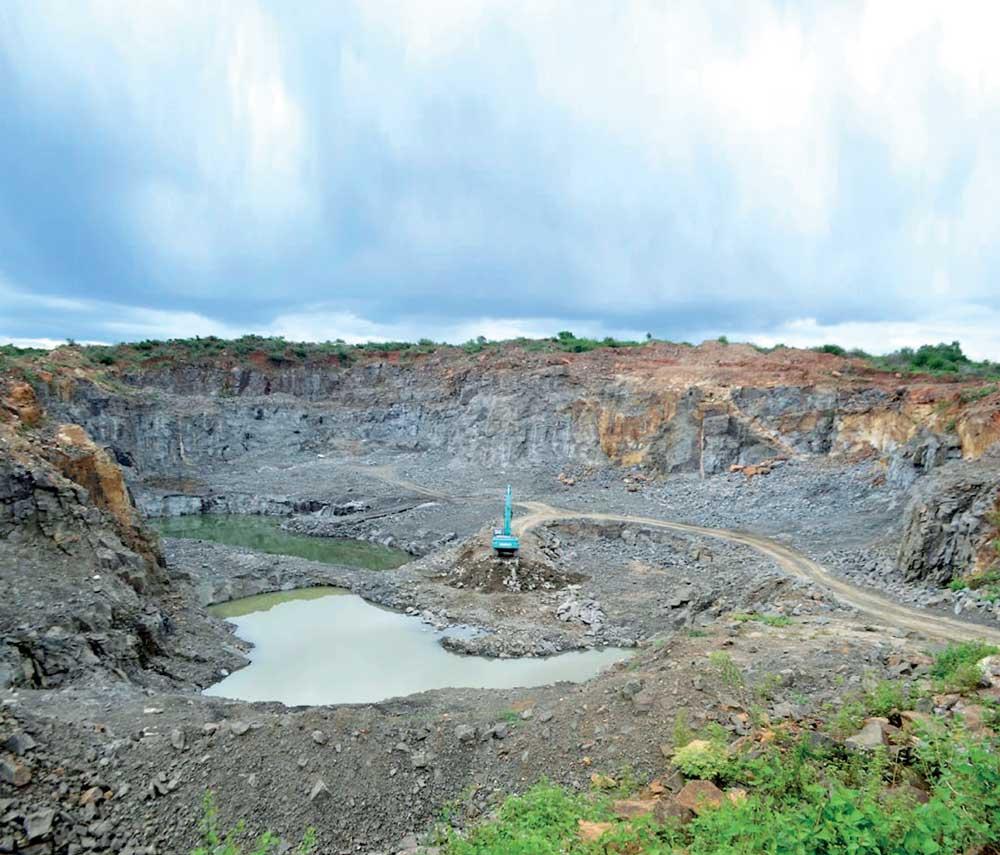
A large-scale quarry located within the Elephant Management Reserve
 Due to weak and ineffective land management plans and policies in Sri Lanka, the human–elephant conflict has become a major national issue.
At present, this problem affects 131 Divisional Secretariat divisions in 19 districts across 8 of the country’s nine (9) provinces. Environmentalists state that the issue is reported most frequently in the North Western, North Central, Uva and Southern Provinces.
When the current Government assumed power, it pledged in its policy framework titled ‘A Thriving Nation, A Beautiful Life’ as well as in its environmental policy ‘Mihikatha’ that it would minimise the human–elephant conflict by conducting systematic studies on elephant populations, movement patterns, and habitats, and by implementing programmes based on scientific methods with community participation. However, the government is accused of abandoning its own policies and plans and instead is engaging in actions that intensify the human–elephant conflict.
“Environmental organizations and environmentalists in this country played a significant role in bringing this government to power. They did so in the hope that the present government would genuinely work to resolve these environmental issues. However, like previous governments, they too are distributing forest lands arbitrarily to please investors and their political allies, thereby increasing the human–elephant conflict. At present, there are plans to construct a 150-megawatt solar power park, described as a $150 million investment and the largest of its kind in the country, within the Hambantota Elephant Management Reserve. We are not against solar power. However, when there are plenty of alternative locations available, we oppose the use of forest areas rich in biodiversity and heavily populated by wild elephants for this purpose,” said Sameera Weerasinghe of the Udawalawe Elephant Management Programme.
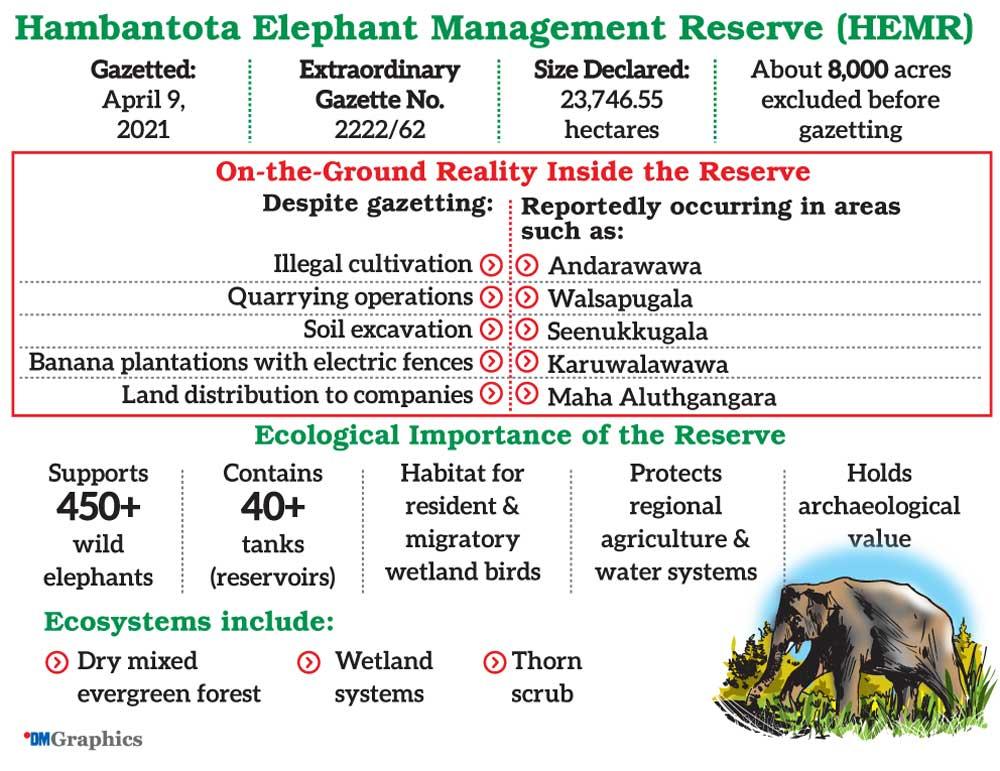
In the face of the human–elephant conflict, it is in the South that we encounter farmers who have taken to the streets demanding justice for wild elephants. They are the farmers of the left bank of the Walawe River in Hambantota. For more than a decade, they have been struggling with successive governments, demanding a permanent habitat for wild elephants. These farmer groups state that until land is allocated for wild elephants, these animals will not allow them to live in peace either. As a result of years of struggle, the then government declared 25,740 hectares as the Hambantota Elephant Management Reserve through a gazette. However, leaders of the farmers on the left bank of the Walawe alleged that the gazette was merely an empty document that completely misled them.
“On January 19, 2021, our farmers took to the streets demanding that the Hambantota Elephant Management Reserve, which had been allocated for wild elephants in 2011, be gazetted without a delay. After 105 consecutive days of continuous satyagraha and a hunger strike, 25,740 hectares were finally allocated to the Hambantota Elephant Management Reserve. However, this was about 3,000 hectares less than the extent originally set aside for the reserve. Even according to that gazette, there is still no real protection for animals within the allocated land. Even at present, land inside the reserve is being distributed to companies, quarrying activities are taking place, soil is being excavated, lands are being taken over and cultivated, and permission is being granted for large-scale solar projects. There is nothing that is not being done there. In reality, by gazetting this forest as an Elephant Management Reserve at that time, the government merely deceived the farmers,” alleged Mahinda Samarawickrama, Chairman of the United Farmers’ Organization of the Walawe Left Bank.
Large-scale, unplanned development projects
After the end of the thirty-year war in Sri Lanka, numerous large-scale development projects were implemented, particularly focusing on the Hambantota District in the Southern Province. According to environmental organizations in the country, these development projects, which were planned and executed without proper environmental assessments or scientific approaches, have significantly intensified the human–elephant conflict in areas such as Ketanwewa, Kudaidiwewa, Nagarawawa, Panwewa, Walsapugala, Thalawilla, Ilukpelessa, Seenukkugala, and Metigathwewa in the Hambantota District. They stated that as a result, large numbers of wild elephants in these areas are being killed by humans, while human lives, property, and their crops are being destroyed daily by wild elephants.
“To construct the Mattala Airport, Sri Lanka’s second international airport, about 5,000 acres of forest land—where wild elephants once roamed in large numbers and still do—were destroyed. Subsequently, additional forest areas were cleared to build the Hambantota Port and the required road networks and other infrastructure facilities. Forests heavily used by wild elephants were also destroyed for the construction of the Magam Ruhunupura International Convention Centre, the Mirijjawila Industrial Park, the Hambantota Administrative Complex, the expressway system and the cricket stadium. As a result, new human–elephant conflicts emerged in areas such as Andaragas Wewa, Dimuthugama, Elalla, Pahala Mattala, Uda Mattala, Jadura, Badagiriya, as well as Kuda Gammana five and six established under the Lunugamvehera Reservoir scheme.
“Due to massive construction carried out without proper studies or planning, wild elephants have become trapped in small forest patches such as Manajjawa, Madunagala, Nagarawawa, Ihala Kumbukwewa, and Kumaragama and they enter villages at night in search of food. Moreover, the Elephant Management Reserve, which had been proposed as a solution to the elephant issue, was divided in two by the construction of the expressway from Matara to Hambantota. The expressway built from Matara through Ihala Andarawawa to Mattala, along with the expressway entrance constructed from the Hambantota Port to Ihala Andarawawa, has significantly fragmented the reserve. Because of this fragmentation, wild elephants are now forced onto the expressways. Due to these expressways, forest areas within the Elephant Management Reserve such as Seenukkugala, Walsapugala, and Karuwalawawa have become completely isolated along with their elephant populations,” pointed out Senior Environmentalist Sajeewa Chamikara of the Movement for Land and Agricultural Reform (MONLAR).
Proposal by farmers’ organizations
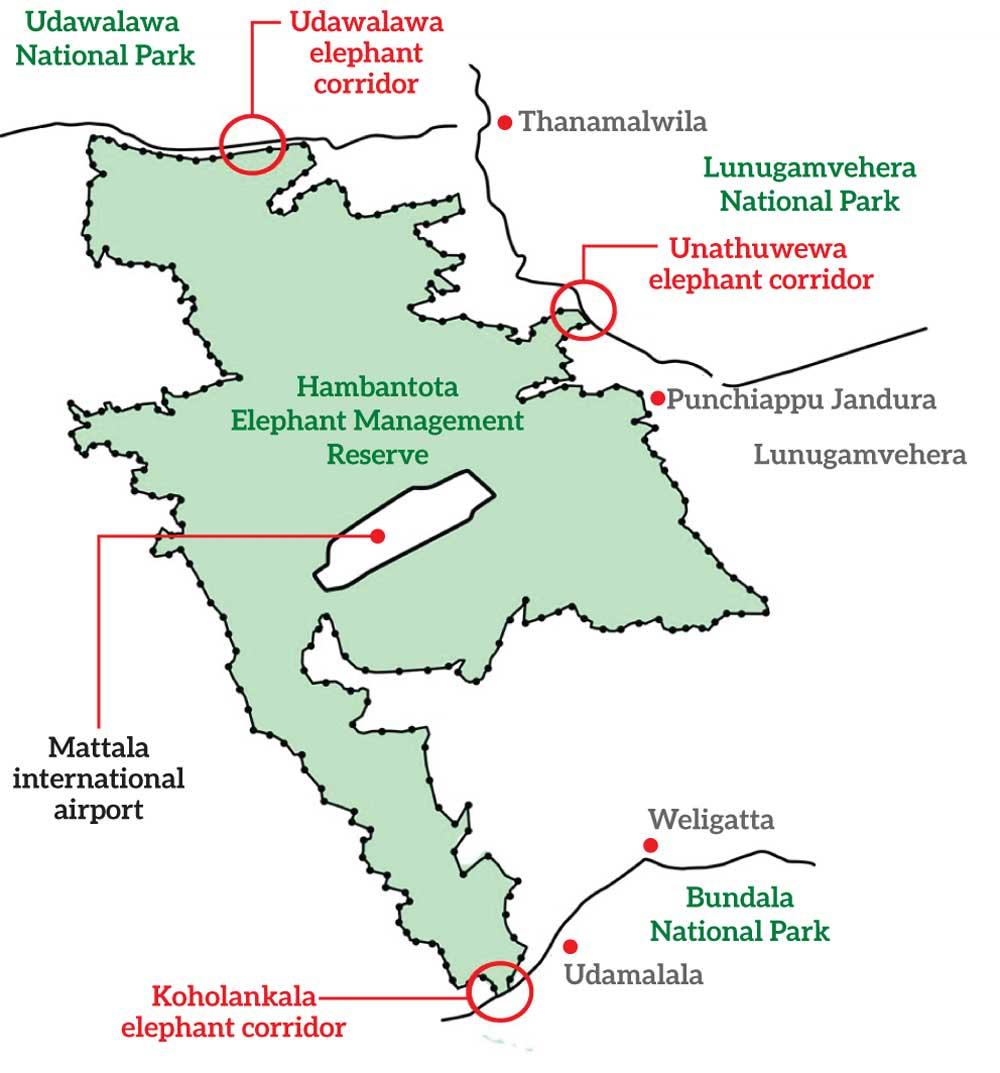
As mentioned earlier, after the end of the war, the Rajapaksa government focused heavily on developing the Southern Province. Under the Walawe Left Bank Development Project, the Lunugamvehera Project, and the Hambantota Municipal Council Area Development Plan prepared in line with the National Physical Plan, more than 35,000 acres of forest land were cleared. As a result, large extents of elephant habitats were destroyed. In 2011, a proposal was made to establish an Elephant Management Reserve covering 60,000 acres, enabling wild elephants to migrate freely between Udawalawa, Lunugamvehera and Bundala National Parks. The objective was to ensure the safety of elephants displaced by development and to reduce their return to villages. This initiative was led by the “Gajamithuro” programme. Over a period of two years, they developed the plan after consulting all government institutions in the Hambantota District and rural communities affected by wild elephants. In 2012, the Gajamithuro District Committee unanimously approved the proposal. Most of the land within the proposed reserve, amounting to 23,746.55 hectares, belonged to the Land Reform Commission, while the remaining lands were under the Department of Forest Conservation and the Mahaweli Authority.
“In 2006, a major operation was launched to drive wild elephants that had entered villages in this area into Lunugamvehera National Park. The government at the time spent around 16 million rupees on this operation. However, it failed to drive all the elephants into the park. About 180 elephants became trapped in isolated forest patches in areas such as Kuttigala, Ridiyagama and Ambalantanna. Therefore, the Department of Wildlife Conservation constructed an electric fence encompassing all these areas, with the aim of preventing the elephants trapped in isolated forest patches from re-entering villages. In 2011, when we proposed the Hambantota Elephant Management Reserve, we referred to the area within this electric fence. However, the Mahaweli Authority has been allocating around 8,000 acres of land within this fenced area, which was under its control, for various development projects. The Mattala Airport itself has been built on land that falls within the proposed Elephant Management Reserve. In addition, the Mahaweli Authority continues to distribute these forest lands for large-scale solar projects, major development programmes and quarrying. These lands being allocated are identified as areas heavily used by wild elephants,” added Samarawickrama.
Farmers take to the streets
Since 2010, farmers on the Walawe Left Bank have been fighting for the allocation of suitable land for wild elephants displaced by large-scale development projects centered in the Southern Province. In 2011, through the “Gajamithuro” programme, a proposal was submitted to establish an Elephant Management Reserve for the Hambantota District and to have it legally gazetted. However, as no authority paid attention to the matter, farmers of the United Farmers’ Organization of the Walawe Left Bank launched a continuous satyagraha campaign and a hunger strike in the Walsapugala area against the then government on January 19, 2021.
By doing so, they pressured the government to promptly gazette the Hambantota Elephant Management Reserve as originally planned in 2010 and to intervene in reducing elephants’ entry into villages. Although the government initially ignored the protest, after 105 consecutive days, when the campaign escalated into a major hunger strike, it could no longer be disregarded due to mounting political pressure. As a result, on April 9, 2021, Wimalaweera Dissanayake, the then State Minister of Wildlife Protection, adopted safety measures including the construction of electrical fences and trenches and reforestation. An Extraordinary Gazette No. 2222/62 was issued declaring the Hambantota Elephant Management Reserve. However, at the request of the Mahaweli Authority and the Sustainable Energy Authority, approximately 8,000 acres of forest land originally proposed for the reserve were excluded.
Representatives of farmers’ organisations stated that these excluded forest areas are places where wild elephants are heavily concentrated.
Accordingly, 23,746.55 hectares of forest land located within the Divisional Secretariat divisions of Hambantota, Sooriyawewa, Lunugamvehera and Thanamalwila in the administrative districts of Hambantota and Monaragala, across the Southern and Uva Provinces, were included in the Elephant Management Reserve.
“The then government used this gazette to deceive the farmers who were protesting in Walsapugala and the environmental organisations in this country. Nowhere in the gazette were regulations included regarding the administration of the Elephant Management Reserve. As a result, no measures were taken such as constructing electric fences, removing elephants from villages, evicting unauthorised cultivators within the reserve, or providing necessary facilities for elephants inside the parks. In reality, the gazette was nothing more than an empty document without real significance.
“We believed that after the current government came to power, it would legalise and properly protect this Elephant Management Reserve. But we do not see that happening. Before gaining power, Hambantota District Member of Parliament Nihal Galappaththi of the current government stated that all solar projects constructed within the Elephant Management Reserve were illegal and should be removed. However, now he not only justifies the construction of those solar power plants within the reserve, but is also facilitating new projects that further destroy it. During our struggle for this reserve, the present government’s Minister Lal Kantha and Deputy Minister Namal Karunaratne joined our protest and supported our cause. In reality, what they did was simply use us to gain political power. We will never again be deceived by politicians,” added Samarawickrama.
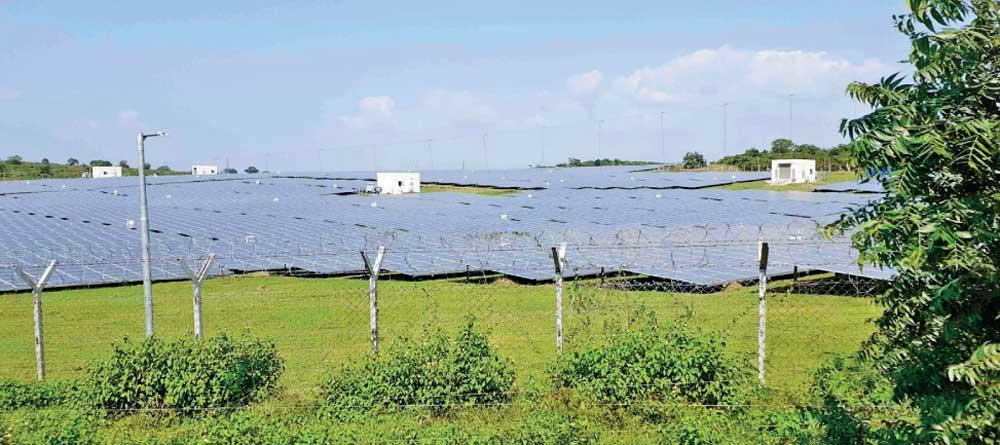
A solar power project built inside an elephant management reserve
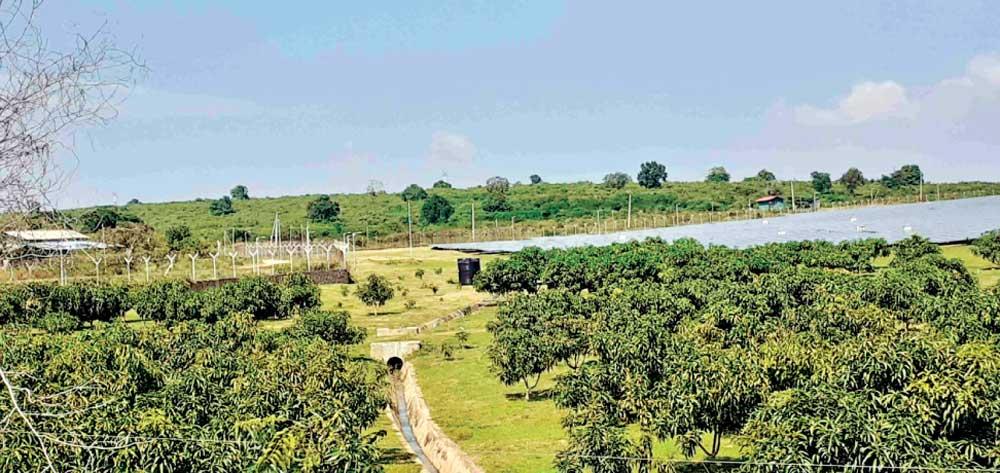
A large-scale development project underway in the reserve
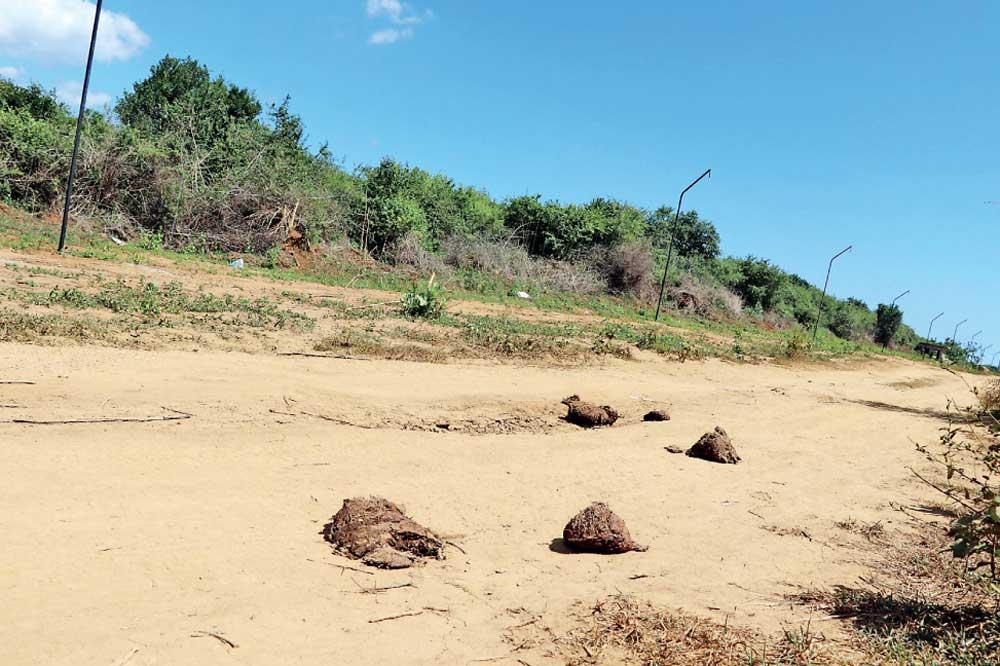
Elephant excreta seen in the land outside the forest reserve
Land grabbing
The clearing of forest lands and the distribution of such lands among political and business associates under the guise of development projects in the Hambantota District have reportedly been taking place since around 2009. Certain forest lands that fell under the Mahaweli Authority were distributed among various parties on the claim that they were “Nindagam” lands (Nindagam lands in Sri Lanka are historical, feudal-era land grants that were traditionally given to individuals for services rendered). It is pointed out that 500 acres from Gonnoruwa to Paththawa, identified as Gonnoruwa Nindagama, and another 600 acres known as Galahitiyawatta Nindagama were allocated by the Mahaweli Authority to various companies and businessmen, despite opposition from local residents. Environmental activists further stated that prior to the declaration of the Hambantota Elephant Management Reserve in 2021, officials of the Mahaweli Authority took steps to exclude from the proposed reserve a zone stretching from Andarawawa to Walsapugala, an area heavily frequented by wild elephants.
“More than 1,000 acres between Andarawawa and Walsapugala were removed from the originally proposed reserve boundaries when the Ministry of Environment gazetted the Hambantota Elephant Management Reserve in 2021. Yet this area remains a zone heavily used by wild elephants even at present. Subsequently, the Mahaweli Authority leased these forest lands to various companies for quarrying operations and large-scale solar projects. These activities have contributed to the ongoing human–elephant conflict in the area,” said Chamikara.
No elephant corridors
Although the Hambantota Elephant Management Reserve has been officially declared, many of the elephant corridors connected to it have reportedly been distributed by the Mahaweli Authority among various parties. This has further intensified the human–elephant conflict in the area. Environmental and farmer organisations alleged that due to the allocation of the elephant corridor extending from the Elephant Management Reserve to the Madunagala Sanctuary, around 20 to 25 wild elephants have become trapped in nearby small forest patches. These trapped elephants are said to be the ones entering nearby villages at night.
The elephant corridor used by elephants travelling from the Gonnoruwa area within the reserve to Bundala National Park has now been completely blocked due to irregular land use in the Galwewa area. In addition, the Koholankala elephant passage connecting Bundala National Park to the Elephant Management Reserve has been allocated for a large-scale chili cultivation project. As a result, elephants have been trapped near villages and are entering them at night. Moreover, villagers stated that the Hedigalla elephant corridor, a main entry point into the reserve, has been obstructed for a housing project. Of the 5,000 acres acquired for the construction of the Hambanthota Port, around 2,500 acres reportedly now confine about 20 to 25 elephants, which periodically break into nearby villages.
At present, the elephant issue severely affects 20 villages within four Divisional Secretariat divisions in the Hambantota District: Hambantota, Ambalantota, Sooriyawewa and Sewanagala.
Commenting further Chamikara stated: “Simply declaring an Elephant Management Reserve doesn’t achieve the intended results. This reserve was declared to enable elephants to migrate freely between Udawalawa, Bundala and Lunugamvehera National Parks. However, most of the elephant corridors are now occupied by individuals and companies. Therefore, the expected outcomes of declaring this reserve have not been realised. All corridors linking Bundala and this Elephant Management Reserve are blocked. Political interference has prevented the reopening of the elephant corridor between the 31st and 32nd kilometer points on the Udawalawa–Thanamalwila road, which connects to Udawalawa National Park. As a result, habitat planning issues have emerged. Large-scale quarrying operations and the allocation of land for major solar power projects within the area originally proposed for the reserve have increased elephant intrusions into villages. In areas under the Mahaweli Authority such as Hamuduruwewa, Andarawewa, Seenukkugala, Pahala Andarawewa, Dimuthugama and Weliwewa, large-scale illegal cultivation is taking place. Similarly, in forest lands under the Forest Conservation Department, including Dakshina Wewa, Aluth Wewa, Kadawara Wewa, Badagiriya Wewa, Maha Aluthgangara Wewa, Ranawarunawa Wewa, Devranvehera Wewa, Mayurapura, and Nagarawewa, there are large-scale soil excavations and illegal land encroachments. In addition, extensive quarrying is being carried out within forest lands inside the Elephant Management Reserve in areas such as Maha Aluthgangara and Weheragala, which fall under the Mahaweli Authority and the Forest Conservation Department. Under such circumstances, the so-called Elephant Management Reserve is nothing more than a signboard,” he said.
Farmers in the area also stated that between Maha Andarawawa and Pahala Andarawawa in the Sooriyawewa Divisional Secretariat division, about eight individuals have illegally occupied around 2,000 acres in the catchment area of Hamuduruwawa and are operating a large-scale banana plantation with unauthorised hanging electric fences. This has obstructed elephant habitats and led to severe damage in villages such as Andarawewa, Walsapugala, Karuwalawewa, Thissapura and Ranamayurapura. They also pointed out that illegal cultivation has blocked elephants’ access routes to Weera Wewa, Elalla Wewa and Pusgale Wewa, further increasing the wild elephant threat in the area.
No legal custodian
Although 23,746.55 hectares were gazetted in 2021 as the Hambantota Elephant Management Reserve, the legal status of the reserve remains questionable. Farmers organisations stated that because there is no clearly designated legal authority responsible for it, lands belonging to the Elephant Management Reserve are being encroached upon by various parties and distributed to different companies under the guise of development projects.
“When we informed Mahaweli officials about issues concerning the Elephant Management Reserve, they said that although the lands belong to the Mahaweli Authority, since the area has been gazetted as a reserve and handed over to the Department of Wildlife Conservation, we should speak to Wildlife officials. However, when we approached Wildlife officials, they said that the reserve hasn’t been legally handed over to them, so they cannot intervene. When we informed the Hambantota District Secretary, he said that since there are no proper legal provisions to act regarding these lands, it is difficult to intervene in these issues. So to whom are we supposed to present the problems within this reserve” said Gamage Sudesh, Chairman of the Mayurapura Farmers’ Organization in Hambantota.
Plans to distribute
forest lands
A considerable extent of residual forest under the DFC has been included within the Hambantota Elephant Management Reserve. Among the main areas are the Thammenna–Badagiriya residual forest of approximately 600 hectares, the Bundala Siriyagama residual forest of about 500 hectares, the Rathmudu Wewa Forest Reserve of around 2,000 hectares, and the Keligama–Koholankala forest of about 600 hectares. Environmental organisations and local farmer leaders stated that all these lands are currently unprotected and that there are plans to distribute them among various groups.
Approximately 40 percent of the land within the Elephant Management Reserve belongs to the Mahaweli Authority. Under Section 3(1) of the Sri Lanka Mahaweli Authority Act No. 23 of 1979, a large extent of land in the Walawe region was vested in the Mahaweli Authority through Gazette No. 137 dated April 16, 1981.
Environmentalists stated that six forest blocks within the Elephant Management Reserve that belong to the Mahaweli Authority are currently unprotected. Among them are the Karambagasmulla medicinal forest of approximately 300 hectares near the Madunagala Sanctuary and the Konketiara forest of around 700 hectares. Commenting on this matter, Weerasinghe stated that these Mahaweli-owned forest areas are regions heavily frequented by elephants and are environmentally sensitive water catchment zones. Therefore, he emphasised that these areas should be transferred to the Department of Wildlife Conservation and given proper protection.
Govt.’s elephant operations
Although the current government stated before assuming power that it would conduct a systematic study of the causes of the human–elephant conflict and resolve the issue through scientific methods, Wildlife Researcher Supun Lahiru Prakash said that their actions so far indicate that they too believe the problem can be solved merely by driving elephants away. He pointed out that without resolving the issues surrounding the Hambantota Elephant Management Reserve, it is difficult to find a solution to the elephant problem in Hambantota.
“Before driving elephants into the Elephant Management Reserve, the forest areas surrounding the gazetted reserve should first be incorporated, and all elephant corridors connecting the reserve with Udawalawa, Lunugamvehera, and Bundala National Parks must be freed from human activities. Thereafter, illegal cultivation within the reserve, quarry pits, and all activities that obstruct the free movement of wildlife must be stopped. The gazette establishing the Elephant Management Reserve, which exists only in name, should be activated and the reserve granted proper legal management authority. At the same time, food availability within the reserve must be ensured and the safety of elephants guaranteed. If, without doing these things, the government attempts to solve the problem merely by driving elephants into forests and erecting electric fences, as previous governments did, it will be ineffective,” he said.
Conservation of forests
and ecosystems
Within the zone of the Hambantota Elephant Management Reserve managed by the Forest Conservation Department, there are more than 25 tanks, including Swarnamali Wewa, Lolugaswewa, and Metigath Wewa. In addition, around 17 tanks are found within the portion belonging to the Mahaweli Authority, including Divulpelessa Wewa, Andarawawa, and Usgala Wewa. The protection of all these tanks, the region’s agriculture, and the entire biodiversity of the area, including wild elephants, depends on the conservation of the forests within the Elephant Management Reserve. The reserve is not merely a habitat for elephants. It consists of several distinct ecosystems, including dry mixed evergreen forests, thorny scrublands, and wetland systems associated with tanks. These ecosystems support a population of over 450 wild elephants and a rich biodiversity. The area serves as a habitat for a large number of resident wetland birds and also as a feeding ground for migratory wetland birds. In addition, this zone holds significant archaeological value. Therefore, the government must at least now ensure proper legal protection for this forest area, which has been declared an Elephant Management Reserve in name, and refrain from dividing and distributing it in parcels.
15 Jun 2026 19 minute ago
15 Jun 2026 22 minute ago
15 Jun 2026 30 minute ago
15 Jun 2026 35 minute ago
15 Jun 2026 42 minute ago