24 Mar 2026 - {{hitsCtrl.values.hits}}
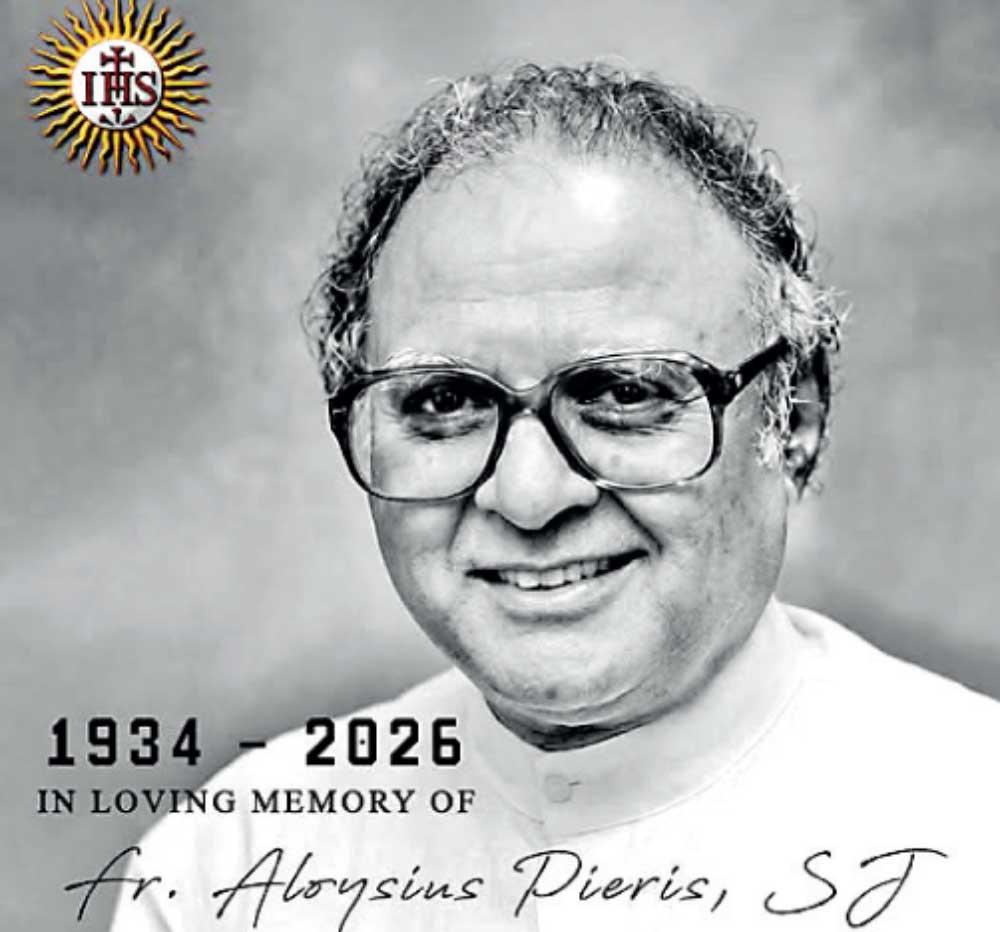

It is with a heavy heart that I write these words when a true kalyana-mitra of ours who had the good fortune of associating with him has departed. Although the news I received in the morning was not totally unexpected with his recent illness and advanced age, one starts feeling a vacuum revealing thereby that, knowingly or unknowingly, you have been so much dependent on this man for guidance and light. And the light being no more, one does not have an alternative but being a light unto oneself, as the Buddha admonished.
On his 90th birth day, I remember, there was a simple function at Tulana organised by the Tulana community and I had the honour of speaking a few words by way of celebrating his compassionate and illuminating life. At this occasion, I quoted the Dhammapada, Dūresantopakāsentihimavantovapabbato: ‘Like the Himalayan mountain, satpurushas --people with substance -- are visible even from distance!’ Fr. Aloy, being not that much spacious physically, nevertheless was a towering figure in his intellect, sincerity and compassion. He will continue to be visible like a mountain for years to come!
Reflecting at this moment of his multidimensional expertise and activism, the first thing we realise is that the gap created by his departure cannot be filled at least in the near future. Among his many dimensions, I would focus on the following even very briefly: Fr. Aloy was an advocate of Asian liberation theology, an outstanding example of inter-religious studies, inter-religious understanding and practice, an educationist with a broad outlook, and an eminent scholar in Buddhism.
Fr. Aloy was an admirer of liberation theology that had its origins in Latin America. inspired by this interpretation of Bible and the resultant social activism, it is Fr. Aloy who conceptualised and articulated the phenomenon called Asian liberation theology. In his own life, as all those who came to associate with him knew, he exemplified the principles that liberation theology enriched by the Asian religious traditions.
A prominent aspect of his life was inter-religious activism, the basis for which was provided by his inter-religious studies and inter-religious understanding. Fr. Aloy used to say a story about how he was directed to study Buddhism deeply by none other than the great Buddhist scholar and Catholic priest E. Lamotte. On being asked as to what he intended to study for his doctorate, Fr. Aloy had said that he planned to do a comparative study between Buddhism and Christianity upon which Lamotte has observed: “So you are going to compare something you know with something you don’t know!”
It is at this point that Fr. Aloy decided to come back to Sri Lanka and study Pali and Buddhism thoroughly. He studied Pali and Sanskrit (in addition to Latin, Greek and Hebrew which he already had). He came to associate with such eminent Buddhist scholars as Dr. Walopala Rahula Thera, Kotagama Vacissara Thera, Nyanaponika Thera, KN. Jayatilleke, and DJ Kalupahana.
Finally, he did his doctorate on the psychology and philosophy of Dhammapala, a leading commentator of the Pali canon, next to Buddhaghosa. It is not an exaggeration to say that he remains still the best authority not only in Sri Lanka but perhaps all over the world on Dhammapala. In addition to his expertise in scholastic Buddhism, Fr. Aloy’s expertise in Abhidhamma is well recognised. His paper on ‘cardiac theory of consciousness’ is an outstanding contribution to the understanding of Buddhist psychology and philosophy.
Coming to Inter-religious understanding and dialogue from inter-religious studies, Fr. Aloy was a living example of true inter-religious living characterised respectful treatment of other religious traditions while being faithful to his own. It is well known how Fr. Aloy disagreed even with the Pope whose representation of other religions including Buddhism, he felt, was misrepresenting those religions. Further, he stressed that the other religions should not be misrepresented in the course of distinguishing them from one’s own. As the editor of Dialogue, the journal published by The Ecumenical Institute for Study and Dialogue, Fr. Aloy exemplified impartiality and fairness in discussing issues across religions, politics and economics.
For Fr. Aloy, inter-religious dialogue was not a matter of compromise between two systems of belief for pragmatic reasons. One needs to approach other religions with a sense of dignity and compassion while one is established on one’s own grounds.
This account is not meant to be an academic appraisal of Fr. Aloy’s scholarship and activism. It is meant to capture a glimpse of a rich religious life in which his vast knowledge of languages such as Pali and Sanskrit, Hebrew, Greek and Latin and of Christian and Buddhist scriptures served only as instruments and nothing more.
Fr. Aloy smiled sincerely and genuinely; he laughed light-heartedly with the innocence of a child. He did not have an aura surrounding him; he welcomed people wholeheartedly. Personally for me, visiting him, even occasionally, was not different from visiting an elderly Buddhist monk for advice, guidance and inspiration.
May his forward journey be blissful!
Asanga Tilakaratne is an Emeritus Professor of Buddhist Studies, University of Colombo. He is currently, Visiting Professor, Nalanda University, Rajgir, Bihar, India
08 Jun 2026 13 minute ago
08 Jun 2026 21 minute ago
08 Jun 2026 44 minute ago
08 Jun 2026 47 minute ago
08 Jun 2026 1 hours ago