15 May 2025 - {{hitsCtrl.values.hits}}
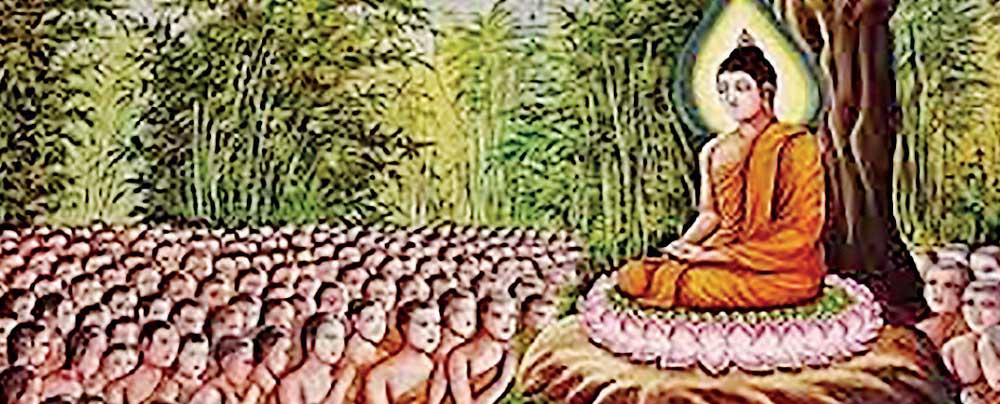
 Buddhism is considered a ‘Religion’ in a traditional form and understanding. 26 centuries ago, when people became devotees of The Buddha, it continued as a religion from generation to generation. There exists a question as to in fact and in true sense, whether it is a religion.
The English term ‘Religion’ has been originated from the Latin word ‘Religio’. Some say it has several etymological roots such as ‘Religare’ which means “to tie-back” or “to re-bind”.
Summarily, it could be defined as “the proper performance of rites in veneration of Gods”. In general, all the followers of a religion shall have faith and trust in the God or gods believed by the devotees of such religions.
The Buddha’s first admonition to the first 60 Arahants demonstrates that his teaching was converse of the teachings of all the other religions.
“Caratha bhikkave carikam, bahujana-hitaya, bahujana-sukhaya, lokanukampaya, atthaya hithaya, sukhaya devamanussanam”
Which means “O’monks, go on your ways, and preach the Dhamma, with the compassion to all beings in the world and for the benefit of the masses of gods and human being”.
During that period, the common feature of all the religions that existed was the belief that beings and the world were a creation of the God or all beings are at the mercy of the God or gods.
When The Buddha admonished the monks to extend the compassion not only to human beings, but also to gods, clear message was communicated that human beings were not slaves or depending on the God or gods, who were considered as supra-natural beings.
The path was opened for men and women to realize that they are unique and far excellence.
The Dhamma preached by The Buddha is meaningful and beneficial in the beginning, in the middle and at the end and it leads to a noble life.
One should have his own reasoning and engage in mindful observation and reflection to gain a deeper understanding of himself and the world.
One should not believe a particular fact because it has been acquired by repeated hearing, nor upon tradition, nor upon rumour, nor upon what is in a scripture, nor upon surmise, nor upon axiom, nor upon spacious reasoning, nor upon bias towards a notion that has been another’s seeming ability, nor upon the consideration.
In that context, The Buddha insisted that one should not believe or follow a thing just because it is a teaching of The Buddha.
Unlike in all the other religions, Buddhism gives a priority to make the mind of the man, as all things whether good or bad are conceived in the mind and not anywhere else.
The mind is instrumental in moulding and shaping a life of a person whether it is good or bad. Hence, this teaching is mainly concentrated in making one’s mind pure, by eradicating evil roots. If one has to do it completely, he has to uproot the craving in full.
Then, he will be able to comprehend the Eight-fold Path, a guide to a life of ethical conduct, meditation and wisdom leading to the cessation of suffering.
For that purpose, one must understand the Four Noble Truths, preached by The Buddha, in his first sermon, ‘Dhamma chakka pavathwana sutta’ to His first five pupils.
That sermon covers the entire gamut of the sansara circle. The Noble Truths are;
This means suffering as it appears superficially, but it is neither pessimistic nor optimistic. It is realistic in view of both the life and the universe. It looks at things objectively (yathabutam). Although a person enjoys a thing as pleasurable or comfortable, it ends as a suffering. There are three significant features of dukkha, namely;
a) Dukkha-dukkha – dukkha as ordinary suffering
Birth, old age, sickness, death, association with unpleasant persons and conditions, disassociation from pleasant persons, not getting one’s desire, etc. are suffering in both the forms, physical and mental.
b) Viparinama dukkha – dukkha produced by change
Whatever the happy condition in life is neither permanent, nor everlasting. It changes sooner or later. This is the vicissitude included in dukkha.
c) Samkhara dukkha – dukkha as condition of states
This category of dukkha includes a philosophical aspect of Four Noble Truths. ‘I’ or ‘being’ or ‘individual’ is only a combination of over changing physical and mental forces or energies which could be divided into five aggregates called ‘pancakkhandha’;
2. Dukkha samudaya ariyasacca – the origin of suffering
The desire or craving leads to all forms of suffering and it is inter-dependent. This condition of the circle of beings is described as “Conditional Genesis” (paticca-samuppada). This arises due to the defilements and impurities known as ‘kilesa kasawa dhamma’. Desire includes not only for wealth and power, but also a desire for attachment to ideas, opinions, theories, beliefs, etc.
3. Dukkha niroda ariyasacca – cessation of suffering
It is a truth that there is a possibility for liberation/emancipation from suffering if one comprehends these noble truths and cease the suffering by attaining nirvana. English language may not be capable of articulating what the “nirvana” means.
In general form, it is called supra-mundane which has to be realized only through one’s experience. Complete cessation of suffering could be realized by the extinction of desire (ragakkhayo), the extinction of hatred (dosakkhayo), the extinction of illusion (mohakkhayo) and for that it is necessary to uproot the cause for the attachments.
4. Dukkha niroda gamini patipada ariyasacca – the way leading to the cessation of suffering
This is the way towards the cessation of suffering, which also means the middle path. It is to avoid the extremes, namely, going behind pleasure of the senses and self-mortification which is different from asceticism.
The Buddha showed the middle path which is commonly called Noble Eight-fold Path (ariya attangika magga). Right speech means abstention from uttering of lies, slandering, using harsh and abusive words, talking babbles and gossips. All the said disciplines are inter-connected and there is no order in which they should be practiced. Each one helps other to develop their qualities.
Right speech means abstention from uttering of lies, slandering, using harsh and abusive words, talking babbles and gossips. All the said disciplines are inter-connected and there is no order in which they should be practiced. One who resorts to the said path voluntarily and ensure self-purification, with spiritual and intellectual perfection could attain nibbana/nirvana.
11 Jun 2026 50 minute ago
11 Jun 2026 55 minute ago
11 Jun 2026 2 hours ago
11 Jun 2026 2 hours ago
11 Jun 2026 2 hours ago