22 Dec 2025 - {{hitsCtrl.values.hits}}
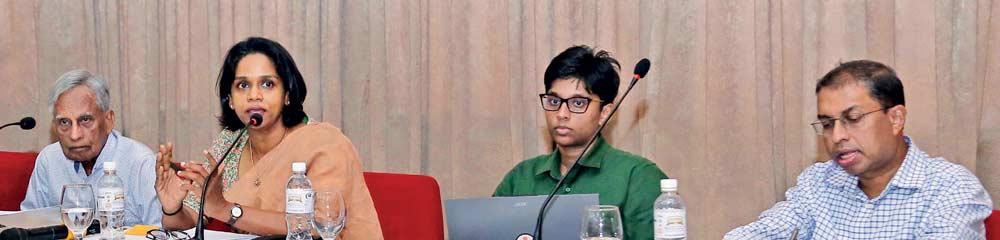
(Seated left to right) – Austin Fernando, Bhavani Fonseka, Yolani Fernando, and Saliya Pieris
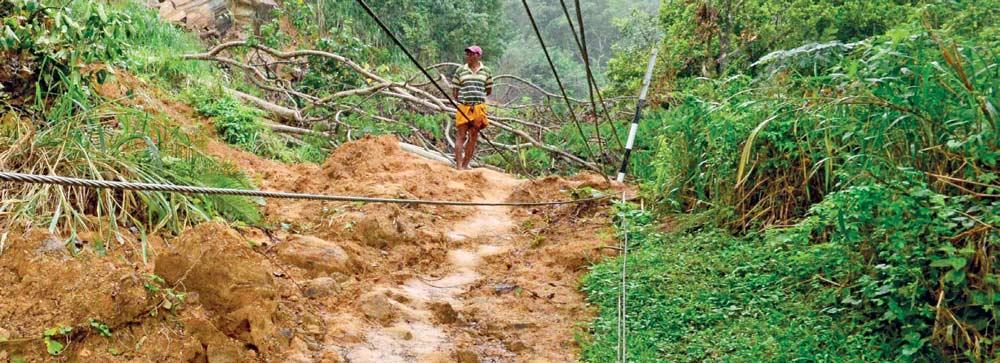
Many roads still obstructed due to landslides, hindering connectivity
Pix by Kithsiri De Mel
 In his remarks, President’s Counsel Saliya Pieris said that one of the key issues is about the use of emergency regulations – whether the regulations were needed and whether the regulations which have been promulgated are the correct regulations is a question
Cyclone Ditwah is described as one of the worst tragedies that occurred in Sri Lanka in recent times. It is believed that the impact of this disaster may be felt for years to come, similarly to the aftermath of the Indian Ocean tsunami in 2004. While authorities continue to assess the full scale of fatalities and destruction caused by the cyclone, recovery, rebuilding and rehabilitation efforts would require immense efforts, funding and coordination. In this backdrop, interest groups including civil society organisations have started questioning the government on the promulgation of emergency regulations, state of the economy and issues of transparency and accountability in overall governance structures
Myriad of concerns
Immediately after the cyclone, the government declared a state of emergency followed by the appointment of new actors such as the Commissioner Generals for essential services and civil security. “One of the questions we have raised is that the regulations itself are rather vague,” said Bhavani Fonseka, human rights lawyer and activist during a recent discussion organised by the Centre for Policy Alternatives on the theme ‘Governance, Human Rights and Related Issues in Times of a disaster.’
She highlighted the fact that the Disaster Management Act was brought in soon after the tsunami.
There are sections within the Public Security Ordinance that could have been used and were used by the President. “In terms of response and reforms there are vulnerable groups such as women, youth, children and disabled people that require quite a lot of attention. Intersectionality needs to be looked at. One factor highlighted during this disaster is climate issues. One of the new dimensions is that the economic crisis created new layers of insecurity and vulnerability. There are questions being raised about the composition of the Rebuilding Sri Lanka fund and how it would execute context specific responses,” she added.
Lessons from the past
Sharing his experiences, Austin Fernando, one of the senior-most civil servants in Sri Lanka recalled a cyclone that hit Sri Lanka in November 1978. Back then, Fernando had been serving as a government agent and he was given six hours notice of a cyclone coming at a speed of 125 mph. “I received a telegramme at around 3.00pm and the notice indicated that the cyclone would reach Polonnaruwa around 9.00pm. But with present technological advancements things should have been expedited much earlier. That is a part of preparedness which we talk in governance. Whether we are prepared in terms of early warnings, drills to mitigate the impact of the disaster are questions that need to be asked,” he said.
Fernando said that even though the Disaster Management Act was passed in 2005, there was one meeting convened by President Maithripala Sirisena regarding a flood or drought, somewhere in 2020. “So we have not been prepared as a country although preparation is one of the main aspects in terms of governance,” he added.
He also shed light on maintenance of disaster-prone areas and decades of misuse. “Certain water retention areas have been encroached by people, putting up two-three storey buildings, raising questions about how approval has been given for such constructions. In this situation we find some sort of unpreparedness, governance issues in terms of information not being shared. There’s a lack of coordination and collaboration among agencies. Tasks and responsibilities are being duplicated. We need information to guide the recovery process. There’s so much of perishable data. If field studies are not being taken seriously, much of this data would be perished and it is a bad sign,” Fernando opined.
He further said reconstruction would be a multi billion dollar issue, which would lead to corruption and favoritism and we have experienced these matters before. “Going forward, the Disaster Management Centre, Disaster Management Council and other structures need to be strengthened in addition to certain institutional and system changes that need to happen in order to set governance standards right,” he underscored.
Another blow to the economy?
Shedding light on the current economic perspective, Yolani Fernando, political economist and Executive Director at Arutha said that anything that was said prior to the disaster in terms of how the government was doing, revenue earnings etc. should now be relooked because we were already on a narrow path and it became a bit narrower.
“There would be certain adjustments made by IMF and other partners that will allow us to keep going. Initial estimates put the reconstruction bill somewhere in the USD 7 billion range. But these are all estimates. There are certain concerns regarding restrictions that are there as a result of the reforms that have happened. For instance, the Public Finance Management Act and its particular restriction being primary expenditure (expenditure without debt servicing) having to be maintained at 13%. There are provisions to change that up to 14-14.5% that doesn’t require an amendment in Parliament but a resolution. But such a resolution would have to provide justification to Parliament along with time bound measures to return to a path where we are avoiding debt accumulation,” she explained.
Speaking about impacts on tourism and agriculture Fernando said that the agriculture sector contributes about 8% of GDP while 30% of the employed population is in agriculture. “I believe the Yala season was projected to be 14% more than last years. That number doesn’t hold anymore when we have over 500,000 hectares of paddy lands that have been flooded. This would also affect the next season,” she added.
Fernando said that the public finance committee has endorsed a Rs. 50 billion supplementary allocation. “This is money that has to be spent before December 31. In terms of next year, what makes sense and what the Treasury seems to be doing is that money that has already been allocated to roads is now being used for reconstruction of roads as opposed to construction of new roads. In terms of supporting people, the government should look at cash transfers. The government could look at debt moratoriums as long as they are time bound and well targeted. One good thing that the government has done is not wasting time talking to IMF about a rapid financing instrument. This wasn’t done during COVID and it cost us dearly,” she underscored.
A call to implement proper Emergency Regulations
In his remarks, President’s Counsel Saliya Pieris said that one of the key issues is about the use of emergency regulations – whether the regulations were needed and whether the regulations which have been promulgated are the correct regulations is a question. “There were provisions relating to requisitioning of vehicles and buildings, appointment of Commissioner Generals of Essential Services and Civil Security in emergency regulations promulgated by President which maybe relevant. But there are many other regulations which have been promulgated but are not related to the current situation. One wonders whether those who were making regulations just copied, cut and pasted, an old template of regulations intended for a different period and were subsequently promulgated,” he added.
Pieris said that there is a reference to Section 369A of the Penal Code which refers to sexual relationships between people of same sexes. “So, it is difficult to understand what that has to do with emergency regulations. In fact, the regulations have missed out certain matters for which regulations could have been used. For instance, the Prescription Period where cases have to be filed. Some of the courts went under water such as the District court in Kandy. It’s record rooms and libraries have been destroyed; lawyers’ briefs and files have been destroyed. So there maybe practical problems relating to the prescription period during which a case can be instituted. The emergency regulations could have been used to suspend certain provisions of the Prescription Ordinance in affected areas.
“There were lawyers who said that there were enjoining orders obtained from courts which couldn’t be extended because the courts didn’t sit. These are areas in which emergency regulations could have been used. The Parate Execution for instance because many businesses and vehicles affected. Could emergency regulations be used to extend payments of lease? I think the emergency regulations could have been used for these purposes but these haven’t been thought of. However, it is still not too late to promulgate a fresh set of regulations to cover essential areas,” he added.
He further said that the Disaster Management Act enacted in 2005 has a provision to declare a state of national disaster. “But the provisions there are not as strong as emergency regulations. There’s already a Disaster Management Plan in place from 2023-2030. Was it really brought into effect and was the public made aware of such a plan? There’s another 50-page document about another emergency operation plan. This is also on the DMC website. This talks about early warnings in relation to cyclones. So, were those in authority actually aware of it? The government should look at strengthening the Act. On the other hand, there are broader environmental issues that need to be addressed,” he further noted.
Pieris also pointed several broader issues of democracy that the state shouldn’t lose track of. “Three existing civil members of the Constitutional Council would be ending their term in January. So how would they be appointed? At the end of the year there will be a vacancy in the office of Chief Justice, in addition to several vacancies in the Supreme Court. Some of the 2026/2027 terms in most commissions would lapse. There are reforms for Prevention to Terrorism Act, Online Safety Act and perennially discussed Constitutional reforms before the minister. So these aspects too should be addressed,” he said.
07 Jun 2026 46 minute ago
06 Jun 2026 06 Jun 2026
06 Jun 2026 06 Jun 2026
06 Jun 2026 06 Jun 2026
06 Jun 2026 06 Jun 2026