20 Sep 2025 - {{hitsCtrl.values.hits}}
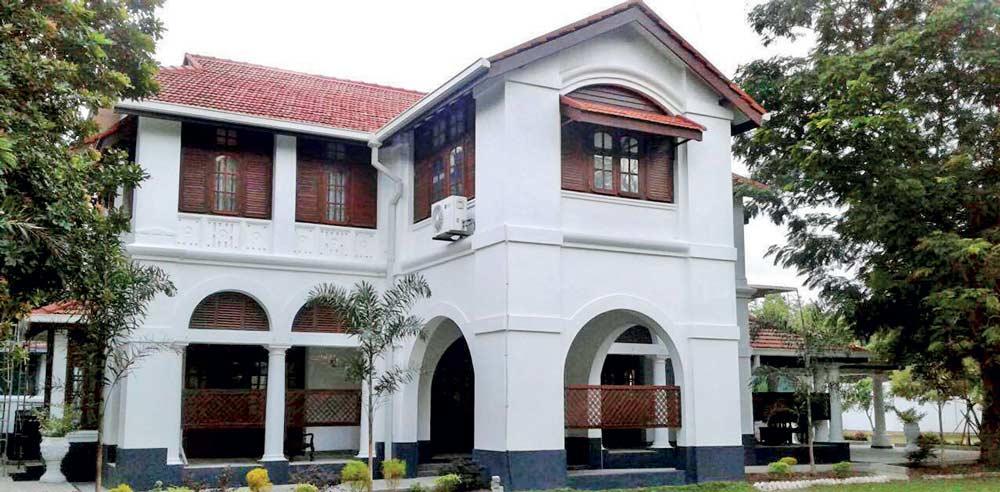
The palatial state residence on Wijerama Mawatha, valued at Rs 3 billion, where former President Mahinda Rajapaksa lived rent-free until the new legislation. FILE PHOTO
 Rs 491.2 million was spent on former presidents’ perks from 2017 to mid-2025; meanwhile, security costs stood at Rs 1.4 billion in 2024
The Presidents’ Entitlement (Repeal) Bill abolishes official residences, vehicles, and secretariat allowances for former presidents
 Sri Lankans have a somewhat skewed sense of victimhood. No wonder every conman, wheeler-dealer and corrupt politician, when hauled before the court, cries loud that they have been politically victimised. Therefore, it comes as no surprise that the ex-presidents and their acolytes have resorted to the same gimmick when they were stripped of perks under the Presidents’ Entitlement (Repeal) Bill passed in Parliament last week. The Bill effectively abolished the ex-presidents and their widows’ entitlement to official residence, vehicles, and secretariat allowances.
What followed the Bill was a heart-wrenching spectacle at Mahinda Rajapaksa’s publicly funded palatial residence in Wijerama Mawatha. It appeared as if the average man and woman in the street, who on any other day would be struggling to make ends meet, had united to save the ex-president’s privilege. Heartbroken at this brazen injustice, they travelled from far-flung corners to cry, howl and kowtow before the ex-president in front of television cameras. What a sickly orchestrated show! It has now moved to the mini theatre in Carlton in Tangalle.
Former President Mahinda Rajapaksa, until last week, resided rent-free in a state house on a sprawling one-acre plot of land, valued at 3 billion rupees, with a monthly rental calculated at 4.5 million rupees by the government assessor.
He has decried his eviction, pursuant to the new Act, as an act of ‘political terrorism’. (Those like Lasantha Wickremetunge, Lalith, Kugan and Pradeep Ekneligoda might have offered a different explanation of ‘political terrorism’).
Other former presidents were less vindictive: Maithripala Sirisena sang a song in prime time news on his plight, and said he would leave without making a show. Chandrika Kumaratunge, who claimed she was in ill health, had asked for two months to vacate until she renovates her new residence. Gotabaya Rajapaksa and Ranil Wickremesinghe had returned to their private houses at the end of their terms, and Hema Premadasa had moved out of her official residence before the new Act came into effect.
The government claimed it had fulfilled an election promise, and also revealed that the public funds to the tune of Rs 491.2 million (Rs 491,203,422) had been spent as expenses for former presidents and their widows from 2017 to the first six months of 2025. Conversely, the estimated budget for the renovation of Colombo Central Bus Stand, which was launched on Monday, is Rs 424 million. That may reveal the skewed priorities that had plagued Sri Lanka and perhaps also, much hyped and much needed renovation is nothing more than a patchwork, more so since a commonsense economic approach would have been such projects to be undertaken in public- private partnership on a long term lease, since the government owned institutions have repeatedly shown they could neither monetise nor maintain such properties.
The abolition of the ex-presidents’ perks is good politics for the government; it might even appear as an economic saver on paper. Those savings of Rs 500 million would be better utilised if 5000 students were given scholarships to pursue a technical course. However, the billions of rupees lost due to inefficiency, red tape, and mismanagement of government institutions far exceed them by a manifold. Therefore, these populist measures should not be a distraction from the much-needed economic reforms and liberalisation, in which the government is yet to make headway.
Critics of the government have argued that the latest measures are penny-wise but pound-foolish. They say that without financial security during their retirement, politicians would resort to profiteering when they are in power. However, the extent of corruption revealed in the latest court filings by the Bribery Commission may suggest that the post-retirement perks had no moderating effect on corruption.
Another rhetorical question is whether the new Act does justice to politicians, some of whom have served selflessly, spending from their own pockets. While the JVP clamour about a 76-year curse, there are quite a few politicians who gave more to the country than they took. For instance, the late prime minister Sirimavo Bandaranaike introduced the most revolutionary land reform programme in this part of the world, and gave away much of her ancestral land. She, however, did all that before any of those perks for ex-heads of state were introduced in 1986.
Interestingly, on paper, many of the perks accorded to the ex-presidents do not appear as excessive. The now-repealed Presidential Remuneration Act No. 4 of 1986 provided every ex-president or their widows with an appropriate house free of rent during their lifetime. It also stated that where a suitable residence is unavailable, the former heads of state would be given 30% of their salary as a housing allowance. Given the pension of the ex-president is Rs 97.500, that would be Rs 32,500. Further, past presidents and their spouses should be provided a pension, office staff, official residence, security, vehicles and fuel expenses.
What happened in implementation was gross abuses of these perks and resultant misappropriation of public funds. The ex-presidents were housed in palatial residences, paid with unchecked renovation expenses, plus fuel expenses and an expansive security detail.
Excluding their enormous security expenses, the five ex-presidents and a widow splurged 110 million rupees last year.
However, security expenses, undertaken without a coherent threat analysis, dwarf any other costs associated with ex-presidents. Security expenses for 2024 for the five ex-presidents and the presidential widow totalled 1.4 billion rupees. In fact, ex-presidents in this country are accorded security details akin to those of African warlords.
In 2024, Mahinda Rajapaksa had a security detail of 228 Tri-Forces personnel and 60 police officers and Maithripala Sirisena had a security detail of 4 Tri-Forces personnel and 60 police officers. 188 Tri-Forces personnel and 22 police officers were assigned to Gotabaya Rajapaksa, and Ranil Wickremesinghe was protected by 57 Tri-Forces personnel and 60 police officers.
Former President Chandrika Bandaranaike Kumaratunga had 60 police officers, and 10 police officers guarded Hema Premadasa.
What justifies such an enormous security detail and the associated expenses of ex-presidents other than propping up their fragile egos? Such measures militarise the polity and generate fear psychosis, which the politicians have nursed to advance their political ends. They also reflect poorly on the resource allocation of the defence force and provide no justice for public funds allocated for the defence budget.
That the government had announced plans to cut down these vast security entourages is commendable. However, this would not necessarily deter future abuses, whether under this government or its successors, until defence officials and their civilian political bosses develop a sense of fiscal accountability. This might explain the logic behind the Act to repeal the perks of ex-presidents, rather than rationalising or downsizing such privileges. When politicians of rival parties serve each other at the expense of public funds, it is hard to set limits; instead, a more aggressive approach was to abolish the facility altogether, which the government has chosen to do. That might not necessarily lead to a significant monetary bonanza, but perhaps it is a civic victory considering the extreme of abuses it had degenerated into over time.
Follow @RangaJayasuriya on X.
08 Jun 2026 8 minute ago
08 Jun 2026 50 minute ago
08 Jun 2026 1 hours ago
08 Jun 2026 2 hours ago
08 Jun 2026 2 hours ago