25 Apr 2025 - {{hitsCtrl.values.hits}}
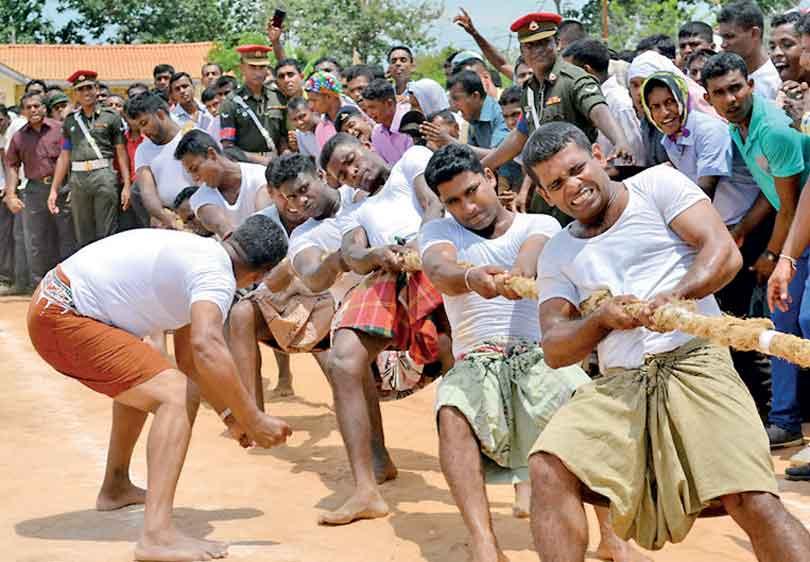
Physical strength plays a big role in which team succeeds at tug of war, but there have been occasions when the underdog has won thanks to better skills
 Many sports activities take place during the Sinhala-Hindu New Year in April. Among some of the robust sports activities on the cards during the festive season is tug of war. It is also considered as one of the traditional sports activities in this island.
With another Sinhala-Hindu New Year festival being celebrated, people have loads of memories of tug of war events being carried out. Along with the tug of war events, there were other cultural and national sports events that were also worked off in many parts of the country.
Tug of War is a contest where physical strength, endurance and team spirit is displayed. Two teams engage in this pulling contest and the one that pulls the other team a stipulated distance (forward) emerges the victor.
|
TWFSL General Secretary Christy Fernando (left) pictured with TWFSL President Retd. Maj. Gen. Janaka Ranasinghe |
In Sri Lanka, tug of war is practised in schools and as a community event. Physical strength plays a big role in which team succeeds, but there have been occasions when the underdog wins, thanks to better skills.
The sport is also popular in other parts of the world. Those who engage in this sport are either professionals or amateurs. According to historians and sources in the sports circle, tug of war is considered as one of the oldest sports in world history. Its presence many centuries ago is confirmed through the discoveries in the Egyptian tomb engravings. These engravings portray Egyptian boys participating in the sport over 4000 years ago. It is believed the term Tug of War originates from the German words ‘toga werra’. It had been recorded in the history books as a royal sport in several ancient civilizations in countries such as China, Egypt and Greece.
Gaining popularity in Europe
This discipline was included in the line-up of sporting events at the Summer Olympics from 1900 to 1920. Sadly it is no longer a sport at the Olympics. At the end of the 19th century, the game became an organised sport in the most parts of Europe. In recent decades, tug of war has increasingly gained popularity, both at national and international levels. Going down memory lane, the governing body for the sport, Tug of War International Federation (TWIF), was established in 1960. This sports federation is responsible in conducting practices and competitions all over the world.
A total of 75 member countries have thrown their weight behind this world Federation. The TWIF has been organising the international Tug of War competitions since 1964.
This fact may be little known, but Sri Lanka too formed its own governing body for the sport in the island back in 2005. That sports body is known as the Tug of War Federation of Sri Lanka (TWFSL). This federation conducted its inaugural tournament that year itself. TWFSL has been organising competitions at district and national level. The main objectives of the Federation are to provide the infrastructure for the sport and ensure good governance that is necessary for the well-being and development of the sport.
“26 Tug of War clubs have been registered already across the country under the Tug of War Federation of Sri Lanka. Anyone could join the Federation through a registered club. A new club could be formed by a collective of new members. But the club has to wait one year to get registered with the Federation. Taking part at the National Championship is also a part of the criterion to be eligible for membership,” TWFSL President J. N. Ranasinghe told the Daily Mirror in an interview.
One of Sri Lanka’s recent achievements in the sport is the islanders wining 1st place in the women’s category at the South Asian Tug of War Championship in 2019. Meanwhile the men’s team was able to win 2nd place in the same tournament. The tournament has been organised by the South Asian Tug of War Federation.
“It is rather pathetic when we take into account the finances available to develop the game. We do not get any support from any of the responsible officers. We collect money within ourselves to organise or to conduct championships. We can move forward if we are able to get the attention of the responsible parties,” said J. N. Ranasinghe.
“We have been trying to find a sponsor for the sport over the years. But it has been quite a difficult task. We have been overlooked very badly. The private sector, businessmen and private parties have been organising tug of war events and championships across the country over the years. They are offering high prize money for the winners,” said TWFSL Secretary Christy Fernando.
“Those parties also earn profits from organising these types of championships. But they are not conducting them in keeping with international standards. Players from clubs are participating in these types of championships and we are unable to prevent this as we cannot organise or offer such a big prize money,” he said.
TWFSL comes under the purview of the Ministry of Sports and Youth Affairs. Many are of the opinion that Sports Ministry bears the responsibility to come forward and find solutions for the difficulties faced by the TWFSL. If this is done, it would immensely held nurture the game here in Sri Lanka.
11 Jun 2026 18 minute ago
11 Jun 2026 1 hours ago
11 Jun 2026 1 hours ago
11 Jun 2026 2 hours ago
11 Jun 2026 2 hours ago