12 Jun 2026 - {{hitsCtrl.values.hits}}
Pic by Nisal Baduge
There has been a chorus of protests. This is exceedingly unpopular and very compelling reasons have been given why this should not be proceeded with
Supreme Court is an institution which has a history of more than 220 years and never in this history has there been 4 unfilled vacancies
Amidst concern, protest and strong opposition against alleged move to increase retirement age of the judges of Superior Courts, the government yesterday announced that it has not yet obtained official Cabinet approval for such a move. Addressing the parliament, Justice and National Integration Minister Harshana Nanayakkara has stated that no official decision has yet been taken regarding the issue. However he has observed that not only judges but professionals from other sectors have also submitted requests seeking an increase in the retirement age, and his government is considering some requests positively. However, over the last two months, the subject has created a turbulent situation especially in the judiciary and related bodies, Bar Association of Sri Lanka, the professional body comprising most of the judges and lawyers in the country, High Court lawyers Association and even independent bodies like Lawyers Collective.
Amidst this backdrop the Daily Mirror took the views of some Sri Lankan legal experts.
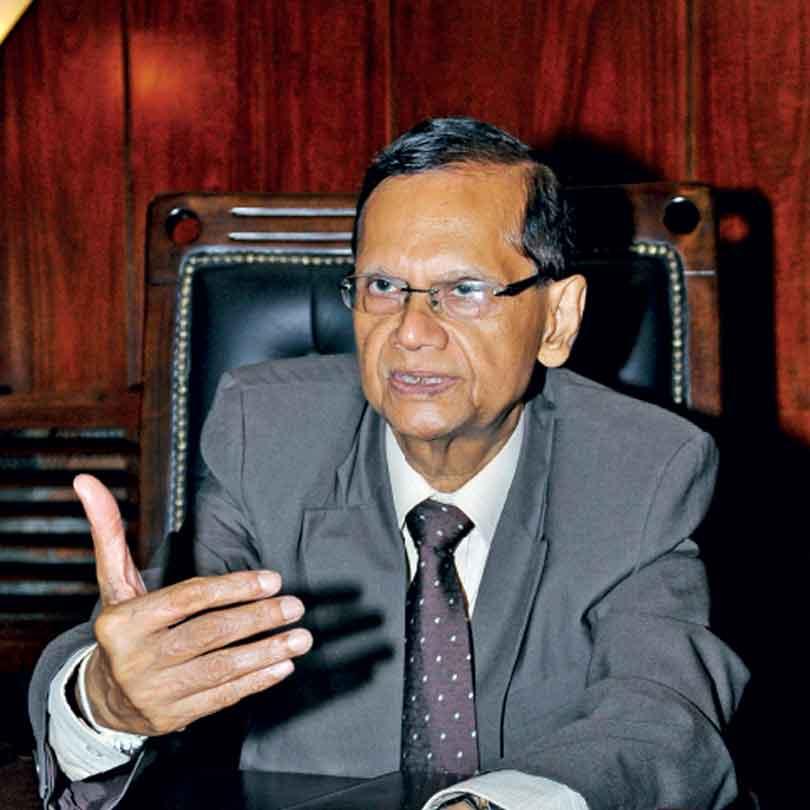
Former Professor of Law at the University of Colombo who produced a large number of legal luminaries in Sri Lanka, and former Minister of Justice G. L Peiris explains some of the serious consequences that could arise if the government continues with a plan to increase the retirement age of the seniormost judges in the country.
A teacher of many students of law who ended up becoming legal experts and judges, Prof. Peiris says that the move could have a drastic consequence not only on the judiciary but on other spheres like education, medical and etc.
Graduating in law from the University of Colombo and receiving D.Phil Degree from Oxford University in 1971, Prof. Peiris in early 1990s was selected for the drafting of the Constitution and finding a political solution to the national problem of the country. With his enormous experience in the subject, Prof. Peiris shared his views on the alleged move by the government to increase the retirement age of judges.
Q Professor, why has this subject created such a controversy at present?
A: One of the liveliest controversies at the moment is that relating to the government’s proposal for the extension of the tenure of judges by two years. Although there has been no formal government announcement, there is a widespread understanding that this is receiving serious consideration from the government. Now, the first question that arises is, why is this being done? What is the need for it? Why is this considered priority? Already, it is manifest that this has given rise to the strongest possible opposition from the legal fraternity and civil society.
There has been a vigorous statement issued by the BASL opposing this and the main ideas in that statement have been echoed by district bar associations and civil society organisations, as well as political parties and trade unions. So there has been a chorus of protests. This is exceedingly unpopular, and very compelling reasons have been given why this should not be proceeded with.
This has also created disunity and division of a very serious kind. The best example of that is a recent meeting of the Judicial Service Association, the official body representing the minor judiciary. This meeting has been widely reported in the media.
Q There were reports that some organisations representing judicial officers had not opposed. Is that correct?
A: At an informal meeting with his excellency the President, the President of the Judicial Service Association (JSC) is said to have assured the President that his association has no objection to the extension of the terms of judges by two years. But this has been vigorously contested by the membership. The membership of the association has emphatically declared that this is not their opinion, that they have never been consulted, and that they have not given authority to the President of the association to convey such a view on their behalf to the President.
Now in that situation, the JSA President had denied making such a statement to the President. He said (3:41) ‘no I haven’t done that’. But then he was contradicted by the secretary of the association, who was present at that informal meeting, and who repeatedly said, no the President did make such a statement.
Now there was a sharp exchange of views, and finally the JSA head considered that he had no right to commit the association to such a point of view and, according to the newspaper reports, this is reflected in the minutes of the association. Now this kind of situation certainly does not represent any service to the judicial, the sharp conflict of opinion on this matter. And now it seems clear that if the President of the association made such a statement, it was done without the concurrence of the membership according to newspaper reports.
Q Why do you think that this issue should be given top most priority?
A: Now during the last few weeks there has been sustained discourse in the media, mainstream media as well as the social media. There have been comments, editorials, cartoons and enquiries into the careers and backgrounds of judges. This kind of controversy is obviously detrimental to the stature of the judiciary.
Now, this is much to be regretted because today I think it can be said without exaggeration that the one institution in our country that commands the full respect and esteem of the public is the judiciary, and nothing must therefore be done to impair that respect in any way. Now, one very important question that arises in this connection is in the midst of this storm of protest; why should the government persist in going ahead with this as a matter of priority? If reform in the area of the judiciary is considered urgent, there are other things that obviously need to be done.
The 20th amendment to the constitution made some important changes with regard to the number of judges in the Supreme Court and the Court of Appeal. The Supreme Court earlier consisted of the chief justice and up to 10 judges, that is 11 in total. The court of appeal consisted of the president of the court of appeal and up to 11 judges, 12 in total.
Now the argument at the time was that one of the most serious problems confronting the judiciary is the law’s delays, cases are piling up and justice delayed is justice denied. So it was then argued that the only realistic solution to this is to increase significantly the number of judges so that there would be more judges available to dispose of cases which have been accumulating and piling up for a long time. So, the effect of the 20th amendment was to increase the number of Supreme Court judges from 11 to 17, 11 to 17 Supreme Court, Court of Appeal from 12 to 20.
Q What about the existing vacancies that need to be filled in the superior courts?
A: Now what is amazing is that, having gone so far as to bring a constitutional amendment to increase significantly the number of judges of these two courts, there are now 4 unfilled positions in the Supreme Court and 4 unfilled positions in the Court of Appeal. These are four vacancies; the Supreme Court is an institution which has a history of more than 220 years and never in this history has there been 4 unfilled vacancies.
Now what is the reason for this? There is a great deal of speculation of a somewhat unhealthy kind about the motive for keeping, persistently keeping these vacant positions unfilled. If there is genuine concern about addressing law’s delays, then surely the first thing to be done is to fill the vacancies. Why is it not being done? Then it is today a fact that there is massive dissatisfaction among the minor judiciary.
I am personally aware of this because as a law professor and an academic who has taught two generations of students in the Faculty of Law of the University of Colombo over a period of 26 years, I have taught many of the people who are now holding judicial offices in Sri Lanka. There are students of mine who are sitting in the Supreme Court, sitting in the court of appeal and all other courts below. So I am aware that there is real dissatisfaction and heartburn among many of these judges about matters directly affecting their service conditions.
One critical area is promotions. Now we concede without any argument, we accept without question that seniority is not the only criteria. Merit counts.
But the problem is that there is no ready yardstick for measuring merit. Therefore, that should not be made a cloak for arbitrary and capricious decisions. If a senior judge is being bypassed, then the reasons for that should be clear.
If there are good reasons, there is no problem at all. If there have been problems about the judge not writing judgements in time or some other acceptable reason for denying the judge a promotion, then that is alright. There is no problem over there.
But if there is no reason that can be given and it is unexplained, then naturally that will result in disillusionment of a higher order. Now at the moment there are about 35 judges who have been affected by this and who are profoundly unhappy. There is also the issue of transfers.
A well-known instance of this is the High Court Judge of Jaffna, Mr. A. G. Alex Raja, who was given his appointment in Jaffna, and within a month he was transferred to Badulla. He didn’t serve even a month. Now that is out of the ordinary.
It is extraordinary. There may be reasons for that, but the public are not aware of the reasons. That is not healthy.
If within such a short time a transfer is deemed to be necessary, then some kind of explanation should accompany the transfer. Then the argument is that these are all decisions by the Judicial Service Commission (JSC). But it is very important to emphasise that these decisions by the JSC represent an exercise not of judicial power but of administrative authority.
Q But the JSC consists of judges?
The JSC consists of judges, no doubt, but when they sit as members of the Judicial Service Commission, they are not exercising judicial power. They are making administrative decisions with regard to promotions, transfers and disciplinary control of the minor judiciary.
So in terms of Article 126, sub-article 1 of the Constitution, this is executive or administrative action, which is amenable to the fundamental rights jurisdiction of the Supreme Court. Then there is another issue in this regard which needs to be highlighted. The composition of the Judicial Service Commission is governed by Article 111(D) (2) of the Constitution.
According to that provision, the JSC consists of the Chief Justice, the senior most judge of the Supreme Court and the next most senior judge of the Supreme Court who has had experience of work in a court of first instance. So the JSC then consisted of the Chief Justice, then the third judge, Justice Samyawardena, fulfilled this requirement. He had served in the original court.
But the strange circumstance is that the second vacancy was not filled. Second vacancy is the senior most judge of the Supreme Court, that is next to the Chief Justice. Now the vacancy arose on March 19, 2026.
With regard to the identification of the second member of the JSC, there is no discretion because the judge is specifically identified in the Constitution. He is the next senior next to the Chief Justice. So that is Justice Yasantha Kodagoda.
The Constitutional Council approved Justice Kodagoda’s appointment on May 22, 2006 and approval was obtained on May 24, 2026. So that vacancy existed for more than two months.
Now that is a violation of the Constitution, because the Constitution requires that appointment to be obtained, and it is obviously desirable that the JSC should have a full composition. But there was this vacancy for more than two months when the judge to be appointed was specifically identified in the Constitution. Now during that period when this vacancy occurred, there were decisions being made by the JSC with regard to promotions of judges and transfers of judges.
So, would it not have been desirable for all three judges, all three members of the JSC to have participated in the making of these decisions? So that again is a question to be asked. Why that vacancy was kept for so long? So, this is a violation of the Constitution, and there needs to be public discussion on these issues.
Professor Harold Lasky said, eternal vigilance is the price of liberty. So these are matters that the Congress has the right in and indeed the duty to discuss. And these are not judicial functions.
Then there is a famous statement by Lord Atkin in AMBARD AMBARD v. Attorney General for Trinidad and Tobago. Lord Atkin said, Justice is not a cloistered virtue. She must be allowed to suffer the scrutiny and respectful, even though outspoken, comments of ordinary men.
Now this statement was made by Lord Atkin with regard to the decisions of courts. Now, these are not decisions of the courts. These are decisions of an administrative body.
So all the more reason that these are fit and proper matters for public debate. Now, no one is suggesting that decisions made during that period were invalid because the JSC was not fully constituted. It is not a question of legality. But it is a question of propriety and public acceptance. Why was it not done?
Q In case if the government goes ahead with extending the retirement age of the Superior court judges, what would be the fate of those lower to them?
Then the next issue is if the government is seeking to extend the terms of Supreme Court and Court of Appeal judges by two years; an obvious problem that arises is that the promotional avenues of all other judges are blocked. Now these are judges who have spent their entire working life in the service of the judiciary.
And they are naturally looking forward to promotion. But now unexpectedly because of this development, they have to retire earlier than expected because judges of the two highest courts now go on for two more years. Is that fair? That is going to result in a great deal of disenchantment on the part of the minor judiciary whose legitimate expectation of promotion is stultified by this unexpected change.
Then it seems from media reports that at the JSA meeting one view expressed by a section was that there would be no objection if all judicial officers have their service tenure extended by seven years. That is, a seven year extension was proposed. Now this means that for Supreme Court it is from 65 to 67. Then for Court of Appeal it is from 60. Now if the proposal is that all judges will serve until 67 years. Then Supreme Court extension will be two years and the Court of Appeal extension will be four years. High Court extension will be six years.
And District Court and Magistrates extension will be seven years. That is if all are going to be in service until they reach the age of 67. Because a magistrate or a district judge today has to retire at 60.
So if you are going to allow them to work till 67 that is a seven year extension. So it is a major overhaul. Major overhaul of the entire system.
Now what is the need for it? There is absolutely no reason which is apparent and no explanation that is available. And the recurring question is whether there is some hidden motive. Hidden motive that is openly discussed in society.
So that is by no means healthy. Now what seems to be proposed is an amendment to section 107 sub section 5 of the constitution. 107 sub section 5 which defines the ages of retirement.
Retirement of the Supreme Court is at 65, Court of Appeal is 63. Now why is this being brought as a standalone amendment? Standalone amendment because this has repercussions on various other aspects of the constitution.
For instance the electoral system. And devolution of power under the 13th amendment. All of this is interconnected.
So why is the government trying to single out this particular issue? About which there is no paramount need at all. Why is it being done? Now let us say if government says okay we are solving the problems of all judicial offices. No one is going to be prejudiced by this.
Q So if all the judges were given extension would this problem be solved?
Everybody will have their terms extended by one year. There is still a very serious issue which remains. And that issue is this. There has to be coherence and consistency in the public service as a whole. It is one entity.
And in the reforms of 2022 for example, there was reference to the service conditions of Supreme Court judges and university professors. An attempt was made to equate those. University professors retired at 65.
So do judges of the Supreme Court. Then medical specialists, medical consultants retire at 63. But in exceptional circumstances they can be extended until 65.
Heads of department in the public service have to retire at 60. Now all these categories are left exactly as they are. There is no extension for any of them. University professors, medical specialists, heads of department in the administration, all left as they are. But there is this exclusive privilege that is carved out only for judicial offices. Now that could well offend against the principle of equality embodied in Article 12, sub-article 1 of the Constitution.
That is the principle of equality before the law and equal protection under the law. Now if this is done, it is arguably not a matter of classification, but a matter of discrimination. Then there are professional bodies representing other segments of the public service which could well take an interest in this matter.
For example, the Federation of University Teachers Associations, FUTA. Then the Association of Medical Specialists, AMS. Now, then they could go to court on a fundamental rights application on the question of inequality of treatment.
But the embarrassment here is that such an action would have to be heard by the Supreme Court. Because under Sri Lanka’s Constitution, the Supreme Court has a sole and exclusive jurisdiction in relation to fundamental rights. So the very people who are benefiting from this are the judges in their own courts.
So that is a violation of the rules of natural justice. Then the final point is, this is all a question of perception. Perception is the important thing.
That is the famous principle articulated by Lord Hewart that justice must not only be done, but must apparently be seen. Apparently and obviously be seen to be done. Now this can be seen as an inducement that is offered to the judiciary, whether that is the intention or not.
It lends itself to that interpretation, to that construction and that is inimical to the stature of the courts. Now this perception arises not in vacuum, but in conjunction with certain other circumstances.
For example, the President’s remark at the May Day rally, that there was a case that was heard on April 30 and the judgement is to be given on May 25 and that the public must be prepared to applaud this judgement. So that means the President was aware of the judgement that was going to be delivered. Now that certainly compromises the tradition, because the judge is not entitled to discuss a pending judgment with anyone at all.
Then there was also another instance, that is the remark made by the General Secretary of the JVP, Mr. Tilvin Silva, regarding the Special Presidential Commission that was appointed to enquire into the coal scam. Mr. Tilvin Silva, again speaking on May Day in Hambantota, said, this commission has been appointed, it has been given six months to complete its work, but at the end of three months it will be obvious that the people who are making the accusations will become the accused, and all people connected with the government will be fully exonerated.
Now this is clearly a contempt of the Special Presidential Commission, because one of the features of the Special Presidential Commission is that all the members have to be sitting judges. So the government appointed one judge from the Supreme Court, one judge from the Court of Appeal and one judge from the High Court. So they are judges who hear cases from day to day.
Now if a high functionary of the ruling party, the General Secretary, were to say, well this is going to be the decision of the Special Presidential Commission, that is taking the commission for granted. It is a contempt of the commission. Then Mr. Tilvin Silva apologised. This was first referred to in a newspaper called Anidda on March 13, and I immediately reacted to this and pointed out the dangers attendant upon this course of action, and I am still of the view that this should not be proceeded with because this is going to inflict real damage on the institution of the tradition, that is what I mean.
Q Now, hasn’t this ever happened in any other country that extending the retirement age of judges, for whatever reasons that could be justified?
A: No, even in some countries there is no age of retirement, for instance in the United States. But we have had this ever since the enactment of the constitution. So, if it needs to be done, there must be a compelling reason. And I can’t think of any other country where this has been done in this manner with no apparent reason. So, it is the lack of any justification, any need, any practical need for this at this time, that is giving rise to all manner of speculation, and that is not a good thing. And also, what reason is prohibiting them from filling these existing 8 vacancies of the superior court? There is no reason at all.
The president is bound to fill those. He is not doing it and he is keeping them open.
So, why? Why was the 20th amendment enacted at all? It was enacted because more judges were required. Then the amendment increased the number of judges. Having done that, these positions are kept vacant.
Then why was that amendment passed at all? So, that is resulting in all kinds of speculation as to the motive. It must not appear manipulative. They appear manipulative, whatever the real intention.
And it is a violation of the constitution. The president has to appoint the requisite number of judges and there is absolutely no practical constraint, no impediment.
Q Is there any force, any action that can be taken by the citizen when a situation like this arises?
Injustice is obvious. But what is the use of the citizen? Ultimately you end up in the Supreme Court. So, that is the contradiction.
Take a judge who has served all his life in the judiciary. He has ended up in the Court of Appeal. So, he has reached the zenith of the court of appeal.
Then he reaches the age of retirement for the court of appeal. That is 63. But if he is appointed to the Supreme Court, then he can serve for another 2 years.
But that is denied to him. Denied to him although the opportunity for promotion is available. So, is that fair? Does it motivate judges? Is that a proper treatment of the judiciary? You want to motivate people. You want to encourage them to do their best. Not discourage them. So, isn’t this a very strong method of discouragement?
Q I also want to ask you on a related but different question. Can it be acceptable different governments in the past awarding political appointment like diplomatic posts to retiring judges, specially those in the superior courts? Aren’t they also amount to various inducements offered by governments?
A: Yes, it has been now, the current chief justice of India, right? No, not the current chief justice, the previous chief justice of India, right? (5:03) He delivered the Sujata Jayawardena Memorial Lecture in the University of Karnataka, the previous chief justice. In the course of his lecture, he said that when he was appointed chief justice, he made a public declaration that on his retirement, he will not accept any appointment, paid or unpaid, from the government, from any government, right? Now, I was there at that lecture. There was significant applause from the audience.
They appreciated that. And he said, the judge said that he thought that such a statement was necessary to underline his independence and integrity, right? And it is that received the applause. Now, in Sri Lanka, unfortunately, this has been violated by previous governments.
It has happened, right? But here is a government that came into office promising to introduce a completely new culture, right? So, it is useless quoting precedents from the past because the premise was that those were them. And they needed to be rejected. And a new culture initiated, right? So, if a judge soon after relinquishing judicial office is appointed to a plum diplomatic position, right? Then there are doubts that can arise in the public mind about his impartiality during the last few years, So, the best antidote to that is the action that was taken by the previous Chief Justice of India.
He said, no, we are giving a public declaration that we won’t accept such positions. It’s a very healthy practise. It needs to be emulated.
|
Dr. Nihal Jayawickrama |
It is a fundamental tenet of judicial independence that a judge should have a constitutionally guaranteed tenure. It could be for life; until a mandatory retirement age, or the expiry of a fixed term of office. National practice appears to favour a specified retirement age for judges of superior courts.
For example, the constitutionally prescribed retirement age for judges of the highest court ranges from 62 in Belize, Botswana and Guyana, to 65 in Greece, India, Malaysia, Singapore and Turkey. However, in Belize and Botswana, provision exists to permit a judge who has reached retirement age to continue in office “as long as may be necessary to enable him to deliver judgement or to do any other thing in relation to proceedings that were commenced before him before he attained that age”.
The 1947 Independence Constitution of Ceylon specified that the retirement age of Judges of the Supreme Court shall be 62 years. It also stated that the Governor-General “may permit a Judge who has reached the age of 62 years to continue in office for a period not exceeding 12 months”. Neither Sir Ivor Jennings who prepared the Ministers’ Draft, nor B.P. Peiris, the draftsman of the 1947 Constitution, has taken responsibility for the extension provision.
It is, therefore, likely that it was inserted by the British Government, having regard to the interests of members of the Colonial Judicial Service who were serving on the Supreme Court at the time when that Constitution came into force.
When the 1972 Constitution was being drafted, it was decided to omit this discretionary power of the government to grant selective extensions of service to judges of their choice. Instead, the retirement age of Judges of the Supreme Court was fixed at 63 years, while the retirement age of judges of lower courts remained at 60 years. The 1978 Constitution arbitrarily terminated the services of several Judges of the Supreme Court and the Court of Appeal, and then increased the retirement age of the chosen ones to 65 years and 63 years respectively.
There does not appear to be any valid or credible reason today for extending the tenure of the Chief Justice, of the Judges of the Supreme Court, of the Court of Appeal or of the subordinate courts. The legal profession has never been as large in number as it is today. Consequently, the field of selection of judges is enormous. To extend the tenure of serving judges is also to deny the legitimate expectation of many for promotion in service. The failure of the Government to fill several vacancies that exist today at all levels of the judiciary, coupled with reports of the likelihood of extending the terms of service of serving Judges, suggests an unwarranted interference with the due administration of justice in the country.
12 Jun 2026 12 minute ago
12 Jun 2026 18 minute ago
12 Jun 2026 22 minute ago
12 Jun 2026 38 minute ago
12 Jun 2026 45 minute ago