22 Aug 2025 - {{hitsCtrl.values.hits}}
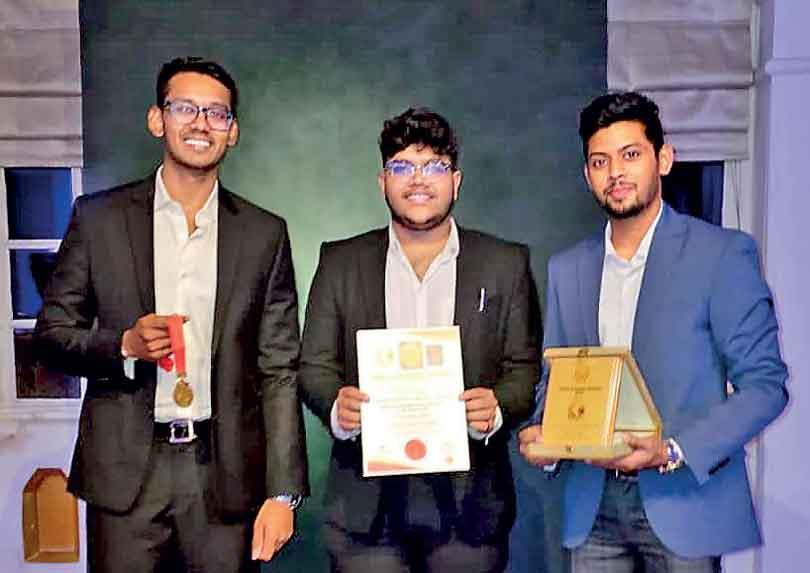
Chevaan Wickremesinghe, CEO of Apollo Consulting Group, (centre) pictured with Sadhan Jayasuriya and Shavendra Rajapakse (Both Directors of Apollo Consulting Group)
By Rashitha Dahanayaka
With Sri Lanka’s IT Industry’s hopes of transforming from $1.2 billion to $5 billion by 2030, a new wave of entrepreneurs are not just trying to be part of this transformation, but be transformers themselves. Amongst them is Chevaan Wickremesinghe, Founder and CEO of Apollo Consulting Group, who took the bold step by leaving a promising legal path to shift to business and technology.
The Daily Mirror sat down with Wickremesinghe to talk about entrepreneurship, his vision, and the challenges of doing business in Sri Lanka.
Excerpts of the interview.
Q How did your ACG Journey begin?
Our first office, after securing investment, was a “cool startup house” on two floors in Kotte, far from the city centre. My business partners and I lived upstairs, while the ground floor housed their starting team of five or six people. My partner and I used to live upstairs. We got ourselves a helper and a dog, a cute little dog named Izzy. And we were like, “okay, this is our hope for the next two years”. But, within 8 months, we had to leave the house even though we had a 2-year lease with them.
During the 2022 fuel crisis, I had my first few hiring and business calls from my dad’s car, while in the fuel queues for 2 to 3 days
Q What is it that your company does?
We are a Growth Consulting company, not an agency, so when people hear ‘Apollo’, they should think of a ‘Growth Consulting firm’. Most other companies go to an agency and say, “Listen, I want a social media presence or I want a new website”, but how we operate is customers and clients come and tell us, “Hey, listen, we’ve got this unique problem”.
So a client may ask, “We are taking a product out to certain markets in Eastern Europe, we want to make so and so amount of sales, is this possible?” We don’t just respond with a website or a social media campaign; we get inside the business. It could be marketing, tech, operations, customer service, pretty much anything that impacts growth.
Q What does the top leadership team comprise of?
It’s a tight core team. Consists of Me and my two partners: Shavendra Rajapakse, and Sadhan Jayasuriya who serve as directors. Between the three of us, we cover a lot of ground.
We all come from different industries: commodities, hospitality, tech, food, apparel, so there’s a good mix of perspectives at the table. And I think that really helps when we’re solving complex problems for clients. We’re not just talking from theory. We’ve been in the trenches. Honestly, it’s not about titles with us, we just do what needs to get done.
Q What are some exciting products you are currently working on?
Most of our products are tailored to the clients. If you want an ERP (Enterprise Resource Planning), we can provide that; if you want a POS (Point of Sale) system, we can do that, We will basically build you whatever system you need to improve that operational structure, but it all comes down to what the client needs.
We have also been quietly building something for a while now. It’s different. It’s not just a tool, it’s more like an ecosystem we’re developing, something that we believe could genuinely change the way businesses grow, operate, and manage their internal processes.
Our goal is to create something that feels intuitive, removes the clutter, and helps people focus on what matters. Especially for startups and small businesses, they often don’t have access to the kinds of tools that larger firms take for granted. We’re trying to bridge that gap.
What we are building here is of global-grade quality. I honestly believe this will be one of the top three unicorn apps in the world. I say that with full conviction.
It will be spoken about in Congress one day. It will touch every business in the democratic world. And it started here.
We’re still early, and still it is in a pre-seed stage and we are developing it, hence there is some refining to do, but let’s just say, if we get this right, it’ll speak for itself.
Q You once said that this could become “one of the top three unicorn apps in the world.” How would you measure that?
For us, the clearest indicator would be a paid user base in the tens of millions. We’re not chasing vanity metrics like downloads. We’re looking at how many people actually use and pay for the product and stick around. In terms of pricing, we’ve mapped out tiers that make it accessible for smaller businesses, while still giving enterprise clients what they need. The goal is to balance reach with sustainability.
Q Would you describe it as an AI platform?
AI plays a role, yes. But we don’t throw that term around. For us, we want to call it not just artificial intelligence, but augmented intelligence. We want to help people make better decisions, faster. We’re not trying to replace the human; we’re trying to elevate them.
Q What’s your North Star? What would make you feel like, “Yeah, we’re on track”?
If we can help take that number, nine out of ten startups failing, and make it eight? That’s the impact. That’s families getting paid, founders not burning out. And if Apollo becomes the reason why a business can go from an idea to an IPO? Then we’ve done our job.
Q What are some challenges you have faced and how have you tackled them?
There’s no shortage of challenges. We started Apollo during a turbulent period, so we’ve had to adapt fast.
I look at Singapore and the Middle East and maybe a few other countries as ideal environments for businesses to thrive, and we hope that Sri Lanka moves in that direction.
Those countries have ideal environments, their regulation, their structure, the way they incubate business, that’s how things should be. Creating an environment similar to that in Sri Lanka would only boost our economy even more. Here, it can feel like you’re constantly adjusting to new taxes, new regulations, and new policies. That uncertainty makes it harder to scale confidently. It is money leaving the country!
We’ve had to learn to navigate that, keep moving forward, and not get too distracted by the noise. At the end of the day, resilience is everything. You work with what you’ve got and keep building.
Q To follow up, can you share an example of a regulation change here that’s disrupted your plans?
Sure. Something as simple as a nationwide power cut or a sudden strike can derail operations for days. There have been changes in investment policy that have made overseas partners hesitate, and that’s frustrating. Singapore’s strength is that you can make a 10-year plan there and be reasonably confident the rules won’t change. Here, that’s harder and it pushes some founders to look elsewhere.
We also face brain drain. A lot of our most talented people are leaving. That’s not unique to Apollo, but it affects the whole ecosystem. If you want to build a global-standard company here, you need the right people, and you need them to stay.
Q To sign off, why does this story matter, especially for Sri Lanka?
Because it proves you don’t have to leave this country to build something world-class. It does not have to be in Israel or Silicon Valley. It can be built here.
08 Jun 2026 35 minute ago
08 Jun 2026 43 minute ago
08 Jun 2026 1 hours ago
08 Jun 2026 1 hours ago
08 Jun 2026 2 hours ago