23 Sep 2025 - {{hitsCtrl.values.hits}}
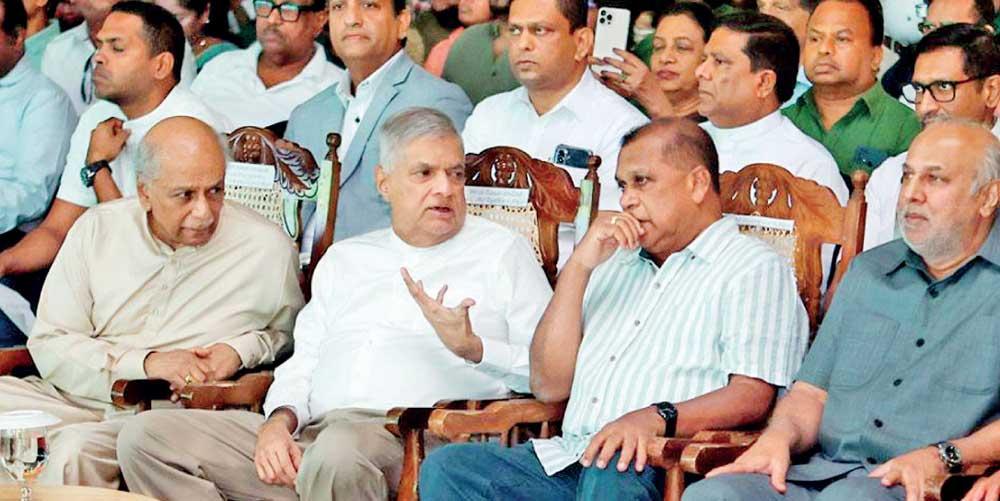
 The UNP convention last Saturday showcased a potential realignment of Sri Lanka’s centre-right opposition. With parties including SLPP, SLFP, SJB, SLMC, PA, and TPA present, leaders signaled willingness to cooperate in countering the ruling NPP amid legal actions and rising political challenges.
The United National Party (UNP) convention which was conducted last Saturday unfolded as more than a routine political gathering. The party organisers had calculated the event as a show of strength among the parties in the opposition against the ruling National People’s Power (NPP).
In fact, it is an attempt to unite the centre-right forces against the centre-left government.
Ahead of the convention, the UNP revoked the suspension of party memberships of those who sided with its breakaway group, the Samagi Jana Balawegaya (SJB).
It is a clear, symbolic effort to mend fences with the two parties.
Representatives from the Sri Lanka Podujana Peramuna (SLPP), Sri Lanka Freedom Party (SLFP), People’s Alliance (PA), Sri Lanka Muslim Congress (SLMC), and Tamil Progressive Alliance (TPA) also attended the convention.
Their presence highlighted the willingness of various parties to explore collaboration under the current political circumstances.
The current government, accused of majoritarian excesses, has targeted the entire opposition over alleged past abuses of power and irregularities and malpractices involving public finances.
UNP leader and former President Ranil Wickremesinghe was also taken to court. These moves have compelled the opposition to close ranks and realise its combined strength against a government wielding near-absolute power.
The parties in the opposition differ in traditions. At times, they also differ in terms of their ideological leanings. The UNP is historically a pro–open economy force that champions open market and market reforms.
The SJB, which is the main opposition, is only a breakaway group of the UNP. It too embraces market reforms in an open economy, but with a social-democratic approach. The SLPP, rooted in nationalism, now tries to open up as the situation demands.
The SLMC is a party standing for community rights and interests, and the same goes for TPA as far as the upcountry Tamil community, which it represents, is concerned. No matter what, the rise and actions of the NPP have created a shared incentive for them to cast aside differences.
It is not difficult for them to join forces. They all are centre-right forces, believing in multi-party democracy.
They favour open markets, private-sector-led growth, foreign investment, and fiscal discipline. More or less, they accept a social safety net but reject large-scale state ownership.
Now, in the face of political challenges, the opposition appears to have calculated that the government can be outmanoeuvered easily through the employment of its collective strength. The combined opposition is numerically superior to the government even according to the results of the last local authorities’ elections.
In politics, there are no permanent friends or enemies, but interests. Now, interests merge in the wake of mounting political challenges.
Some opposition representatives did not mince their words. In what appeared to be a warning wrapped in a friendly tone, MP Chamara Sampath Dasanayake of the SLFP called for reconciliation between the UNP and SJB, in the main.
“Without mending fences, don’t approach us for any alliance!” he told the gathering. That is a call for resolving internal differences for a coordinated opposition front.
The current development is a response to challenges posed by the government.
Political alignments are a response to circumstances unfolding. Some alignments evolve into well-knit electoral alliances, whereas others are meant to serve a particular purpose.
In the current context, the emerging unity among the opposition ranks is primarily meant to counter the government’s repressive actions against its representatives through institutions of legal action.
In the formation of a formal alliance in view of future elections, challenges lie ahead for all of them. These parties and their leaders, in the past, remained arch rivals. Today, they are united under circumstances.
There is a saying in folklore that a cobra and a mongoose cling to the same rafter when they are caught in the floodwaters. Otherwise, cobras and mongooses are natural enemies, known to fight to the death in an encounter.
The current situation of the opposition parties holds some resemblance to such a predicament. The comparison is not exact. As such, an electoral alliance cannot be ruled out.
The opposition parties, while ideologically and historically opposed, find themselves united by extraordinary circumstances: The need to safeguard their political relevance, defend democratic processes, and counter what they perceive as an overconcentration of power in the government.
At a public meeting, SJB leader Sajith Premadasa said that the government’s attempt to form one-party rule should be defeated forthwith.
Still, it does not suggest that their cooperation is seamless or permanent. Divergent political cultures, leadership ambitions, and past rivalries remain significant barriers. Yet, the floodwaters of the current political crisis have created a shared imperative.
Under these pressures, alliances that might have seemed unlikely in calmer times are now being seriously considered. The possibility of an electoral alliance, while not guaranteed, cannot be ruled out, as necessity has forged temporary unity among Sri Lanka’s otherwise fractious centre-right forces.
The SLPP, steered by its national organiser Namal Rajapaksa, is unlikely to be a mere appendage of a broad political alliance to be formed in view of elections.
he party will work together with others in the opposition under the current circumstances. But it will resist being subsumed under an alliance led by either the UNP or the SJB.
Yet, there are initiatives being made in certain quarters to unite the centre-right forces of the country as a front against the government.
These efforts signal that, despite past differences and internal competition, political pragmatism may drive the creation of a coordinated opposition strategy-a development that could reshape the electoral landscape in the months ahead.
It looks like these parties are now applying pressure on the government to take steps to declare elections to the provincial councils.
The provincial councils have remained defunct since 2017 due to an inability to conduct elections over procedural glitches.
The government is likely to come under increasing pressure to conduct these elections. The actual shape of political alignment of parties in the opposition will become visible only then.
08 Jun 2026 8 minute ago
08 Jun 2026 50 minute ago
08 Jun 2026 1 hours ago
08 Jun 2026 2 hours ago
08 Jun 2026 2 hours ago