04 May 2018 - {{hitsCtrl.values.hits}}
Hailing the completion of four cultivating seasons, the Government recently held a felicitation ceremony to acknowledge and celebrate the success of its toxin-free  agriculture programme at the Bandaranaike Memorial International Conference Hall. Dubbed the ‘Vasa Visa Nethi Ratak’ or a Toxin Free Nation, the three year programme was launched in 2016 in accordance with President Maithripala Sirisena’s manifesto.
Two years on, officials spearheading the programme have never been more confident of their victories. Several officials representing a host of Government authorities including the Ministry of Agriculture, the Department of Irrigation and religious leaders were present at the occasion. Three factors were highlighted as the foundation on which the programme was built on.
The requirement to create an environment for all living creatures to exist by banning the use of selected universal herbicides and weedicides being the first of these factors. Their priorities also included providing farmers with a ‘farmer subsidy’ instead of the fertiliser subsidy which was exclusively provided to companies which supplied agrochemicals. The research and development of biological farming with the vision of empowering a toxin-free nation was also among the priorities.

Explaining the value of biological farming in his speech Asoka Ranwala, an activist at the forefront of the campaign against the use of chemical agriculture in Sri Lanka, questioned if biological farming was merely an oral tradition limited to folklore. He said at the inception of the toxin free agriculture programme, scientific minds were forced to question the practices of traditional farmers. “There is evidence to establish that Sri Lanka has a history spanning over 3000 years where biological farming was in practice,” Ranwala said.
Biological farming is a method that improves the live top soil layer that contains the microbial-sphere or rhizosphere in order to optimise yield. With this method the conditions are created to enable all life forms both visible and invisible that live within the rhizosphere to help crops flourish. “It is a natural process which had been in practice in traditional agriculture, long before agrochemicals were introduced to our farmers. It was the reason why our farmers preferred cow dung and the waste soil of Mattakuliya over chemicals to fertilise their plots of land,”Ranwala said.
Biological farming regenerates and rejuvenates soil which has been destroyed through years of agrochemical use. According to experts this takes place within the span of just one planting season. The root cap and microbial action surrounding the plant is of utmost importance in this type of farming. Microbes in the rhizosphere prepare nutrients for absorption by the plant, while the root hairs do the needful. Biological farming strengthens and support this process. While chemical fertiliser provides the plant with saline, biological farming provides the plant with food.
According to Ranwala biological farming is most suited to tropical areas with high biodiversity. “Unfortunately, despite Sri Lanka being a country rich in biodiversity, little or no research had been conducted on this method of farming during the past two decades. Neither agricultural experts nor extension officers possess the knowledge of biological farming techniques, leading to the promotion of outdated agricultural practices,” he lamented. Ranwala noted that practices adopted under the toxin-free programme is a mix of traditional conservation farming and biological farming, developed through biotechnology research adopted in Japan.

Strategic Enterprise Management Agency Chairman Asoka Abeygunawardena believes that biological farming has successfully responded to questions posed by those engaged in commercial chemical agriculture. “Even though there was no substantial evidence it was common belief that organic agriculture was expensive,”Abeygunawardena said. However according to him research has proven that biological farming is now in the lead. He made this statement citing a comparative study conducted by the Department of Agriculture on biological farming and chemical farming. The study ensured that no unfair advantage was leveraged by biological farming efforts.

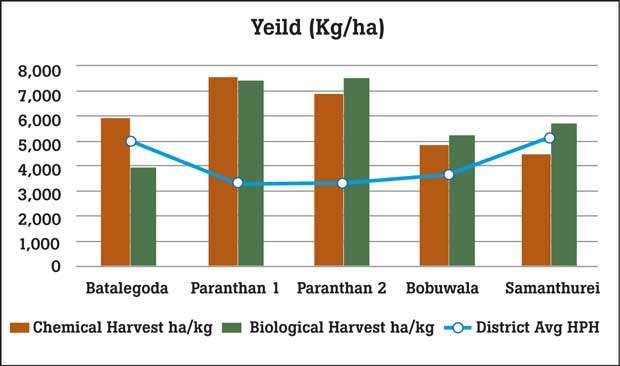
In 151 plots established on farmer plots in 9 districts- established by the Department of Agriculture- the yield from biological farming was higher in 76 plots amounting to 50%. The risk of yield reduction from biological farming meanwhile was noted at only 31% which is equal to the risk of chemical farming. “The cost, labour and input for biological farming are lower than chemical farming and it has been proven in our research,” Abeygunawardena said dispelling many arguments against biological farming efforts.
Speaking on the ban of the weedicide Glyphosate and its effects on the plantation sector, Abeygunawardena said the myth that the herbicide was essential for plantations had been busted. “The real challenge faced by the plantation sector is not the ban of the chemical, but the utter negligence which result in the plantations being gradually destroyed,” he alleged. “Only glyphosate and the likes of it were banned, as they completely destroy the rhizosphere. Large plantation companies charge that tea yield fell by 11% in 2016 due to the ban, but this is a fallacy. In 2017 while the ban was in place, the yield increased by 5%. Therefore there is no co-relation between the ban and the yield,” he said attributing the losses faced in plantations and agriculture in 2016 to the extended drought Sri Lanka suffered at the time.
Echoing his sentiments, Ven. Athuraliye Rathana Thera, who was a key instigator in banning Glyphosate, said that achieving safe and secure food consumption is the key to solving a number of burdensome issues in Sri Lanka. “We are a debt ridden, developing nation. We brought forth a change of Government to change this situation,” Ven. Rathana Thera said.
The cost, labour and input for biological farming are lower than chemical farming and it has been proven in our research
“No opportunity was granted for us to discuss the way forward with regard to the Glyphosate ban,” the monk alleged. “We understand that the reversal to biological farming takes time and planning. It is the very reason we requested for a systematic provision of fertiliser in order to avoid direct provisions of chemical fertiliser. But let us have an opportunity to discuss the issues and find out remedies together,” he said.
“Hunger and malnutrition are maladies which we need to get rid of. Our health and well-being depend on the food we consume and it is simply commonsense to rid ourselves of toxic foods. Over $300 are spent on food related costs each year, according to Central Bank reports. If we as a country are able to spend less on importing food and cultivate our own, it is my belief that many of the problems we are suffering from would be solved,” the thera opined.
“Until the next election takes place, Sri Lanka needs a movement by the farmers to change attitudes towards biological farming,”Rathana thera said while challenging any one of the 2020 presidential candidates to attempt lifting the ban on glyphosate. “Through our efforts we are attempting to not only save the millions of forex usually spent on the import of agrochemicals, but also make toxin-free foods abundantly available,”he said.
With the experience of four cultivating seasons, these experts are now in the belief that higher yields can be achieved during the next cultivating seasons, with lesser cost, input and labour. Accordingly the sole need at present is to facilitate the Rs. 20 billion investment needed to launch this programme island-wide. Their ambitious belief is that the capital costs can be recovered within two months.
Biological farming regenerates and rejuvenates soil which has been destroyed through years of agrochemical use. According to experts this takes place within the span of just one planting season
The discussion was followed by a felicitation ceremony to honour those who tirelessly campaigned to make toxin-free agriculture in Sri Lanka a reality. Ven. Athuraliye Rathana Thera, Prof. Channa Jayasumana and Dr. Damayanthi Perera were accorded in recognition of their services in laying the foundations for a toxin-free nation.
Several media organisations and journalists including Indika Hewawitharana of the Ada newspaper were honoured for their valuable contributions. Representatives of farming organisations across the country who contributed to the development of toxin-free agriculture by cultivating their own plots of land under the guidance of the Agriculture Ministry were also felicitated at the event.
23 Jun 2026 14 minute ago
23 Jun 2026 19 minute ago
23 Jun 2026 34 minute ago
23 Jun 2026 48 minute ago
23 Jun 2026 58 minute ago