07 Mar 2026 - {{hitsCtrl.values.hits}}
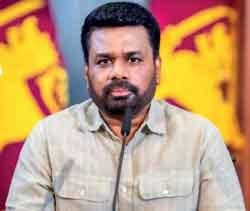 Sri Lanka’s economy is resilient enough to withstand potential fallout from the escalating Middle East conflict, a confident President Anura Kumara Dissanayake said this week, outlining contingency plans to safeguard foreign workers, tourism, trade and financial stability if the crisis deepens.
Dissanayake, addressing a special media briefing at the Presidential Secretariat, said the government is closely monitoring economic and security developments while preparing multiple response scenarios with the support of the Central Bank of Sri Lanka.
“We are in a position to withstand this situation. In fact, we have already purchased nearly USD 700 million from the market, which demonstrates the strength we have achieved,” said Dissanayake.
He pointed to recent economic indicators to support the government’s confidence, including a current account surplus exceeding US$ 1.8 billion, one of only a handful of occasions Sri Lanka has recorded a positive balance historically.
The primary fiscal balance, set at 2.3 percent under the programme with the International Monetary Fund (IMF), currently exceeds 5 percent, while 2025 also recorded the lowest budget deficit and highest government revenue in recent history.
Dissanayake said the government’s ability to absorb shocks had already been tested following the damage caused by Cyclone Ditwah, which resulted in an estimated US$ 4.1 billion in losses. Despite the disaster, authorities were able to allocate Rs. 500 billion separately to address recovery needs without altering the budget framework approved earlier by Parliament.
The Central Bank has prepared financial market projections based on three possible scenarios , the current situation, a moderate escalation and a worst-case scenario, to guide policy responses, he said.
“We cannot predict exactly how the situation will evolve, but based on present conditions we are fully capable of coping with the situation,” he noted.
Beyond financial markets, the government is also assessing the impact on Sri Lankan workers overseas, tourism flows and maritime trade, he added.
Authorities are coordinating with embassies and have established 24-hour emergency hotlines for Sri Lankans living in conflict-affected countries. The government is also considering evacuation arrangements should the situation deteriorate. Tourist safety remains another priority, with officials working alongside hotels and travel agencies to assist travellers who may face disruptions due to airspace restrictions. Among the measures under discussion is granting a temporary two-week visa-free extension for tourists unable to depart as scheduled while arranging alternative travel routes.
Shipping and logistics have also begun to feel the effects of the conflict, with several vessels bound for the Middle East temporarily unable to continue their journey. These ships are currently being accommodated at the Port of Colombo while authorities explore options including allocating additional land for container storage.
The government is also monitoring risks to tea exports, one of Sri Lanka’s key foreign exchange earners. The Foreign Affairs Minister is currently in India seeking support to maintain trade flows if shipping routes remain disrupted, Dissanayake said.
Concerns over fuel availability have also surfaced domestically, triggering queues at petrol stations earlier this week. However, the President said there was no immediate risk to fuel supplies.
“At present we do not face such a problem,” he said, noting that Sri Lanka imports fuel based on demand rather than holding large reserves. He cautioned that a severe escalation disrupting global supply routes could affect not only Sri Lanka but international energy markets.
For now, he said a team of experienced officials is closely managing procurement and supply to ensure stability.
“Our approach is to hope for the best while preparing for the worst,” Dissanayake said.
14 Jun 2026 7 minute ago
14 Jun 2026 2 hours ago
14 Jun 2026 4 hours ago
14 Jun 2026 5 hours ago